






The European Innovation Council supports E.T. PACK-Fly, a project to mitigate space debris

The European Innovation Council supports E.T. PACK-Fly, a project to mitigate space debris

17/05/2022

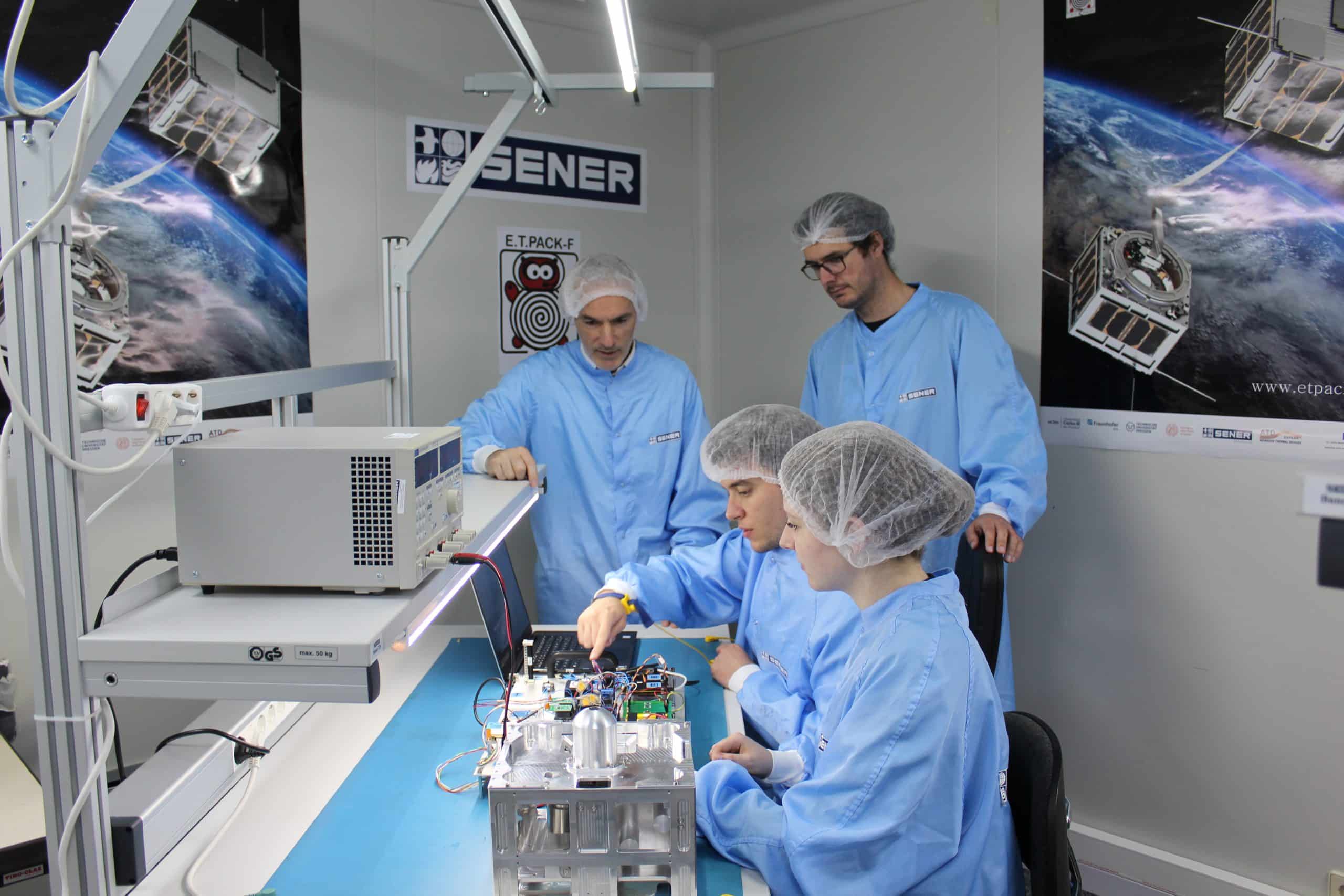
The E.T.PACK-Fly consortium, coordinated by the Universidad Carlos III de Madrid (UC3M) and made up of the University of Padova, the Technical University of Dresden (TU Dresden), the Spanish company SENER Aeroespacial and the German start-up Rocket Factory Augsburg (RFA), has received €2.5 million from the European Innovation Council (EIC) to develop a device based on a space tether to deorbit space debris.

The E.T.PACK-Fly consortium, coordinated by the Universidad Carlos III de Madrid (UC3M) and made up of the University of Padova, the Technical University of Dresden (TU Dresden), the Spanish company SENER Aeroespacial and the German start-up Rocket Factory Augsburg (RFA), has received €2.5 million from the European Innovation Council (EIC) to develop a device based on a space tether to deorbit space debris.

Due to the high cost involved, most satellites are not removed after their mission is completed. This fact, together with spontaneous explosions in orbits as a result of the harsh space environment, has caused the accumulation of a high number of space debris in Low Earth Orbit. They represent a threat since, when a collision occurs between two objects in orbit, a cloud of dangerous shrapnels for operational satellites is generated.

E.T. PACK-Fly aims to solve this problem by developing a device capable of deorbiting, that is, decreasing the altitude of the orbit of the space debris until it is eliminated during the reentry in the Earth’s atmosphere. Unlike conventional propulsion systems, the E.T. PACK-Fly equipment uses a disruptive technology, known as an electrodynamic space tether, that does not require propellant. This electrodynamic tether is a very thin aluminium tape (about two centimetres wide and a couple of kilometres long), which works by using the plasma around the Earth and the geomagnetic field to generate an electric current. This electrodynamic effect results in a force known as the Lorentz drag. This force deorbits the satellite up to the reentry into the Earth’s atmosphere, where it is eliminated by the heat generated by this process. The tether is the fundamental part of the deorbiting device which, since it does not require fuel, is small and light. It is also designed to stabilise the attitude of the satellite, and to control the deorbiting manoeuvre in order to avoid possible collisions with other objects.

The European Innovation Council (EIC) has funded the E.T. PACK-Fly project through its EIC Transition programme. With a duration of two and a half years, the project will start in September 2022 and it aims to prepare the flight model of a deorbit device to be launched into orbit in 2025. RFA and SENER Aeroespacial have already signed the launch service agreement. The E.T. PACK-Fly project is the continuation of the E.T. PACK project, also funded by the EIC. A first prototype of the deorbit device was developed and built in the framework of E.T.PACK.  “We are very grateful to the EIC for the trust it has placed in us and its commitment to the development of technologies that allow a sustainable use of the space environment”, says Gonzalo Sánchez Arriaga, Associate Professor at UC3M and coordinator of the E.T. PACK and E.T. PACK-Fly projects. «It is important to invest in disruptive technologies that can mitigate the proliferation of space debris while generating wealth and new business opportunities,» he concludes.

Furthermore, Lorenzo Tarabini, director of the E.T.PACK-Fly project at SENER Aeroespacial, points out: “This project gives us the opportunity to build and qualify for space, through a complete series of tests, a light, compact and completely autonomous platform for deorbiting the final stages of launchers. The ETPACK-Fly platform is expected to be launched in 2025 with RFA to demonstrate its proficiency and pave the way for commercial exploitation of deorbiting technology.”

In the same vein, the CCO at RFA Jörn Spurmann adds that “we are very pleased that this innovative initiative will continue to receive funding to take it to the next level. Space debris removal is one of the most pressing challenges in space and it is part of RFA’s philosophy and vision to enable sustainable solutions like E.T-PACK”.

SENER Aeroespacial takes part in the European Commission USSPS project

SENER Aeroespacial takes part in the European Commission USSPS project

19/04/2022

The E.T.PACK-Fly consortium, coordinated by the Universidad Carlos III de Madrid (UC3M) and made up of the University of Padova, the Technical University of Dresden (TU Dresden), the Spanish company SENER Aeroespacial and the German start-up Rocket Factory Augsburg (RFA), has received €2.5 million from the European Innovation Council (EIC) to develop a device based on a space tether to deorbit space debris.

The E.T.PACK-Fly consortium, coordinated by the Universidad Carlos III de Madrid (UC3M) and made up of the University of Padova, the Technical University of Dresden (TU Dresden), the Spanish company SENER Aeroespacial and the German start-up Rocket Factory Augsburg (RFA), has received €2.5 million from the European Innovation Council (EIC) to develop a device based on a space tether to deorbit space debris.

Due to the high cost involved, most satellites are not removed after their mission is completed. This fact, together with spontaneous explosions in orbits as a result of the harsh space environment, has caused the accumulation of a high number of space debris in Low Earth Orbit. They represent a threat since, when a collision occurs between two objects in orbit, a cloud of dangerous shrapnels for operational satellites is generated.

E.T. PACK-Fly aims to solve this problem by developing a device capable of deorbiting, that is, decreasing the altitude of the orbit of the space debris until it is eliminated during the reentry in the Earth’s atmosphere. Unlike conventional propulsion systems, the E.T. PACK-Fly equipment uses a disruptive technology, known as an electrodynamic space tether, that does not require propellant. This electrodynamic tether is a very thin aluminium tape (about two centimetres wide and a couple of kilometres long), which works by using the plasma around the Earth and the geomagnetic field to generate an electric current. This electrodynamic effect results in a force known as the Lorentz drag. This force deorbits the satellite up to the reentry into the Earth’s atmosphere, where it is eliminated by the heat generated by this process. The tether is the fundamental part of the deorbiting device which, since it does not require fuel, is small and light. It is also designed to stabilise the attitude of the satellite, and to control the deorbiting manoeuvre in order to avoid possible collisions with other objects.

The European Innovation Council (EIC) has funded the E.T. PACK-Fly project through its EIC Transition programme. With a duration of two and a half years, the project will start in September 2022 and it aims to prepare the flight model of a deorbit device to be launched into orbit in 2025. RFA and SENER Aeroespacial have already signed the launch service agreement. The E.T. PACK-Fly project is the continuation of the E.T. PACK project, also funded by the EIC. A first prototype of the deorbit device was developed and built in the framework of E.T.PACK.  “We are very grateful to the EIC for the trust it has placed in us and its commitment to the development of technologies that allow a sustainable use of the space environment”, says Gonzalo Sánchez Arriaga, Associate Professor at UC3M and coordinator of the E.T. PACK and E.T. PACK-Fly projects. «It is important to invest in disruptive technologies that can mitigate the proliferation of space debris while generating wealth and new business opportunities,» he concludes.

Furthermore, Lorenzo Tarabini, director of the E.T.PACK-Fly project at SENER Aeroespacial, points out: “This project gives us the opportunity to build and qualify for space, through a complete series of tests, a light, compact and completely autonomous platform for deorbiting the final stages of launchers. The ETPACK-Fly platform is expected to be launched in 2025 with RFA to demonstrate its proficiency and pave the way for commercial exploitation of deorbiting technology.”

In the same vein, the CCO at RFA Jörn Spurmann adds that “we are very pleased that this innovative initiative will continue to receive funding to take it to the next level. Space debris removal is one of the most pressing challenges in space and it is part of RFA’s philosophy and vision to enable sustainable solutions like E.T-PACK”.

PDF

Format: PDF

89,39 KB

SENER Aeroespacial completes Hard Capture System (HCS) for the International Berthing and Docking Mechanism

SENER Aeroespacial completes Hard Capture System (HCS) for the International Berthing and Docking Mechanism

24/03/2022

The E.T.PACK-Fly consortium, coordinated by the Universidad Carlos III de Madrid (UC3M) and made up of the University of Padova, the Technical University of Dresden (TU Dresden), the Spanish company SENER Aeroespacial and the German start-up Rocket Factory Augsburg (RFA), has received €2.5 million from the European Innovation Council (EIC) to develop a device based on a space tether to deorbit space debris.

The E.T.PACK-Fly consortium, coordinated by the Universidad Carlos III de Madrid (UC3M) and made up of the University of Padova, the Technical University of Dresden (TU Dresden), the Spanish company SENER Aeroespacial and the German start-up Rocket Factory Augsburg (RFA), has received €2.5 million from the European Innovation Council (EIC) to develop a device based on a space tether to deorbit space debris.

Due to the high cost involved, most satellites are not removed after their mission is completed. This fact, together with spontaneous explosions in orbits as a result of the harsh space environment, has caused the accumulation of a high number of space debris in Low Earth Orbit. They represent a threat since, when a collision occurs between two objects in orbit, a cloud of dangerous shrapnels for operational satellites is generated.

E.T. PACK-Fly aims to solve this problem by developing a device capable of deorbiting, that is, decreasing the altitude of the orbit of the space debris until it is eliminated during the reentry in the Earth’s atmosphere. Unlike conventional propulsion systems, the E.T. PACK-Fly equipment uses a disruptive technology, known as an electrodynamic space tether, that does not require propellant. This electrodynamic tether is a very thin aluminium tape (about two centimetres wide and a couple of kilometres long), which works by using the plasma around the Earth and the geomagnetic field to generate an electric current. This electrodynamic effect results in a force known as the Lorentz drag. This force deorbits the satellite up to the reentry into the Earth’s atmosphere, where it is eliminated by the heat generated by this process. The tether is the fundamental part of the deorbiting device which, since it does not require fuel, is small and light. It is also designed to stabilise the attitude of the satellite, and to control the deorbiting manoeuvre in order to avoid possible collisions with other objects.

The European Innovation Council (EIC) has funded the E.T. PACK-Fly project through its EIC Transition programme. With a duration of two and a half years, the project will start in September 2022 and it aims to prepare the flight model of a deorbit device to be launched into orbit in 2025. RFA and SENER Aeroespacial have already signed the launch service agreement. The E.T. PACK-Fly project is the continuation of the E.T. PACK project, also funded by the EIC. A first prototype of the deorbit device was developed and built in the framework of E.T.PACK.  “We are very grateful to the EIC for the trust it has placed in us and its commitment to the development of technologies that allow a sustainable use of the space environment”, says Gonzalo Sánchez Arriaga, Associate Professor at UC3M and coordinator of the E.T. PACK and E.T. PACK-Fly projects. «It is important to invest in disruptive technologies that can mitigate the proliferation of space debris while generating wealth and new business opportunities,» he concludes.

Furthermore, Lorenzo Tarabini, director of the E.T.PACK-Fly project at SENER Aeroespacial, points out: “This project gives us the opportunity to build and qualify for space, through a complete series of tests, a light, compact and completely autonomous platform for deorbiting the final stages of launchers. The ETPACK-Fly platform is expected to be launched in 2025 with RFA to demonstrate its proficiency and pave the way for commercial exploitation of deorbiting technology.”

In the same vein, the CCO at RFA Jörn Spurmann adds that “we are very pleased that this innovative initiative will continue to receive funding to take it to the next level. Space debris removal is one of the most pressing challenges in space and it is part of RFA’s philosophy and vision to enable sustainable solutions like E.T-PACK”.

PDF

Format: PDF

89,39 KB

SENER Aeroespacial and Aerdron collaborate to develop a drone designed to fly on Mars

SENER Aeroespacial and Aerdron collaborate to develop a drone designed to fly on Mars

23/03/2022

The E.T.PACK-Fly consortium, coordinated by the Universidad Carlos III de Madrid (UC3M) and made up of the University of Padova, the Technical University of Dresden (TU Dresden), the Spanish company SENER Aeroespacial and the German start-up Rocket Factory Augsburg (RFA), has received €2.5 million from the European Innovation Council (EIC) to develop a device based on a space tether to deorbit space debris.

The E.T.PACK-Fly consortium, coordinated by the Universidad Carlos III de Madrid (UC3M) and made up of the University of Padova, the Technical University of Dresden (TU Dresden), the Spanish company SENER Aeroespacial and the German start-up Rocket Factory Augsburg (RFA), has received €2.5 million from the European Innovation Council (EIC) to develop a device based on a space tether to deorbit space debris.

Due to the high cost involved, most satellites are not removed after their mission is completed. This fact, together with spontaneous explosions in orbits as a result of the harsh space environment, has caused the accumulation of a high number of space debris in Low Earth Orbit. They represent a threat since, when a collision occurs between two objects in orbit, a cloud of dangerous shrapnels for operational satellites is generated.

E.T. PACK-Fly aims to solve this problem by developing a device capable of deorbiting, that is, decreasing the altitude of the orbit of the space debris until it is eliminated during the reentry in the Earth’s atmosphere. Unlike conventional propulsion systems, the E.T. PACK-Fly equipment uses a disruptive technology, known as an electrodynamic space tether, that does not require propellant. This electrodynamic tether is a very thin aluminium tape (about two centimetres wide and a couple of kilometres long), which works by using the plasma around the Earth and the geomagnetic field to generate an electric current. This electrodynamic effect results in a force known as the Lorentz drag. This force deorbits the satellite up to the reentry into the Earth’s atmosphere, where it is eliminated by the heat generated by this process. The tether is the fundamental part of the deorbiting device which, since it does not require fuel, is small and light. It is also designed to stabilise the attitude of the satellite, and to control the deorbiting manoeuvre in order to avoid possible collisions with other objects.

The European Innovation Council (EIC) has funded the E.T. PACK-Fly project through its EIC Transition programme. With a duration of two and a half years, the project will start in September 2022 and it aims to prepare the flight model of a deorbit device to be launched into orbit in 2025. RFA and SENER Aeroespacial have already signed the launch service agreement. The E.T. PACK-Fly project is the continuation of the E.T. PACK project, also funded by the EIC. A first prototype of the deorbit device was developed and built in the framework of E.T.PACK.  “We are very grateful to the EIC for the trust it has placed in us and its commitment to the development of technologies that allow a sustainable use of the space environment”, says Gonzalo Sánchez Arriaga, Associate Professor at UC3M and coordinator of the E.T. PACK and E.T. PACK-Fly projects. «It is important to invest in disruptive technologies that can mitigate the proliferation of space debris while generating wealth and new business opportunities,» he concludes.

Furthermore, Lorenzo Tarabini, director of the E.T.PACK-Fly project at SENER Aeroespacial, points out: “This project gives us the opportunity to build and qualify for space, through a complete series of tests, a light, compact and completely autonomous platform for deorbiting the final stages of launchers. The ETPACK-Fly platform is expected to be launched in 2025 with RFA to demonstrate its proficiency and pave the way for commercial exploitation of deorbiting technology.”

In the same vein, the CCO at RFA Jörn Spurmann adds that “we are very pleased that this innovative initiative will continue to receive funding to take it to the next level. Space debris removal is one of the most pressing challenges in space and it is part of RFA’s philosophy and vision to enable sustainable solutions like E.T-PACK”.

PDF

Format: PDF

89,39 KB

SENER is certified in BIM according to ISO 19650 with LRQA

SENER is certified in BIM according to ISO 19650 with LRQA

15/03/2022

The E.T.PACK-Fly consortium, coordinated by the Universidad Carlos III de Madrid (UC3M) and made up of the University of Padova, the Technical University of Dresden (TU Dresden), the Spanish company SENER Aeroespacial and the German start-up Rocket Factory Augsburg (RFA), has received €2.5 million from the European Innovation Council (EIC) to develop a device based on a space tether to deorbit space debris.

The E.T.PACK-Fly consortium, coordinated by the Universidad Carlos III de Madrid (UC3M) and made up of the University of Padova, the Technical University of Dresden (TU Dresden), the Spanish company SENER Aeroespacial and the German start-up Rocket Factory Augsburg (RFA), has received €2.5 million from the European Innovation Council (EIC) to develop a device based on a space tether to deorbit space debris.

Due to the high cost involved, most satellites are not removed after their mission is completed. This fact, together with spontaneous explosions in orbits as a result of the harsh space environment, has caused the accumulation of a high number of space debris in Low Earth Orbit. They represent a threat since, when a collision occurs between two objects in orbit, a cloud of dangerous shrapnels for operational satellites is generated.

E.T. PACK-Fly aims to solve this problem by developing a device capable of deorbiting, that is, decreasing the altitude of the orbit of the space debris until it is eliminated during the reentry in the Earth’s atmosphere. Unlike conventional propulsion systems, the E.T. PACK-Fly equipment uses a disruptive technology, known as an electrodynamic space tether, that does not require propellant. This electrodynamic tether is a very thin aluminium tape (about two centimetres wide and a couple of kilometres long), which works by using the plasma around the Earth and the geomagnetic field to generate an electric current. This electrodynamic effect results in a force known as the Lorentz drag. This force deorbits the satellite up to the reentry into the Earth’s atmosphere, where it is eliminated by the heat generated by this process. The tether is the fundamental part of the deorbiting device which, since it does not require fuel, is small and light. It is also designed to stabilise the attitude of the satellite, and to control the deorbiting manoeuvre in order to avoid possible collisions with other objects.

The European Innovation Council (EIC) has funded the E.T. PACK-Fly project through its EIC Transition programme. With a duration of two and a half years, the project will start in September 2022 and it aims to prepare the flight model of a deorbit device to be launched into orbit in 2025. RFA and SENER Aeroespacial have already signed the launch service agreement. The E.T. PACK-Fly project is the continuation of the E.T. PACK project, also funded by the EIC. A first prototype of the deorbit device was developed and built in the framework of E.T.PACK.  “We are very grateful to the EIC for the trust it has placed in us and its commitment to the development of technologies that allow a sustainable use of the space environment”, says Gonzalo Sánchez Arriaga, Associate Professor at UC3M and coordinator of the E.T. PACK and E.T. PACK-Fly projects. «It is important to invest in disruptive technologies that can mitigate the proliferation of space debris while generating wealth and new business opportunities,» he concludes.

Furthermore, Lorenzo Tarabini, director of the E.T.PACK-Fly project at SENER Aeroespacial, points out: “This project gives us the opportunity to build and qualify for space, through a complete series of tests, a light, compact and completely autonomous platform for deorbiting the final stages of launchers. The ETPACK-Fly platform is expected to be launched in 2025 with RFA to demonstrate its proficiency and pave the way for commercial exploitation of deorbiting technology.”

In the same vein, the CCO at RFA Jörn Spurmann adds that “we are very pleased that this innovative initiative will continue to receive funding to take it to the next level. Space debris removal is one of the most pressing challenges in space and it is part of RFA’s philosophy and vision to enable sustainable solutions like E.T-PACK”.

PDF

Format: PDF

89,39 KB

SENER Aeroespacial awarded with a new contract for Airbus’ OneSat program

SENER Aeroespacial awarded with a new contract for Airbus’ OneSat program

10/03/2022

The E.T.PACK-Fly consortium, coordinated by the Universidad Carlos III de Madrid (UC3M) and made up of the University of Padova, the Technical University of Dresden (TU Dresden), the Spanish company SENER Aeroespacial and the German start-up Rocket Factory Augsburg (RFA), has received €2.5 million from the European Innovation Council (EIC) to develop a device based on a space tether to deorbit space debris.

The E.T.PACK-Fly consortium, coordinated by the Universidad Carlos III de Madrid (UC3M) and made up of the University of Padova, the Technical University of Dresden (TU Dresden), the Spanish company SENER Aeroespacial and the German start-up Rocket Factory Augsburg (RFA), has received €2.5 million from the European Innovation Council (EIC) to develop a device based on a space tether to deorbit space debris.

Due to the high cost involved, most satellites are not removed after their mission is completed. This fact, together with spontaneous explosions in orbits as a result of the harsh space environment, has caused the accumulation of a high number of space debris in Low Earth Orbit. They represent a threat since, when a collision occurs between two objects in orbit, a cloud of dangerous shrapnels for operational satellites is generated.

E.T. PACK-Fly aims to solve this problem by developing a device capable of deorbiting, that is, decreasing the altitude of the orbit of the space debris until it is eliminated during the reentry in the Earth’s atmosphere. Unlike conventional propulsion systems, the E.T. PACK-Fly equipment uses a disruptive technology, known as an electrodynamic space tether, that does not require propellant. This electrodynamic tether is a very thin aluminium tape (about two centimetres wide and a couple of kilometres long), which works by using the plasma around the Earth and the geomagnetic field to generate an electric current. This electrodynamic effect results in a force known as the Lorentz drag. This force deorbits the satellite up to the reentry into the Earth’s atmosphere, where it is eliminated by the heat generated by this process. The tether is the fundamental part of the deorbiting device which, since it does not require fuel, is small and light. It is also designed to stabilise the attitude of the satellite, and to control the deorbiting manoeuvre in order to avoid possible collisions with other objects.

The European Innovation Council (EIC) has funded the E.T. PACK-Fly project through its EIC Transition programme. With a duration of two and a half years, the project will start in September 2022 and it aims to prepare the flight model of a deorbit device to be launched into orbit in 2025. RFA and SENER Aeroespacial have already signed the launch service agreement. The E.T. PACK-Fly project is the continuation of the E.T. PACK project, also funded by the EIC. A first prototype of the deorbit device was developed and built in the framework of E.T.PACK.  “We are very grateful to the EIC for the trust it has placed in us and its commitment to the development of technologies that allow a sustainable use of the space environment”, says Gonzalo Sánchez Arriaga, Associate Professor at UC3M and coordinator of the E.T. PACK and E.T. PACK-Fly projects. «It is important to invest in disruptive technologies that can mitigate the proliferation of space debris while generating wealth and new business opportunities,» he concludes.

Furthermore, Lorenzo Tarabini, director of the E.T.PACK-Fly project at SENER Aeroespacial, points out: “This project gives us the opportunity to build and qualify for space, through a complete series of tests, a light, compact and completely autonomous platform for deorbiting the final stages of launchers. The ETPACK-Fly platform is expected to be launched in 2025 with RFA to demonstrate its proficiency and pave the way for commercial exploitation of deorbiting technology.”

In the same vein, the CCO at RFA Jörn Spurmann adds that “we are very pleased that this innovative initiative will continue to receive funding to take it to the next level. Space debris removal is one of the most pressing challenges in space and it is part of RFA’s philosophy and vision to enable sustainable solutions like E.T-PACK”.

PDF

Format: PDF

89,39 KB

SENER wins the Best Engineering Corporate Governance Europe 2021 award

SENER wins the Best Engineering Corporate Governance Europe 2021 award

08/03/2022

The E.T.PACK-Fly consortium, coordinated by the Universidad Carlos III de Madrid (UC3M) and made up of the University of Padova, the Technical University of Dresden (TU Dresden), the Spanish company SENER Aeroespacial and the German start-up Rocket Factory Augsburg (RFA), has received €2.5 million from the European Innovation Council (EIC) to develop a device based on a space tether to deorbit space debris.

The E.T.PACK-Fly consortium, coordinated by the Universidad Carlos III de Madrid (UC3M) and made up of the University of Padova, the Technical University of Dresden (TU Dresden), the Spanish company SENER Aeroespacial and the German start-up Rocket Factory Augsburg (RFA), has received €2.5 million from the European Innovation Council (EIC) to develop a device based on a space tether to deorbit space debris.

Due to the high cost involved, most satellites are not removed after their mission is completed. This fact, together with spontaneous explosions in orbits as a result of the harsh space environment, has caused the accumulation of a high number of space debris in Low Earth Orbit. They represent a threat since, when a collision occurs between two objects in orbit, a cloud of dangerous shrapnels for operational satellites is generated.

E.T. PACK-Fly aims to solve this problem by developing a device capable of deorbiting, that is, decreasing the altitude of the orbit of the space debris until it is eliminated during the reentry in the Earth’s atmosphere. Unlike conventional propulsion systems, the E.T. PACK-Fly equipment uses a disruptive technology, known as an electrodynamic space tether, that does not require propellant. This electrodynamic tether is a very thin aluminium tape (about two centimetres wide and a couple of kilometres long), which works by using the plasma around the Earth and the geomagnetic field to generate an electric current. This electrodynamic effect results in a force known as the Lorentz drag. This force deorbits the satellite up to the reentry into the Earth’s atmosphere, where it is eliminated by the heat generated by this process. The tether is the fundamental part of the deorbiting device which, since it does not require fuel, is small and light. It is also designed to stabilise the attitude of the satellite, and to control the deorbiting manoeuvre in order to avoid possible collisions with other objects.

The European Innovation Council (EIC) has funded the E.T. PACK-Fly project through its EIC Transition programme. With a duration of two and a half years, the project will start in September 2022 and it aims to prepare the flight model of a deorbit device to be launched into orbit in 2025. RFA and SENER Aeroespacial have already signed the launch service agreement. The E.T. PACK-Fly project is the continuation of the E.T. PACK project, also funded by the EIC. A first prototype of the deorbit device was developed and built in the framework of E.T.PACK.  “We are very grateful to the EIC for the trust it has placed in us and its commitment to the development of technologies that allow a sustainable use of the space environment”, says Gonzalo Sánchez Arriaga, Associate Professor at UC3M and coordinator of the E.T. PACK and E.T. PACK-Fly projects. «It is important to invest in disruptive technologies that can mitigate the proliferation of space debris while generating wealth and new business opportunities,» he concludes.

Furthermore, Lorenzo Tarabini, director of the E.T.PACK-Fly project at SENER Aeroespacial, points out: “This project gives us the opportunity to build and qualify for space, through a complete series of tests, a light, compact and completely autonomous platform for deorbiting the final stages of launchers. The ETPACK-Fly platform is expected to be launched in 2025 with RFA to demonstrate its proficiency and pave the way for commercial exploitation of deorbiting technology.”

In the same vein, the CCO at RFA Jörn Spurmann adds that “we are very pleased that this innovative initiative will continue to receive funding to take it to the next level. Space debris removal is one of the most pressing challenges in space and it is part of RFA’s philosophy and vision to enable sustainable solutions like E.T-PACK”.

PDF

Format: PDF

89,39 KB

The Proba-3 program takes an important step in the integration of its two satellites

The Proba-3 program takes an important step in the integration of its two satellites

18/01/2022

The E.T.PACK-Fly consortium, coordinated by the Universidad Carlos III de Madrid (UC3M) and made up of the University of Padova, the Technical University of Dresden (TU Dresden), the Spanish company SENER Aeroespacial and the German start-up Rocket Factory Augsburg (RFA), has received €2.5 million from the European Innovation Council (EIC) to develop a device based on a space tether to deorbit space debris.

The E.T.PACK-Fly consortium, coordinated by the Universidad Carlos III de Madrid (UC3M) and made up of the University of Padova, the Technical University of Dresden (TU Dresden), the Spanish company SENER Aeroespacial and the German start-up Rocket Factory Augsburg (RFA), has received €2.5 million from the European Innovation Council (EIC) to develop a device based on a space tether to deorbit space debris.

Due to the high cost involved, most satellites are not removed after their mission is completed. This fact, together with spontaneous explosions in orbits as a result of the harsh space environment, has caused the accumulation of a high number of space debris in Low Earth Orbit. They represent a threat since, when a collision occurs between two objects in orbit, a cloud of dangerous shrapnels for operational satellites is generated.

E.T. PACK-Fly aims to solve this problem by developing a device capable of deorbiting, that is, decreasing the altitude of the orbit of the space debris until it is eliminated during the reentry in the Earth’s atmosphere. Unlike conventional propulsion systems, the E.T. PACK-Fly equipment uses a disruptive technology, known as an electrodynamic space tether, that does not require propellant. This electrodynamic tether is a very thin aluminium tape (about two centimetres wide and a couple of kilometres long), which works by using the plasma around the Earth and the geomagnetic field to generate an electric current. This electrodynamic effect results in a force known as the Lorentz drag. This force deorbits the satellite up to the reentry into the Earth’s atmosphere, where it is eliminated by the heat generated by this process. The tether is the fundamental part of the deorbiting device which, since it does not require fuel, is small and light. It is also designed to stabilise the attitude of the satellite, and to control the deorbiting manoeuvre in order to avoid possible collisions with other objects.

The European Innovation Council (EIC) has funded the E.T. PACK-Fly project through its EIC Transition programme. With a duration of two and a half years, the project will start in September 2022 and it aims to prepare the flight model of a deorbit device to be launched into orbit in 2025. RFA and SENER Aeroespacial have already signed the launch service agreement. The E.T. PACK-Fly project is the continuation of the E.T. PACK project, also funded by the EIC. A first prototype of the deorbit device was developed and built in the framework of E.T.PACK.  “We are very grateful to the EIC for the trust it has placed in us and its commitment to the development of technologies that allow a sustainable use of the space environment”, says Gonzalo Sánchez Arriaga, Associate Professor at UC3M and coordinator of the E.T. PACK and E.T. PACK-Fly projects. «It is important to invest in disruptive technologies that can mitigate the proliferation of space debris while generating wealth and new business opportunities,» he concludes.

Furthermore, Lorenzo Tarabini, director of the E.T.PACK-Fly project at SENER Aeroespacial, points out: “This project gives us the opportunity to build and qualify for space, through a complete series of tests, a light, compact and completely autonomous platform for deorbiting the final stages of launchers. The ETPACK-Fly platform is expected to be launched in 2025 with RFA to demonstrate its proficiency and pave the way for commercial exploitation of deorbiting technology.”

In the same vein, the CCO at RFA Jörn Spurmann adds that “we are very pleased that this innovative initiative will continue to receive funding to take it to the next level. Space debris removal is one of the most pressing challenges in space and it is part of RFA’s philosophy and vision to enable sustainable solutions like E.T-PACK”.

PDF

Format: PDF

89,39 KB

Sener develops the NAVIGA navigation unit for the VEGA-C launcher

Sener develops the NAVIGA navigation unit for the VEGA-C launcher

24/02/2021

Sener is in the process of qualifying and manufacturing VNE/NAVIGA, a low-cost modular space navigation unit for space transportation, the first application of which will be in the European VEGA-C launcher. After the flight model is delivered in 2023, SENER Aeroespacial expects to close a ten-years contract with AVIO for the mass production for subsequent VEGA-C missions. Sener has designed a novel product, whose features make it the first of its kind in Europe. It can work as a hybrid unit, inertial-only unit or as a GNSS receiver, and will be able to be used on both launchers and satellites.

  • Sener is in the process of qualifying and manufacturing VNE/NAVIGA, a low-cost modular space navigation unit for space transportation, the first application of which will be in the European VEGA-C launcher.
  • After the flight model is delivered in 2023, SENER Aeroespacial expects to close a ten-years contract with AVIO for the mass production for subsequent VEGA-C missions.
  • Sener has designed a novel product, whose features make it the first of its kind in Europe. It can work as a hybrid unit, inertial-only unit or as a GNSS receiver, and will be able to be used on both launchers and satellites.

Sener has signed a contract with AVIO for the C/D phases of the navigation unit for the VEGA-C launcher, VNE (VEGA-C Navigation Equipment), after successfully completing phases A (feasibility study) and B (preliminary design). Phase C involves the development of the detailed design, and phase D is the qualification and delivery phase of the first flight model.

Sener is the design authority for this unit, which is delivered to the Customer as an integrated product. One of the main features of the unit is the reduction in the production cost by incorporating processes and materials from the world of defense. In addition, this contract paves the way for the mass production of navigation units for subsequent launches of VEGA-C and other space missions.

The navigation unit uses a six-axis compass (position and attitude of the launcher) to provide the rocket’s position to the Guidance, Navigation and Control (CNG) system, developed by AVIO, which is necessary to steer the rocket. NAVIGA is thus a critical component for the success of the mission.

NAVIGA combines an Inertial Measurement Unit (IMU) and a Global Navigation Satellite System (GNSS) receiver, and hybridizes the two readings to achieve a high-performance product – its software is Class A, the most critical in the space industry – but also low-cost compared to the inertial navigation units available on the market.

In the words of Sener Project Manager Silvia Díaz, «the development of this navigation unit puts us at the head of an emerging market in Europe, that of medium cost units with good performances and high reliability. We achieved this product by combining our 55-year experience in the traditional space market, with more than 270 devices and systems on board space missions without any faults, and our experience mass producing products for other markets such as defense and the telecommunications satellite commercial market, which involves lowering the costs of processes and components to adapt to the demands of a more competitive market.»

NAVIGA, a versatile and low-cost navigation unit

NAVIGA is a navigation unit that combines two key elements for future space transportation systems: low cost and versatility.

The design of a unit capable of achieving the same performance as other similar space navigation units at a lower cost was made possible by combining our know-how and experience in space navigation solutions, with our technical knowledge in the development of high-precision aviation and defense products for complex environments.

The three implementation aspects applied to the project to reduce the recurring cost of the unit, while maintaining the required performance, are: the use of sensor hybridization techniques to provide a robust navigation solution; the inclusion of radiation-tolerant parts from the automotive market (new in space); and the adoption of defense production processes to manufacture the unit.

The second key element, versatility, is achieved thanks to the modular and flexible design, which allows a complete and certified unit to be adapted, with minor modifications and testing, to other environments, such as short-duration space missions. The advantages of this versatility are significant in the current market, which is increasingly demanding new products in less time and with lower development costs.

Supplementing these two key elements is a third: NAVIGA is a fully European unit, which renders any ITAR restrictions irrelevant.

To develop this innovative product, Sener invested its own funds for the qualification for using components and processes from the defense and automotive markets and will be installing new and specific equipment within its facilities to test the units.

The project is the result of the partnership between the Italian companies AVIO and CIVITANAVI Systems and the Spanish company Elecnor DEIMOS. The VNE/NAVIGA project is funded by European Space Agency (ESA).

Intelligent ventilation: Presentation of the RESPIRA® system

10.15.2020 pdf

Intelligent ventilation: Presentation of the RESPIRA® system

10.15.2020
Format: pdf

Designed and patented by SENER, RESPIRA® uses artificial intelligence and a dynamic algorithm to predict and control environmental conditions in underground transport networks and large scale infrastructures that enables the implementation of an optimal ventilation strategy.