Sener is one of four Spanish companies selected by the European Commission to develop hydrogen generation technology

Sener is one of four Spanish companies selected by the European Commission to develop hydrogen generation technology

20/07/2022

Sener is one of four Spanish companies selected to develop “important projects of common European interest” in the hydrogen sector.

The European Commission has announced the approval, in accordance with EU State aid rules, of an important project of common European interest (IPCEI) to support research and innovation, as well as the industrial deployment, in the hydrogen technology value chain. The project, called “IPCEI Hy2Tech“, is backed by industry in fifteen Member States: Germany, Austria, Belgium, Denmark, Czech Republic, Estonia, Finland, France, Greece, Italy, Netherlands, Poland, Portugal, Slovakia and Spain.

By virtue of this IPCEI Hy2Tech project, the Member States have committed to contributing up to 5.4 billion euros in public funding, which is expected to unlock an additional 8.8 billion euros in private investment. With this funding, 35 companies have been selected to develop 41 projects related to the entire hydrogen technology value chain, including the generation of hydrogen, fuel cells, storage, transportation and distribution of hydrogen, and end-user applications, in particular in the mobility sector.

Sener has been selected for its project for the technological development of next-generation and alkaline technology electrolyzers. The IPCEI Hy2Tech program will finance the R&D and industrial deployment activities. Sener expects this project to create at least 300 direct jobs, as well as a further 500 indirect jobs as it develops the supply chain with local companies.

In the words of the Director of Hydrogen Development and Investment at Sener Renewable Investments, Telmo Chávarri: “We are proud to be one of four Spanish companies, and 35 European companies, selected by the European Commission in IPCEI Hy2Tech, as it confirms that we are continuing to move in the right direction in the development of hydrogen technology. Our commitment to innovation and sustainability is solid in all our projects. Thanks to this financial boost, we hope to cement our position as technological leaders in the new and promising field of hydrogen technology.”

As part of the process of selecting industrial proposals, the Committee wanted to ensure that the projects financed will develop technologies and processes that go beyond what the market currently offers and will allow major improvements in performance, safety, environmental impact as well as in cost efficiencies. Similarly, the participating companies undertake to share the results of the project with the scientific community and with European industry as a whole, beyond the companies and countries that are part of the IPCEI.

In the words of the European Commission, IPCEI Hy2Tech “contributes to a common objective by supporting a key strategic value chain for the future of Europe, as well as the objectives of key EU policy initiatives such as the Green Deal, the EU Hydrogen Strategy and REPowerEU.”

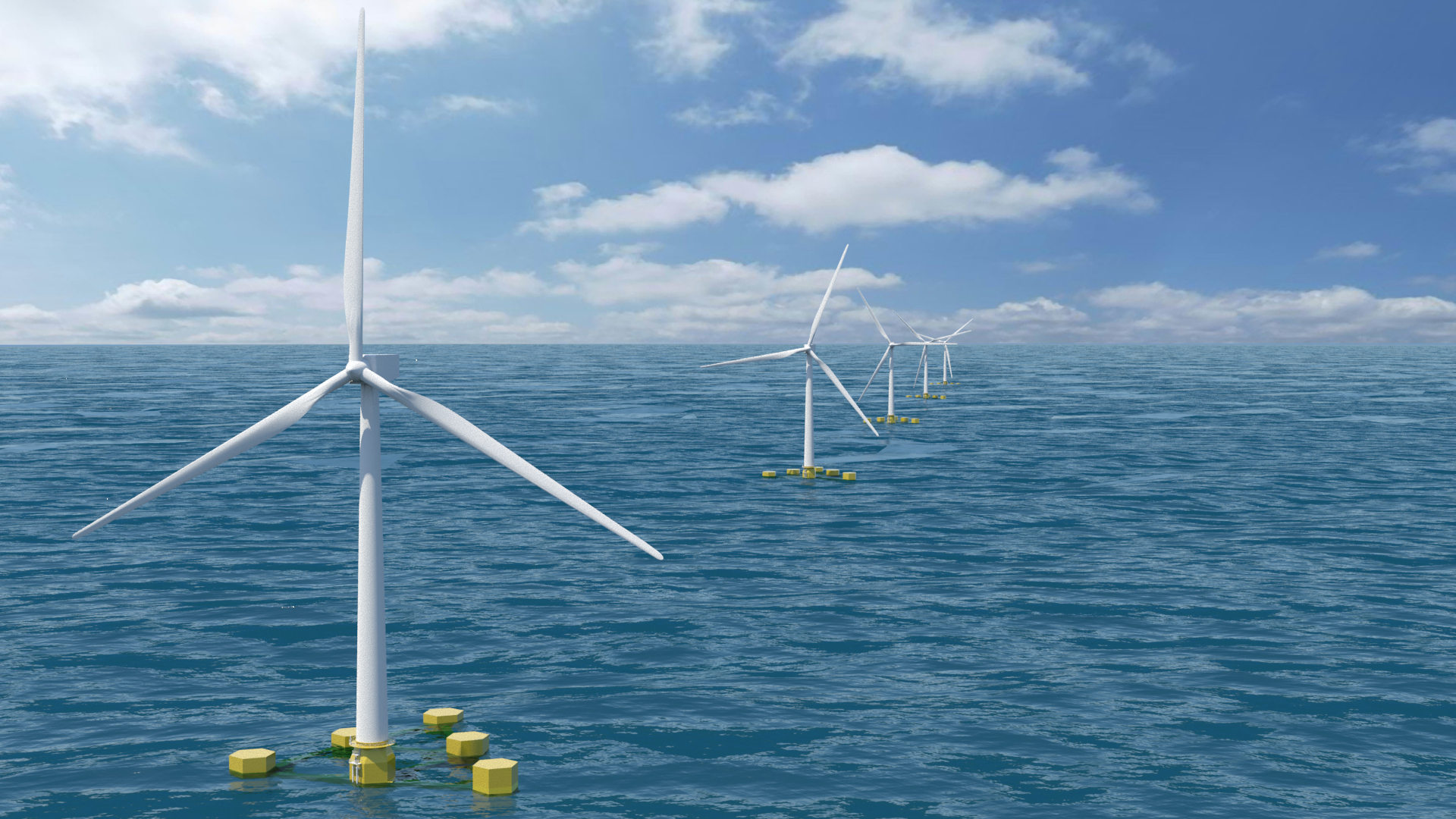
HiveWind: a semi-submersible floating steel platform for offshore wind turbines

Energy

Renewable and Low-Carbon Solutions Generation

Offshore wind

HiveWind: a semi-submersible floating steel platform for offshore wind turbines

Towards a modular future

Case of success

Contact us for more information

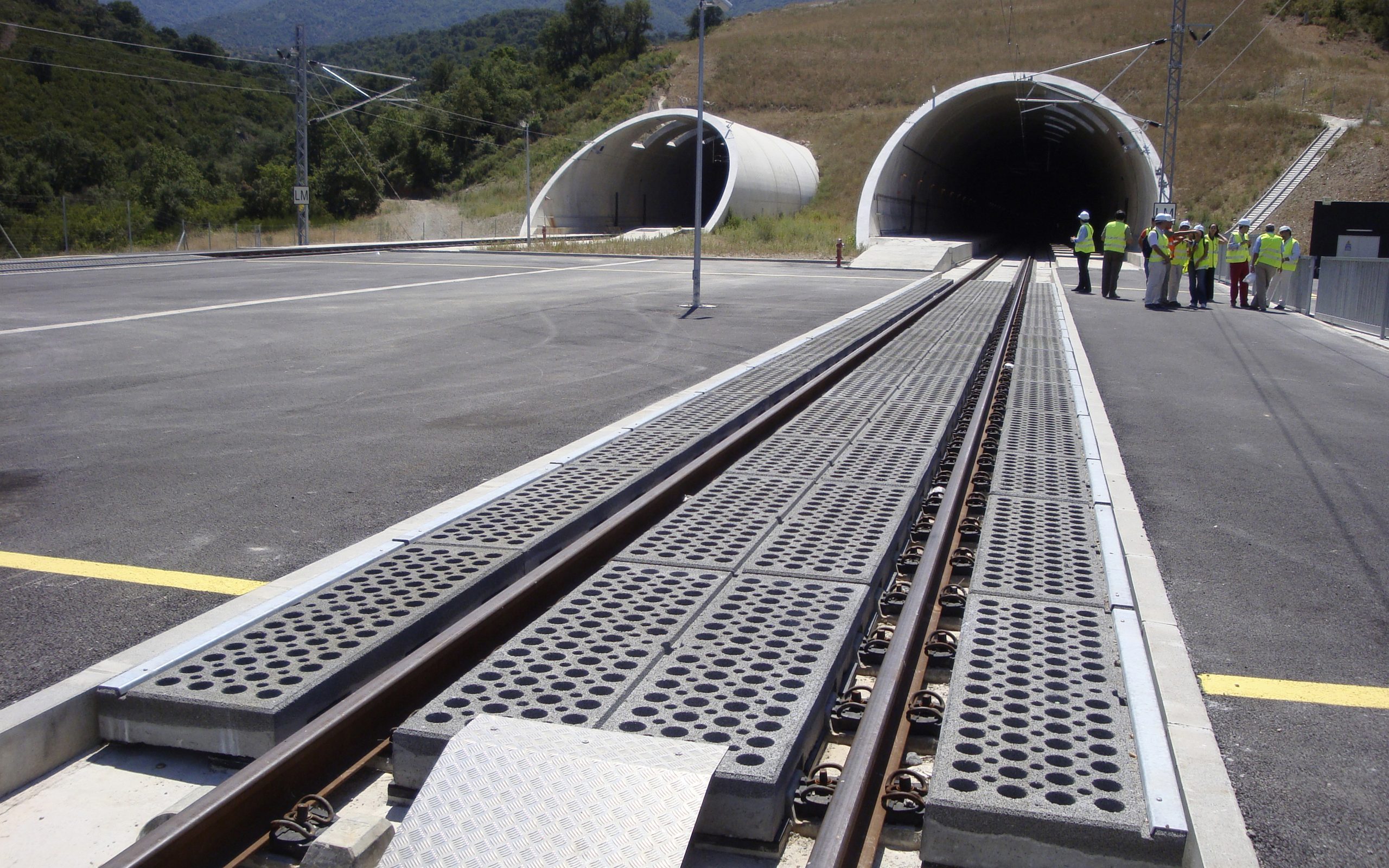
High-Speed Rail Sener’s experience

06.22.2022

High-Speed Rail Sener’s experience

06.22.2022

At Sener we have more than 3 decades of experience in railway engineering, in which we have developed over 3,100 miles of High Speed projects, 1,860 of them are in operation.
We provide a full range of services required to complete any project through different delivery methods.

ProcuRE selects SENER within the Clarity consortium to achieve 100% sustainable buildings

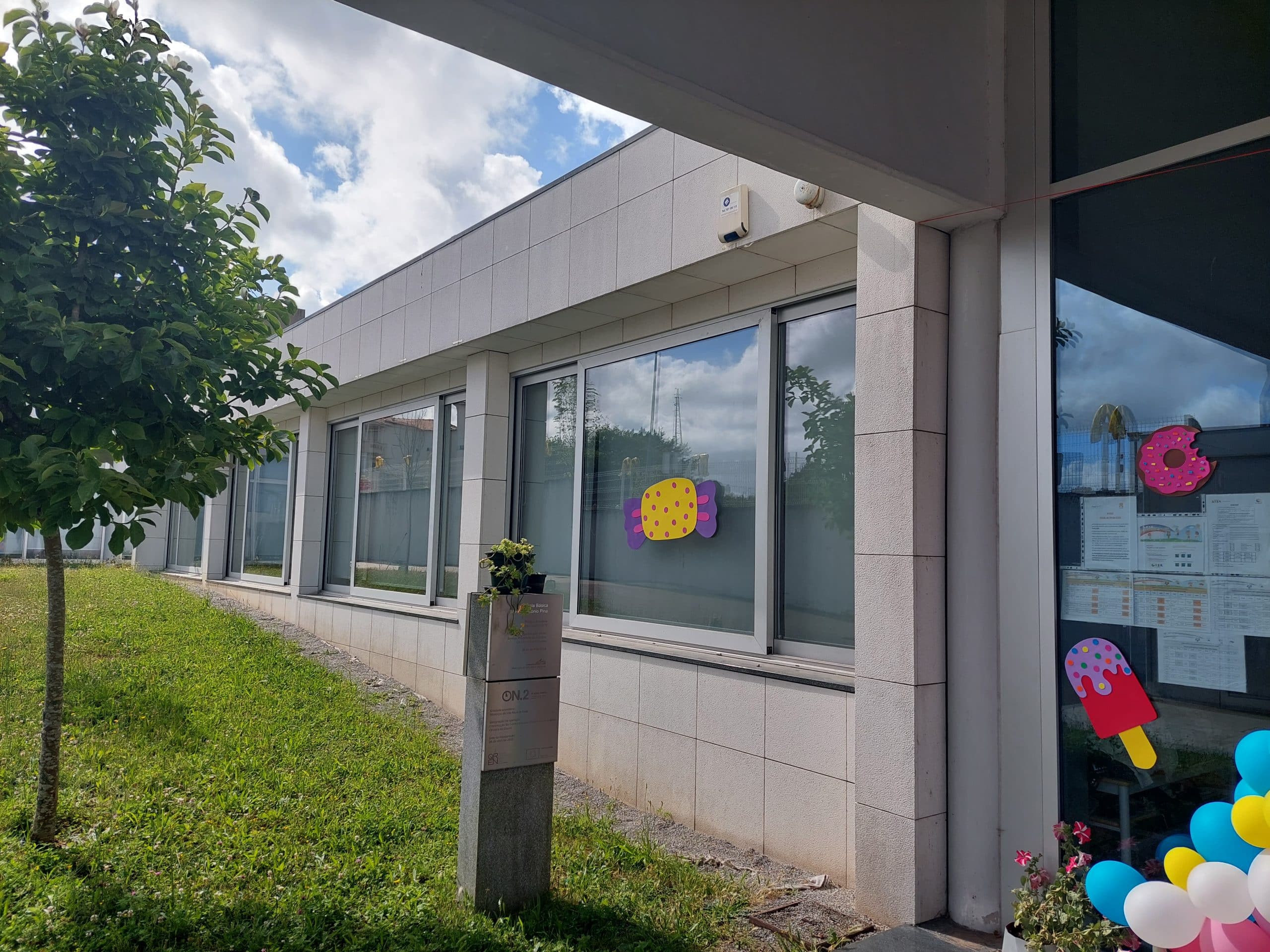
ProcuRE selects SENER within the Clarity consortium to achieve 100% sustainable buildings

21/06/2022

The Clarity consortium, led by SENER, together with EURECAT and AGGITY, was one of the three chosen in the first phase of ProcuRE, an initiative funded by the European Union within the Horizon 2020 program. Clarity aims to integrate Artificial Intelligence solutions capable of converting buildings into sustainable infrastructure in a single platform.

SENER leads the Clarity consortium, one of the three winners of the first phase of the ProcuRE initiative. Comprising SENER, EURECAT and AGGITY, Clarity offers a single platform with artificial intelligence and digitalization solutions that can adapt a building or infrastructure to be sustainable, i.e. reduce CO2 emissions to a minimum, by achieving optimum efficiency and maximum self-consumption. Thanks to this solution, the European initiative ProcuRE – supported by public institutions from six cities – has selected Clarity as one of the three winning consortiums in the first phase of its proposal.

What is ProcuRE?

Within the framework of the European Union’s climate and energy policies, a group of cities and municipalities in Europe has launched the ProcuRE initiative, with the challenge of obtaining 100% renewable energy supplies (RES) in the existing public building stock through sustainability and innovation solutions.

The developer consortium includes entities such as the Savinjska, Šaleška and Koroška Regional Energy Agency (KSSENA), Slovenia, the Barcelona Metropolitan Area, in Spain; the institutions Stadt Nürnberg and Empirica in Germany; Energaia, the Energy Agency for the South of the Porto Metropolitan Area, Portugal; the Municipality of Eilat, in Israel; the Istanbul Metropolitan Municipality and Ozyegin University, Turkey; or Eurac Research in Italy. Between them, they manage more than 21,000 buildings.

ProcuRE is based on the following data: buildings are responsible for 40% of total energy consumption and 36% of CO2 emissions in the EU. Around 35% of buildings in the EU are over 50 years old and almost 75% of the building stock is energy inefficient. For 2050, it is expected that 90% of the existing building stock will remain in service. So refurbishment must be ramped up in Europe to achieve the EU’s climate goals, ensuring that existing buildings reach an optimum efficiency level and maximize self-consumption.

In this way, the ProcuRE developers have launched a tender, open to European suppliers, to design, develop and test innovative proposals, which allow a 100% renewable building to be created without the need to adopt invasive building measures. The initiative proposes carrying out pilot tests on buildings specific to the group of developers, to approve the proposed solution.

The ProcuRE initiative has received funding from the European Union’s Horizon 2020 research and innovation program under grant agreement no. 963648.

SENER’s solution, within the Clarity consortium

Within the Clarity consortium (also including EURECAT and AGGITY), SENER has presented a single platform, based on artificial intelligence software (AI), capable of calculating and designing the optimal scenario to achieve a 100% renewable solution. The optimum installation calculation results in a mix of renewable technologies that should be installed in the building, combining variables such as the economic, regulatory, technical and environmental impact, as well as the impact of operational management, and thus determining the optimum size according to the building’s conditions.

The processes included in the platform are developed through five modules, which are building evaluation, the calculation of renewable installations based on artificial intelligence, preparation of a feasibility report, the design and construction of an as-built BIM model, which allows integration of all information related to the building into a single database, and improvements to building operation and maintenance using digital tools.

Some components or modules proposed by the Clarity consortium in its single platform are R&D products or solutions developed in different innovation projects of the three companies, which have been tested in real-world scenarios with great results. These include: systems to analyze the renewable generation potential of a building, such as the system to help decide on renewable energy sources (RES), the energy asset sizing tool (EAS) or the SENER Energy Management System (EMS), which allows predictive and automatic control of all the energy assets of an installation; operation and maintenance systems such as the RESPIRA® intelligent ventilation system, the SIGMA platform for digital asset management or the methodology registered in BIM blockchain.


SENER Aeroespacial joins the Net Zero Space initiative

SENER Aeroespacial joins the Net Zero Space initiative

26/05/2022

The company is actively involved in projects to mitigate space debris, such as E.T.PACK-Fly; to enable future standard in orbit servicing interface with SIROM; and to develop more robust propulsion systems such as HIPATIA.

The company is actively involved in projects to mitigate space debris, such as E.T.PACK-Fly; to enable future standard in orbit servicing interface with SIROM; and to develop more robust propulsion systems such as HIPATIA.

SENER Aeroespacial has joined the Net Zero Space initiative, as a step forward in the group’s commitment to drive sustainable transformation through engineering and technology.

The Net Zero Space initiative was launched at the occasion of the 4th edition of the Paris Peace Forum by different actors from all over the world concerned by the long-term sustainability of outer space. From satellite operators to launchers, from space agencies to academia and the civil society, all these stakeholders gathered to call to achieving sustainable use of outer space for the benefit of all humankind by 2030 by taking concrete actions to tackle the pressing challenge of reducing debris orbiting Earth.

SENER Aeroespacial se une a la iniciativa Net Zero Space

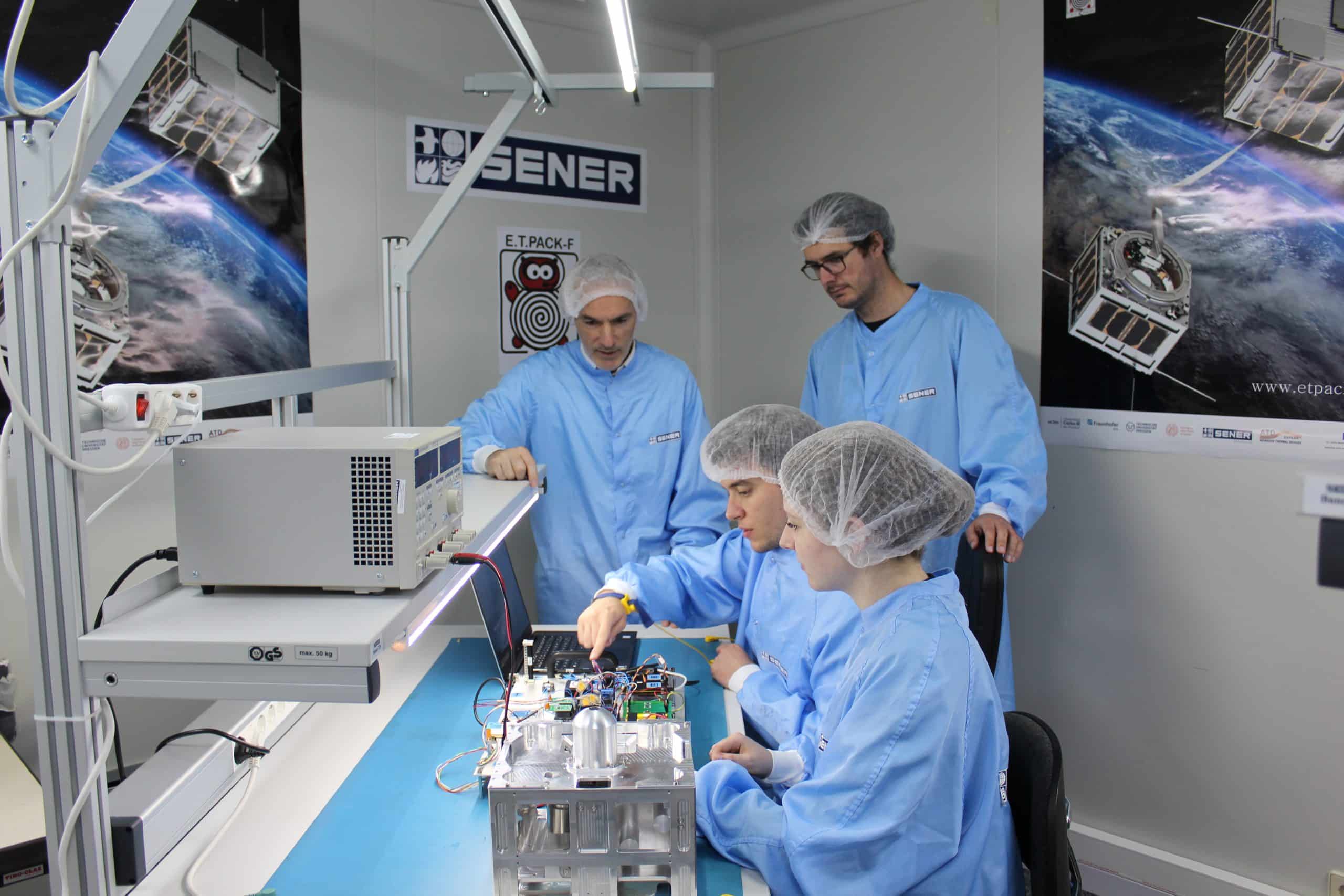
SENER Aeroespacial is already working to generate more efficient orbital infrastructures. Since 2019, the company is part of the E.T.PACK consortium to develop a deorbit device based on a space tether to tackle the space debris proliferation problem.

E.T.PACK Fly, a project to mitigate space debris

The accumulation of a high number of space debris in Low Earth Orbit represents a threat since, when a collision occurs between two objects in orbit, a cloud of dangerous shrapnels for operational satellites is generated. E.T. PACK-Fly aims to solve this problem by developing a device capable of deorbiting, that is, decreasing the altitude of the orbit of the space debris until it is eliminated during the reentry in the Earth’s atmosphere.

Unlike conventional propulsion systems, the E.T. PACK-Fly equipment uses a disruptive technology, known as an electrodynamic space tether, that does not require propellant. This electrodynamic tether is a very thin aluminium tape (about two centimetres wide and a couple of kilometres long), which works by using the plasma around the Earth and the geomagnetic field to generate an electric current. This electrodynamic effect results in a force known as the Lorentz drag. This force deorbits the satellite up to the reentry into the Earth’s atmosphere, where it is eliminated by the heat generated by this process. The tether is the fundamental part of the deorbiting device which, since it does not require fuel, is small and light. It is also designed to be fully autonomous, and to control the deorbiting manoeuvre in order to avoid possible collisions with other objects.

E-T.PACK Fly consortium is coordinated by the Universidad Carlos III de Madrid (UC3M) and made up of the University of Padova, the Technical University of Dresden (TU Dresden), the Spanish company SENER Aeroespacial and the German start-up Rocket Factory Augsburg (RFA), and has recently received €2.5 million from the European Innovation Council (EIC) to prepare the flight model of a deorbit device to be launched into orbit in 2025. RFA and SENER Aeroespacial have already signed the launch service agreement. The E.T. PACK-Fly project is the continuation of the E.T. PACK project, also funded by the EIC. A first prototype of the deorbit device was developed and built in the framework of E.T.PACK.

Lorenzo Tarabini Castellani, director of the E.T.PACK-Fly project at SENER Aeroespacial, points out: “This project gives us the opportunity to build and qualify for space, through a complete series of tests, a light, compact and completely autonomous platform for deorbiting the final stages of launchers. The ETPACK-Fly platform is expected to be launched in 2025 with RFA to demonstrate its proficiency and pave the way for commercial exploitation of deorbiting technology.”

Arrtistic view of the E.T. PACK deorbit device

Other SENER Aeroespacial projects to support the sustainable use of outer space

SENER Aeroespacial is also working on a space refuelling station that will enable in-orbit propellant replenishment, extending the life of satellites. The company will contribute to this future space refuelling station with its SIROM technology, a modular reconfigurable system interface.

Furthermore, SENER Aeroespacial has a long track record in projects that contemplate the generation of space technology from the point of view of sustainability: in institutional programs such as the LOP-Gateway lunar station, SENER Aeroespacial will contribute with antennas and mechanisms to the American HALO module and will provide the IBDM-HCS of the tunnel that will allow astronauts access to the European habitable module, as well as the refuelling of the station.

At launchers, SENER Aeroespacial works in the Space Rider reusable transport system, leading the design of the CNG system of the reentry vehicle.

On the space propulsion side, SENER Aeroespacial is developing the helicon plasma thruster HIPATIA. HIPATIA is a robust radio frequency-powered plasma propulsion system designed to solve several issues affecting electric propulsion systems.

And, on space debris, previously to E.T.PACK project, SENER Aeroespacial coordinated the European Commission’s LEOSWEEP project (‘Improving Low Earth Orbit Security With Enhanced Electric Propulsion’), a consortium of 11 institutions comprised of companies, research centers and universities of the EU and Ukraine that worked in a mitigation method for this space debris problem.

SENER Aeroespacial develops high value-added products and technology for institutional, telecommunications, astronomy and science programs, and launchers, with the capacity to produce recurring series of cost-efficient products.

Joining Net Zero Space is another example of the SENER Group’s commitment to society through sustainable engineering projects and technologies. The SENER Group has also join the Sustainable Development Goals (SDG) approved by the United Nations.


Helicon Plasma Thruster (HTP) developed on a second stage in the HIPATIA project

Fernando Quintana, new Director of Weapon Systems at SENER Aeroespacial

Fernando Quintana, new Director of Weapon Systems at SENER Aeroespacial

24/05/2022

The company is actively involved in projects to mitigate space debris, such as E.T.PACK-Fly; to enable future standard in orbit servicing interface with SIROM; and to develop more robust propulsion systems such as HIPATIA.

The company is actively involved in projects to mitigate space debris, such as E.T.PACK-Fly; to enable future standard in orbit servicing interface with SIROM; and to develop more robust propulsion systems such as HIPATIA.

SENER Aeroespacial has joined the Net Zero Space initiative, as a step forward in the group’s commitment to drive sustainable transformation through engineering and technology.

The Net Zero Space initiative was launched at the occasion of the 4th edition of the Paris Peace Forum by different actors from all over the world concerned by the long-term sustainability of outer space. From satellite operators to launchers, from space agencies to academia and the civil society, all these stakeholders gathered to call to achieving sustainable use of outer space for the benefit of all humankind by 2030 by taking concrete actions to tackle the pressing challenge of reducing debris orbiting Earth.

SENER Aeroespacial se une a la iniciativa Net Zero Space

SENER Aeroespacial is already working to generate more efficient orbital infrastructures. Since 2019, the company is part of the E.T.PACK consortium to develop a deorbit device based on a space tether to tackle the space debris proliferation problem.

E.T.PACK Fly, a project to mitigate space debris

The accumulation of a high number of space debris in Low Earth Orbit represents a threat since, when a collision occurs between two objects in orbit, a cloud of dangerous shrapnels for operational satellites is generated. E.T. PACK-Fly aims to solve this problem by developing a device capable of deorbiting, that is, decreasing the altitude of the orbit of the space debris until it is eliminated during the reentry in the Earth’s atmosphere.

Unlike conventional propulsion systems, the E.T. PACK-Fly equipment uses a disruptive technology, known as an electrodynamic space tether, that does not require propellant. This electrodynamic tether is a very thin aluminium tape (about two centimetres wide and a couple of kilometres long), which works by using the plasma around the Earth and the geomagnetic field to generate an electric current. This electrodynamic effect results in a force known as the Lorentz drag. This force deorbits the satellite up to the reentry into the Earth’s atmosphere, where it is eliminated by the heat generated by this process. The tether is the fundamental part of the deorbiting device which, since it does not require fuel, is small and light. It is also designed to be fully autonomous, and to control the deorbiting manoeuvre in order to avoid possible collisions with other objects.

E-T.PACK Fly consortium is coordinated by the Universidad Carlos III de Madrid (UC3M) and made up of the University of Padova, the Technical University of Dresden (TU Dresden), the Spanish company SENER Aeroespacial and the German start-up Rocket Factory Augsburg (RFA), and has recently received €2.5 million from the European Innovation Council (EIC) to prepare the flight model of a deorbit device to be launched into orbit in 2025. RFA and SENER Aeroespacial have already signed the launch service agreement. The E.T. PACK-Fly project is the continuation of the E.T. PACK project, also funded by the EIC. A first prototype of the deorbit device was developed and built in the framework of E.T.PACK.

Lorenzo Tarabini Castellani, director of the E.T.PACK-Fly project at SENER Aeroespacial, points out: “This project gives us the opportunity to build and qualify for space, through a complete series of tests, a light, compact and completely autonomous platform for deorbiting the final stages of launchers. The ETPACK-Fly platform is expected to be launched in 2025 with RFA to demonstrate its proficiency and pave the way for commercial exploitation of deorbiting technology.”

Arrtistic view of the E.T. PACK deorbit device

Other SENER Aeroespacial projects to support the sustainable use of outer space

SENER Aeroespacial is also working on a space refuelling station that will enable in-orbit propellant replenishment, extending the life of satellites. The company will contribute to this future space refuelling station with its SIROM technology, a modular reconfigurable system interface.

Furthermore, SENER Aeroespacial has a long track record in projects that contemplate the generation of space technology from the point of view of sustainability: in institutional programs such as the LOP-Gateway lunar station, SENER Aeroespacial will contribute with antennas and mechanisms to the American HALO module and will provide the IBDM-HCS of the tunnel that will allow astronauts access to the European habitable module, as well as the refuelling of the station.

At launchers, SENER Aeroespacial works in the Space Rider reusable transport system, leading the design of the CNG system of the reentry vehicle.

On the space propulsion side, SENER Aeroespacial is developing the helicon plasma thruster HIPATIA. HIPATIA is a robust radio frequency-powered plasma propulsion system designed to solve several issues affecting electric propulsion systems.

And, on space debris, previously to E.T.PACK project, SENER Aeroespacial coordinated the European Commission’s LEOSWEEP project (‘Improving Low Earth Orbit Security With Enhanced Electric Propulsion’), a consortium of 11 institutions comprised of companies, research centers and universities of the EU and Ukraine that worked in a mitigation method for this space debris problem.

SENER Aeroespacial develops high value-added products and technology for institutional, telecommunications, astronomy and science programs, and launchers, with the capacity to produce recurring series of cost-efficient products.

Joining Net Zero Space is another example of the SENER Group’s commitment to society through sustainable engineering projects and technologies. The SENER Group has also join the Sustainable Development Goals (SDG) approved by the United Nations.

Helicon Plasma Thruster (HTP) developed on a second stage in the HIPATIA project

The European Innovation Council supports E.T. PACK-Fly, a project to mitigate space debris

The European Innovation Council supports E.T. PACK-Fly, a project to mitigate space debris

17/05/2022

The company is actively involved in projects to mitigate space debris, such as E.T.PACK-Fly; to enable future standard in orbit servicing interface with SIROM; and to develop more robust propulsion systems such as HIPATIA.

The company is actively involved in projects to mitigate space debris, such as E.T.PACK-Fly; to enable future standard in orbit servicing interface with SIROM; and to develop more robust propulsion systems such as HIPATIA.

SENER Aeroespacial has joined the Net Zero Space initiative, as a step forward in the group’s commitment to drive sustainable transformation through engineering and technology.

The Net Zero Space initiative was launched at the occasion of the 4th edition of the Paris Peace Forum by different actors from all over the world concerned by the long-term sustainability of outer space. From satellite operators to launchers, from space agencies to academia and the civil society, all these stakeholders gathered to call to achieving sustainable use of outer space for the benefit of all humankind by 2030 by taking concrete actions to tackle the pressing challenge of reducing debris orbiting Earth.

SENER Aeroespacial se une a la iniciativa Net Zero Space

SENER Aeroespacial is already working to generate more efficient orbital infrastructures. Since 2019, the company is part of the E.T.PACK consortium to develop a deorbit device based on a space tether to tackle the space debris proliferation problem.

E.T.PACK Fly, a project to mitigate space debris

The accumulation of a high number of space debris in Low Earth Orbit represents a threat since, when a collision occurs between two objects in orbit, a cloud of dangerous shrapnels for operational satellites is generated. E.T. PACK-Fly aims to solve this problem by developing a device capable of deorbiting, that is, decreasing the altitude of the orbit of the space debris until it is eliminated during the reentry in the Earth’s atmosphere.

Unlike conventional propulsion systems, the E.T. PACK-Fly equipment uses a disruptive technology, known as an electrodynamic space tether, that does not require propellant. This electrodynamic tether is a very thin aluminium tape (about two centimetres wide and a couple of kilometres long), which works by using the plasma around the Earth and the geomagnetic field to generate an electric current. This electrodynamic effect results in a force known as the Lorentz drag. This force deorbits the satellite up to the reentry into the Earth’s atmosphere, where it is eliminated by the heat generated by this process. The tether is the fundamental part of the deorbiting device which, since it does not require fuel, is small and light. It is also designed to be fully autonomous, and to control the deorbiting manoeuvre in order to avoid possible collisions with other objects.

E-T.PACK Fly consortium is coordinated by the Universidad Carlos III de Madrid (UC3M) and made up of the University of Padova, the Technical University of Dresden (TU Dresden), the Spanish company SENER Aeroespacial and the German start-up Rocket Factory Augsburg (RFA), and has recently received €2.5 million from the European Innovation Council (EIC) to prepare the flight model of a deorbit device to be launched into orbit in 2025. RFA and SENER Aeroespacial have already signed the launch service agreement. The E.T. PACK-Fly project is the continuation of the E.T. PACK project, also funded by the EIC. A first prototype of the deorbit device was developed and built in the framework of E.T.PACK.

Lorenzo Tarabini Castellani, director of the E.T.PACK-Fly project at SENER Aeroespacial, points out: “This project gives us the opportunity to build and qualify for space, through a complete series of tests, a light, compact and completely autonomous platform for deorbiting the final stages of launchers. The ETPACK-Fly platform is expected to be launched in 2025 with RFA to demonstrate its proficiency and pave the way for commercial exploitation of deorbiting technology.”

Arrtistic view of the E.T. PACK deorbit device

Other SENER Aeroespacial projects to support the sustainable use of outer space

SENER Aeroespacial is also working on a space refuelling station that will enable in-orbit propellant replenishment, extending the life of satellites. The company will contribute to this future space refuelling station with its SIROM technology, a modular reconfigurable system interface.

Furthermore, SENER Aeroespacial has a long track record in projects that contemplate the generation of space technology from the point of view of sustainability: in institutional programs such as the LOP-Gateway lunar station, SENER Aeroespacial will contribute with antennas and mechanisms to the American HALO module and will provide the IBDM-HCS of the tunnel that will allow astronauts access to the European habitable module, as well as the refuelling of the station.

At launchers, SENER Aeroespacial works in the Space Rider reusable transport system, leading the design of the CNG system of the reentry vehicle.

On the space propulsion side, SENER Aeroespacial is developing the helicon plasma thruster HIPATIA. HIPATIA is a robust radio frequency-powered plasma propulsion system designed to solve several issues affecting electric propulsion systems.

And, on space debris, previously to E.T.PACK project, SENER Aeroespacial coordinated the European Commission’s LEOSWEEP project (‘Improving Low Earth Orbit Security With Enhanced Electric Propulsion’), a consortium of 11 institutions comprised of companies, research centers and universities of the EU and Ukraine that worked in a mitigation method for this space debris problem.

SENER Aeroespacial develops high value-added products and technology for institutional, telecommunications, astronomy and science programs, and launchers, with the capacity to produce recurring series of cost-efficient products.

Joining Net Zero Space is another example of the SENER Group’s commitment to society through sustainable engineering projects and technologies. The SENER Group has also join the Sustainable Development Goals (SDG) approved by the United Nations.

Helicon Plasma Thruster (HTP) developed on a second stage in the HIPATIA project

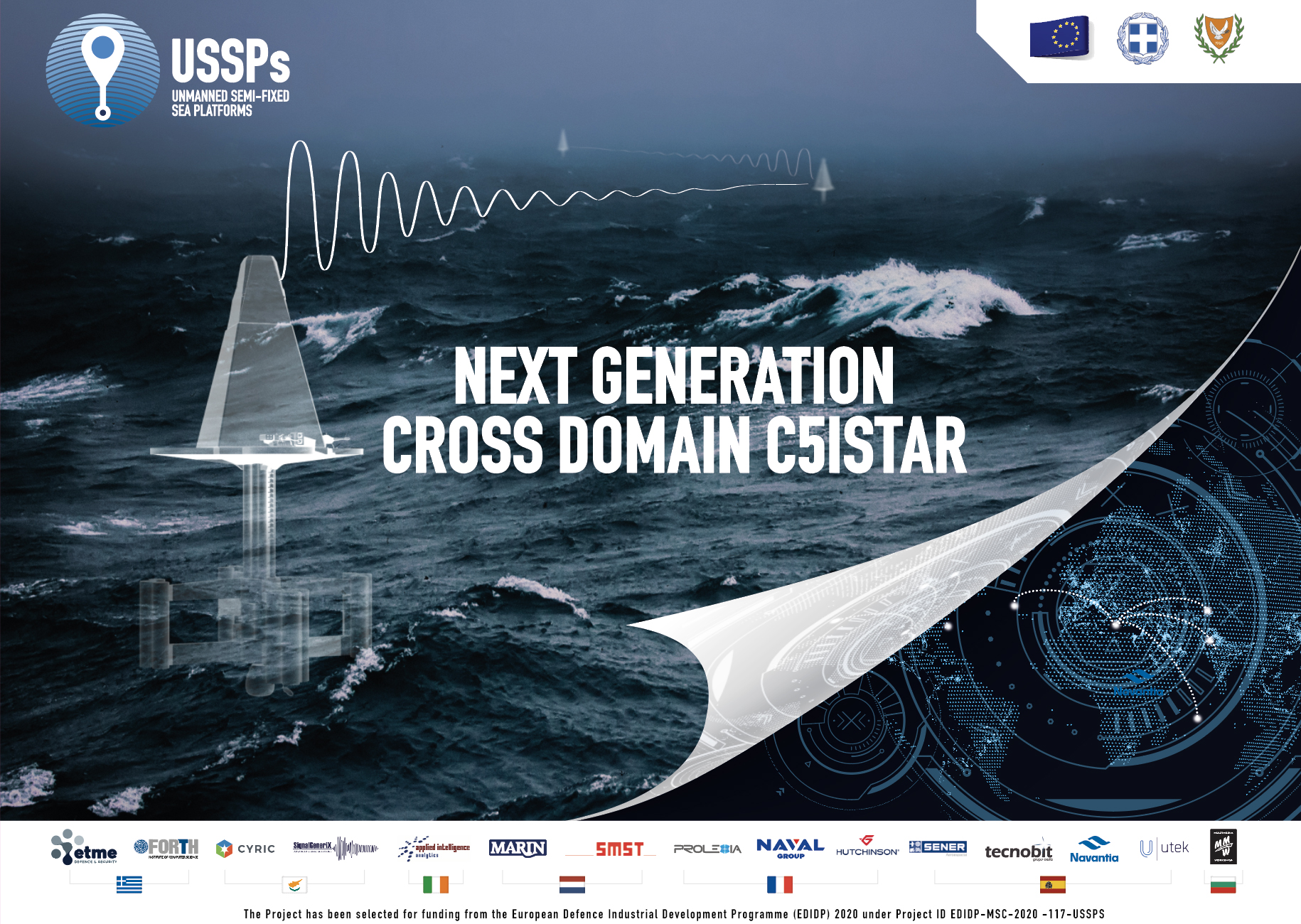
SENER Aeroespacial takes part in the European Commission USSPS project

SENER Aeroespacial takes part in the European Commission USSPS project

19/04/2022

The company is actively involved in projects to mitigate space debris, such as E.T.PACK-Fly; to enable future standard in orbit servicing interface with SIROM; and to develop more robust propulsion systems such as HIPATIA.

The company is actively involved in projects to mitigate space debris, such as E.T.PACK-Fly; to enable future standard in orbit servicing interface with SIROM; and to develop more robust propulsion systems such as HIPATIA.

SENER Aeroespacial has joined the Net Zero Space initiative, as a step forward in the group’s commitment to drive sustainable transformation through engineering and technology.

The Net Zero Space initiative was launched at the occasion of the 4th edition of the Paris Peace Forum by different actors from all over the world concerned by the long-term sustainability of outer space. From satellite operators to launchers, from space agencies to academia and the civil society, all these stakeholders gathered to call to achieving sustainable use of outer space for the benefit of all humankind by 2030 by taking concrete actions to tackle the pressing challenge of reducing debris orbiting Earth.

SENER Aeroespacial se une a la iniciativa Net Zero Space

SENER Aeroespacial is already working to generate more efficient orbital infrastructures. Since 2019, the company is part of the E.T.PACK consortium to develop a deorbit device based on a space tether to tackle the space debris proliferation problem.

E.T.PACK Fly, a project to mitigate space debris

The accumulation of a high number of space debris in Low Earth Orbit represents a threat since, when a collision occurs between two objects in orbit, a cloud of dangerous shrapnels for operational satellites is generated. E.T. PACK-Fly aims to solve this problem by developing a device capable of deorbiting, that is, decreasing the altitude of the orbit of the space debris until it is eliminated during the reentry in the Earth’s atmosphere.

Unlike conventional propulsion systems, the E.T. PACK-Fly equipment uses a disruptive technology, known as an electrodynamic space tether, that does not require propellant. This electrodynamic tether is a very thin aluminium tape (about two centimetres wide and a couple of kilometres long), which works by using the plasma around the Earth and the geomagnetic field to generate an electric current. This electrodynamic effect results in a force known as the Lorentz drag. This force deorbits the satellite up to the reentry into the Earth’s atmosphere, where it is eliminated by the heat generated by this process. The tether is the fundamental part of the deorbiting device which, since it does not require fuel, is small and light. It is also designed to be fully autonomous, and to control the deorbiting manoeuvre in order to avoid possible collisions with other objects.

E-T.PACK Fly consortium is coordinated by the Universidad Carlos III de Madrid (UC3M) and made up of the University of Padova, the Technical University of Dresden (TU Dresden), the Spanish company SENER Aeroespacial and the German start-up Rocket Factory Augsburg (RFA), and has recently received €2.5 million from the European Innovation Council (EIC) to prepare the flight model of a deorbit device to be launched into orbit in 2025. RFA and SENER Aeroespacial have already signed the launch service agreement. The E.T. PACK-Fly project is the continuation of the E.T. PACK project, also funded by the EIC. A first prototype of the deorbit device was developed and built in the framework of E.T.PACK.

Lorenzo Tarabini Castellani, director of the E.T.PACK-Fly project at SENER Aeroespacial, points out: “This project gives us the opportunity to build and qualify for space, through a complete series of tests, a light, compact and completely autonomous platform for deorbiting the final stages of launchers. The ETPACK-Fly platform is expected to be launched in 2025 with RFA to demonstrate its proficiency and pave the way for commercial exploitation of deorbiting technology.”

Arrtistic view of the E.T. PACK deorbit device

Other SENER Aeroespacial projects to support the sustainable use of outer space

SENER Aeroespacial is also working on a space refuelling station that will enable in-orbit propellant replenishment, extending the life of satellites. The company will contribute to this future space refuelling station with its SIROM technology, a modular reconfigurable system interface.

Furthermore, SENER Aeroespacial has a long track record in projects that contemplate the generation of space technology from the point of view of sustainability: in institutional programs such as the LOP-Gateway lunar station, SENER Aeroespacial will contribute with antennas and mechanisms to the American HALO module and will provide the IBDM-HCS of the tunnel that will allow astronauts access to the European habitable module, as well as the refuelling of the station.

At launchers, SENER Aeroespacial works in the Space Rider reusable transport system, leading the design of the CNG system of the reentry vehicle.

On the space propulsion side, SENER Aeroespacial is developing the helicon plasma thruster HIPATIA. HIPATIA is a robust radio frequency-powered plasma propulsion system designed to solve several issues affecting electric propulsion systems.

And, on space debris, previously to E.T.PACK project, SENER Aeroespacial coordinated the European Commission’s LEOSWEEP project (‘Improving Low Earth Orbit Security With Enhanced Electric Propulsion’), a consortium of 11 institutions comprised of companies, research centers and universities of the EU and Ukraine that worked in a mitigation method for this space debris problem.

SENER Aeroespacial develops high value-added products and technology for institutional, telecommunications, astronomy and science programs, and launchers, with the capacity to produce recurring series of cost-efficient products.

Joining Net Zero Space is another example of the SENER Group’s commitment to society through sustainable engineering projects and technologies. The SENER Group has also join the Sustainable Development Goals (SDG) approved by the United Nations.
Helicon Plasma Thruster (HTP) developed on a second stage in the HIPATIA project

PDF

Format: PDF

89,39 KB

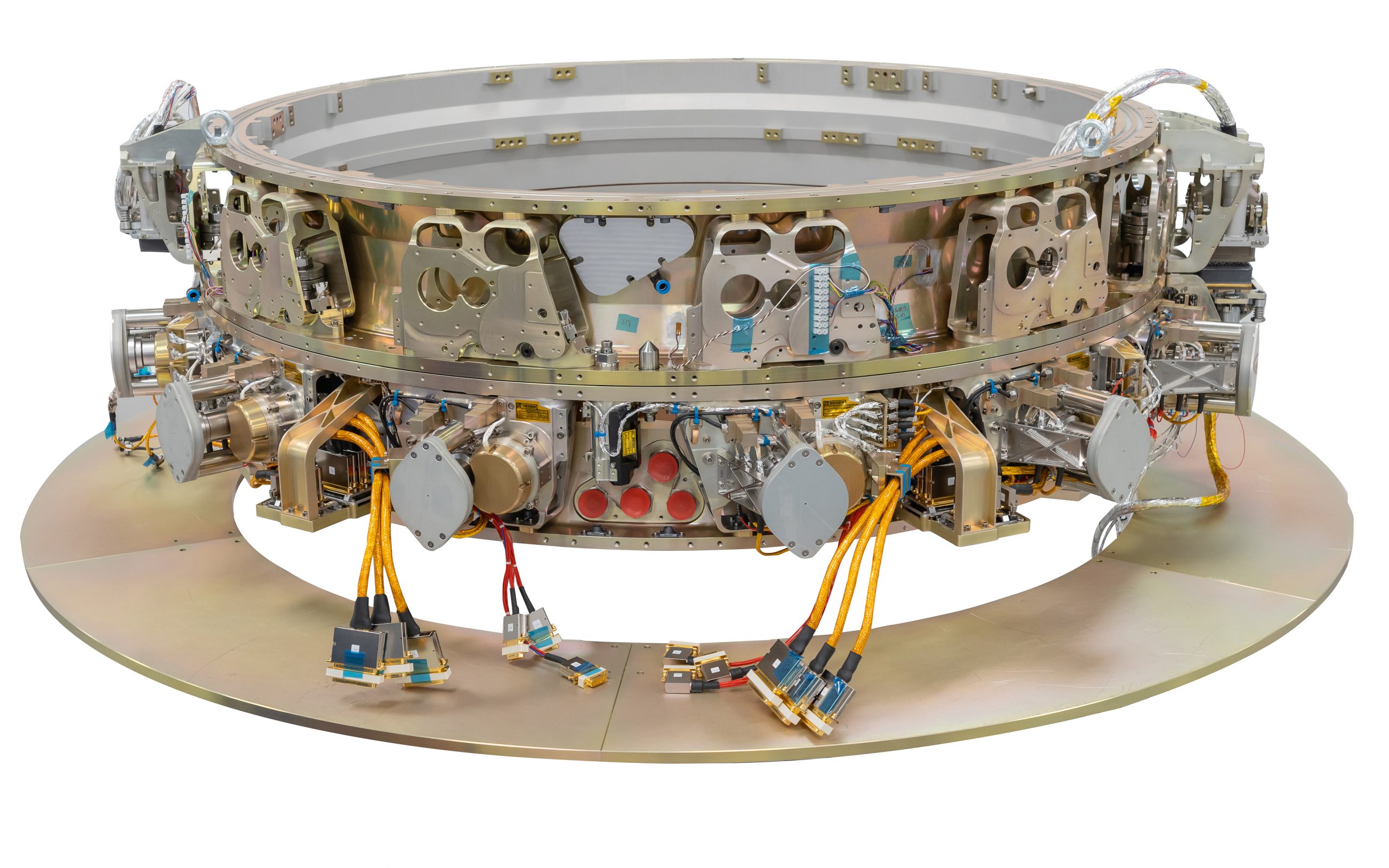
SENER Aeroespacial completes Hard Capture System (HCS) for the International Berthing and Docking Mechanism

SENER Aeroespacial completes Hard Capture System (HCS) for the International Berthing and Docking Mechanism

24/03/2022

The company is actively involved in projects to mitigate space debris, such as E.T.PACK-Fly; to enable future standard in orbit servicing interface with SIROM; and to develop more robust propulsion systems such as HIPATIA.

The company is actively involved in projects to mitigate space debris, such as E.T.PACK-Fly; to enable future standard in orbit servicing interface with SIROM; and to develop more robust propulsion systems such as HIPATIA.

SENER Aeroespacial has joined the Net Zero Space initiative, as a step forward in the group’s commitment to drive sustainable transformation through engineering and technology.

The Net Zero Space initiative was launched at the occasion of the 4th edition of the Paris Peace Forum by different actors from all over the world concerned by the long-term sustainability of outer space. From satellite operators to launchers, from space agencies to academia and the civil society, all these stakeholders gathered to call to achieving sustainable use of outer space for the benefit of all humankind by 2030 by taking concrete actions to tackle the pressing challenge of reducing debris orbiting Earth.

SENER Aeroespacial se une a la iniciativa Net Zero Space

SENER Aeroespacial is already working to generate more efficient orbital infrastructures. Since 2019, the company is part of the E.T.PACK consortium to develop a deorbit device based on a space tether to tackle the space debris proliferation problem.

E.T.PACK Fly, a project to mitigate space debris

The accumulation of a high number of space debris in Low Earth Orbit represents a threat since, when a collision occurs between two objects in orbit, a cloud of dangerous shrapnels for operational satellites is generated. E.T. PACK-Fly aims to solve this problem by developing a device capable of deorbiting, that is, decreasing the altitude of the orbit of the space debris until it is eliminated during the reentry in the Earth’s atmosphere.

Unlike conventional propulsion systems, the E.T. PACK-Fly equipment uses a disruptive technology, known as an electrodynamic space tether, that does not require propellant. This electrodynamic tether is a very thin aluminium tape (about two centimetres wide and a couple of kilometres long), which works by using the plasma around the Earth and the geomagnetic field to generate an electric current. This electrodynamic effect results in a force known as the Lorentz drag. This force deorbits the satellite up to the reentry into the Earth’s atmosphere, where it is eliminated by the heat generated by this process. The tether is the fundamental part of the deorbiting device which, since it does not require fuel, is small and light. It is also designed to be fully autonomous, and to control the deorbiting manoeuvre in order to avoid possible collisions with other objects.

E-T.PACK Fly consortium is coordinated by the Universidad Carlos III de Madrid (UC3M) and made up of the University of Padova, the Technical University of Dresden (TU Dresden), the Spanish company SENER Aeroespacial and the German start-up Rocket Factory Augsburg (RFA), and has recently received €2.5 million from the European Innovation Council (EIC) to prepare the flight model of a deorbit device to be launched into orbit in 2025. RFA and SENER Aeroespacial have already signed the launch service agreement. The E.T. PACK-Fly project is the continuation of the E.T. PACK project, also funded by the EIC. A first prototype of the deorbit device was developed and built in the framework of E.T.PACK.

Lorenzo Tarabini Castellani, director of the E.T.PACK-Fly project at SENER Aeroespacial, points out: “This project gives us the opportunity to build and qualify for space, through a complete series of tests, a light, compact and completely autonomous platform for deorbiting the final stages of launchers. The ETPACK-Fly platform is expected to be launched in 2025 with RFA to demonstrate its proficiency and pave the way for commercial exploitation of deorbiting technology.”

Arrtistic view of the E.T. PACK deorbit device

Other SENER Aeroespacial projects to support the sustainable use of outer space

SENER Aeroespacial is also working on a space refuelling station that will enable in-orbit propellant replenishment, extending the life of satellites. The company will contribute to this future space refuelling station with its SIROM technology, a modular reconfigurable system interface.

Furthermore, SENER Aeroespacial has a long track record in projects that contemplate the generation of space technology from the point of view of sustainability: in institutional programs such as the LOP-Gateway lunar station, SENER Aeroespacial will contribute with antennas and mechanisms to the American HALO module and will provide the IBDM-HCS of the tunnel that will allow astronauts access to the European habitable module, as well as the refuelling of the station.

At launchers, SENER Aeroespacial works in the Space Rider reusable transport system, leading the design of the CNG system of the reentry vehicle.

On the space propulsion side, SENER Aeroespacial is developing the helicon plasma thruster HIPATIA. HIPATIA is a robust radio frequency-powered plasma propulsion system designed to solve several issues affecting electric propulsion systems.

And, on space debris, previously to E.T.PACK project, SENER Aeroespacial coordinated the European Commission’s LEOSWEEP project (‘Improving Low Earth Orbit Security With Enhanced Electric Propulsion’), a consortium of 11 institutions comprised of companies, research centers and universities of the EU and Ukraine that worked in a mitigation method for this space debris problem.

SENER Aeroespacial develops high value-added products and technology for institutional, telecommunications, astronomy and science programs, and launchers, with the capacity to produce recurring series of cost-efficient products.

Joining Net Zero Space is another example of the SENER Group’s commitment to society through sustainable engineering projects and technologies. The SENER Group has also join the Sustainable Development Goals (SDG) approved by the United Nations.

Helicon Plasma Thruster (HTP) developed on a second stage in the HIPATIA project

PDF

Format: PDF

89,39 KB

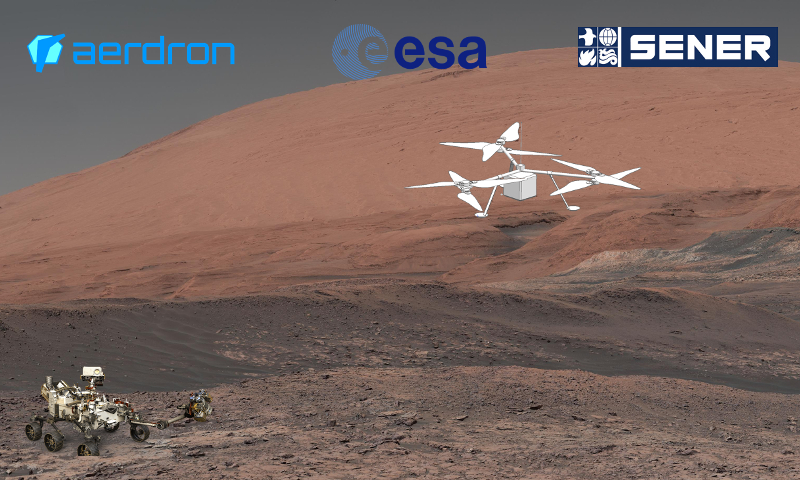
SENER Aeroespacial and Aerdron collaborate to develop a drone designed to fly on Mars

SENER Aeroespacial and Aerdron collaborate to develop a drone designed to fly on Mars

23/03/2022

The company is actively involved in projects to mitigate space debris, such as E.T.PACK-Fly; to enable future standard in orbit servicing interface with SIROM; and to develop more robust propulsion systems such as HIPATIA.

The company is actively involved in projects to mitigate space debris, such as E.T.PACK-Fly; to enable future standard in orbit servicing interface with SIROM; and to develop more robust propulsion systems such as HIPATIA.

SENER Aeroespacial has joined the Net Zero Space initiative, as a step forward in the group’s commitment to drive sustainable transformation through engineering and technology.

The Net Zero Space initiative was launched at the occasion of the 4th edition of the Paris Peace Forum by different actors from all over the world concerned by the long-term sustainability of outer space. From satellite operators to launchers, from space agencies to academia and the civil society, all these stakeholders gathered to call to achieving sustainable use of outer space for the benefit of all humankind by 2030 by taking concrete actions to tackle the pressing challenge of reducing debris orbiting Earth.

SENER Aeroespacial se une a la iniciativa Net Zero Space

SENER Aeroespacial is already working to generate more efficient orbital infrastructures. Since 2019, the company is part of the E.T.PACK consortium to develop a deorbit device based on a space tether to tackle the space debris proliferation problem.

E.T.PACK Fly, a project to mitigate space debris

The accumulation of a high number of space debris in Low Earth Orbit represents a threat since, when a collision occurs between two objects in orbit, a cloud of dangerous shrapnels for operational satellites is generated. E.T. PACK-Fly aims to solve this problem by developing a device capable of deorbiting, that is, decreasing the altitude of the orbit of the space debris until it is eliminated during the reentry in the Earth’s atmosphere.

Unlike conventional propulsion systems, the E.T. PACK-Fly equipment uses a disruptive technology, known as an electrodynamic space tether, that does not require propellant. This electrodynamic tether is a very thin aluminium tape (about two centimetres wide and a couple of kilometres long), which works by using the plasma around the Earth and the geomagnetic field to generate an electric current. This electrodynamic effect results in a force known as the Lorentz drag. This force deorbits the satellite up to the reentry into the Earth’s atmosphere, where it is eliminated by the heat generated by this process. The tether is the fundamental part of the deorbiting device which, since it does not require fuel, is small and light. It is also designed to be fully autonomous, and to control the deorbiting manoeuvre in order to avoid possible collisions with other objects.

E-T.PACK Fly consortium is coordinated by the Universidad Carlos III de Madrid (UC3M) and made up of the University of Padova, the Technical University of Dresden (TU Dresden), the Spanish company SENER Aeroespacial and the German start-up Rocket Factory Augsburg (RFA), and has recently received €2.5 million from the European Innovation Council (EIC) to prepare the flight model of a deorbit device to be launched into orbit in 2025. RFA and SENER Aeroespacial have already signed the launch service agreement. The E.T. PACK-Fly project is the continuation of the E.T. PACK project, also funded by the EIC. A first prototype of the deorbit device was developed and built in the framework of E.T.PACK.

Lorenzo Tarabini Castellani, director of the E.T.PACK-Fly project at SENER Aeroespacial, points out: “This project gives us the opportunity to build and qualify for space, through a complete series of tests, a light, compact and completely autonomous platform for deorbiting the final stages of launchers. The ETPACK-Fly platform is expected to be launched in 2025 with RFA to demonstrate its proficiency and pave the way for commercial exploitation of deorbiting technology.”

Arrtistic view of the E.T. PACK deorbit device

Other SENER Aeroespacial projects to support the sustainable use of outer space

SENER Aeroespacial is also working on a space refuelling station that will enable in-orbit propellant replenishment, extending the life of satellites. The company will contribute to this future space refuelling station with its SIROM technology, a modular reconfigurable system interface.

Furthermore, SENER Aeroespacial has a long track record in projects that contemplate the generation of space technology from the point of view of sustainability: in institutional programs such as the LOP-Gateway lunar station, SENER Aeroespacial will contribute with antennas and mechanisms to the American HALO module and will provide the IBDM-HCS of the tunnel that will allow astronauts access to the European habitable module, as well as the refuelling of the station.

At launchers, SENER Aeroespacial works in the Space Rider reusable transport system, leading the design of the CNG system of the reentry vehicle.

On the space propulsion side, SENER Aeroespacial is developing the helicon plasma thruster HIPATIA. HIPATIA is a robust radio frequency-powered plasma propulsion system designed to solve several issues affecting electric propulsion systems.

And, on space debris, previously to E.T.PACK project, SENER Aeroespacial coordinated the European Commission’s LEOSWEEP project (‘Improving Low Earth Orbit Security With Enhanced Electric Propulsion’), a consortium of 11 institutions comprised of companies, research centers and universities of the EU and Ukraine that worked in a mitigation method for this space debris problem.

SENER Aeroespacial develops high value-added products and technology for institutional, telecommunications, astronomy and science programs, and launchers, with the capacity to produce recurring series of cost-efficient products.

Joining Net Zero Space is another example of the SENER Group’s commitment to society through sustainable engineering projects and technologies. The SENER Group has also join the Sustainable Development Goals (SDG) approved by the United Nations.

Helicon Plasma Thruster (HTP) developed on a second stage in the HIPATIA project

PDF

Format: PDF

89,39 KB