The California High-Speed Rail wins AEP Award

The California High-Speed Rail wins AEP Award

10/04/2025

The California High-Speed Rail project, the first high-speed rail system in the United States and one in which Sener is actively involved, has been awarded the AEP Award in the Environmental Analysis Document category by the California Association of Environmental Professionals (AEP). The recognition focuses on the Palmdale to Burbank section, whose environmental analysis documentation was praised for its innovative approach and technical rigour.

This award highlights the collaborative effort of all partners involved in the project, with a special mention for Circlepoint, Sener’s partner since 2015 and the lead firm in preparing the environmental documentation.

Sener has participated as the lead consultant in the project, coordinating the collaboration between prominent American engineering firms. Our role includes the preliminary design, evaluation of technical alternatives, environmental impact analysis, and the identification of rights of way required for the track alignment, stations, and auxiliary facilities.

This recognition strengthens Sener’s commitment to sustainability, innovation, and technical excellence in major international infrastructure projects.

Spain drives the future of the space industry developing a unique engine

Spain drives the future of the space industry developing a unique engine

09/04/2025

A consortium led by ITP Aero, with the participation of Pangea Aerospace, the engineering and technology industrial group Sener, and Aenium Engineering, will complete the development of the Aerospike engine, an innovative propulsion technology, and integrate it with its European customers. This contract is the second largest project in the Space Technology Plan of the CDTI Innovation and the Spanish Space Agency, with a budget of more than €11 million from the R&D Support Plan for Space Technologies, whose total budget is €70 million.

The MERLIn project (Efficient and Reusable Engine for International Launchers) has received the second largest grant from the Space Technology Plan (PTE), with a budget of €11.6 million, representing more than 10% of the total R&D support plan for space technology awarded by CDTI Innovation and the Spanish Space Agency, through the Ministry of Science and the Ministry of Defense.

This investment within the Space Technology Program reinforces the Government’s commitment to boosting the national aerospace industry and strengthening its position in space propulsion over the next decade, with innovation in key technologies for the future of space exploration. The PTE is an action within the Aerospace PERTE (Aerospace Program), endowed with €70 million in subsidies from the Recovery and Resilience Facility of the PRTR Addendum. The project aims to promote the competitiveness of the Spanish aerospace industry as a key player in the sector’s upcoming challenges and opportunities through the development of technological capabilities based on R&D.

The project, led by ITP Aero and with the participation of Pangea Aerospace, the industrial engineering and technology group Sener, and Aenium Engineering, focuses on the manufacturing and integration of the world’s first flight-ready aerospike engine. Pangea Aerospace, a Barcelona and Toulouse-based startup specializing in space propulsion, thus secures the second largest project in the Space Technology Program with MERLIn. It is also the main funded company in the project, after receiving a €3.9 million grant within the project, representing more than 50% of the total budget.
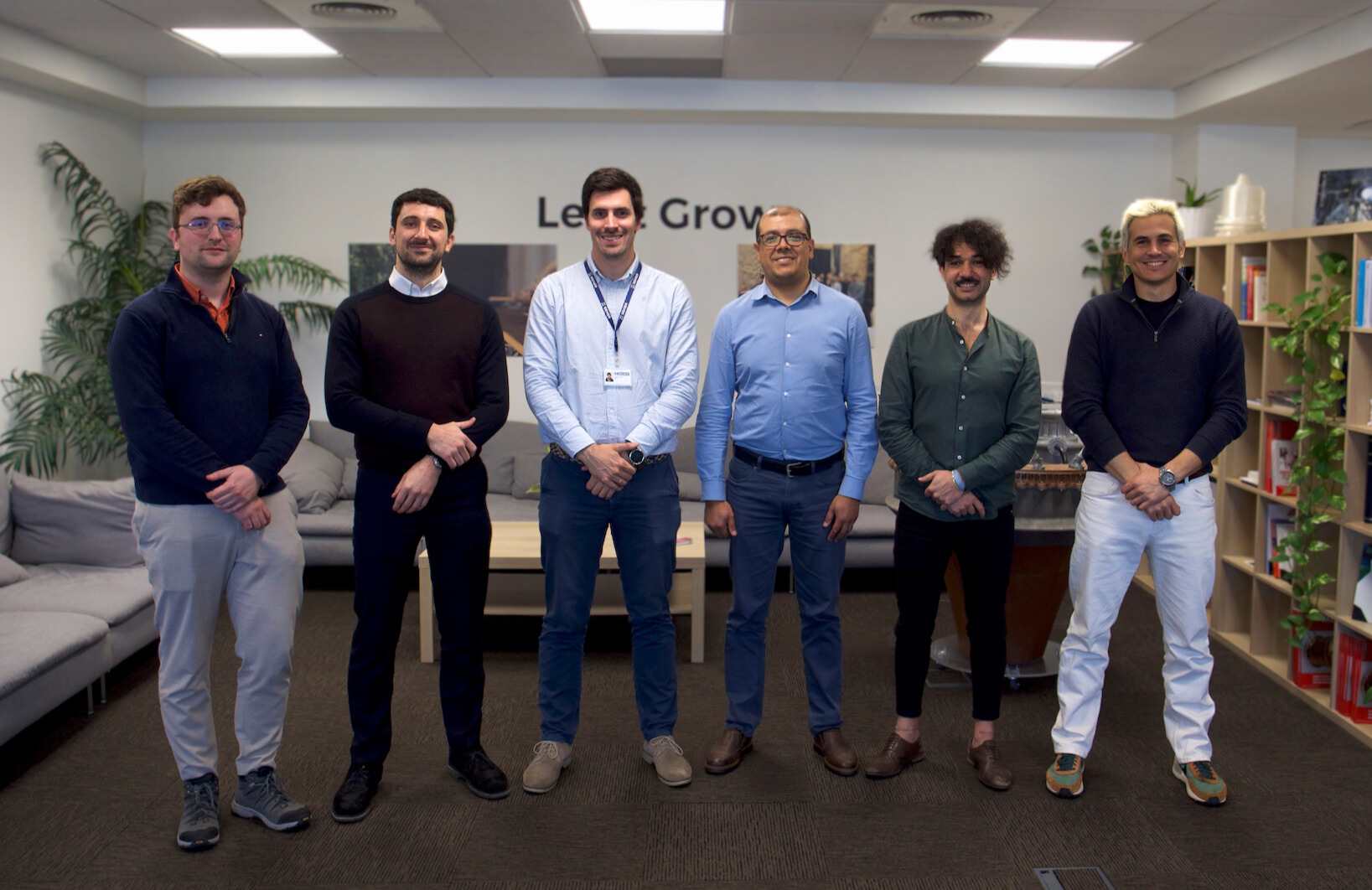
Consorcio Proyecto Merlin: ITP Aero, Sener, Pangea, Aenium

Representatives of the companies participating in the MERLIn consortium.

The MERLIn consortium, made up of other leading participating companies in the Spanish aerospace and technology sector, such as Aenium Engineering, ITP Aero, and Sener, is a clear example of successful public-private collaboration between Spanish companies to boost the competitiveness of the national aerospace industry and prepare it for the major challenges of the future.

Each consortium member contributes key expertise: Pangea Aerospace, responsible for the complete development of the engine from design to testing; ITP Aero, as the consortium leader and a global leader in propulsion technologies; Sener, a leading engineering and technology group with a strong industrial focus, provides the aerospike engine’s TVS control and actuation system; and Aenium Engineering contributes its expertise in advanced materials and additive manufacturing.

ARCOS, a highly efficient and cost-effective engine

The MERLIn project funding will be the first Pangea Aerospace will receive to support all subsystems of its ARCOS engine. With this, the aerospace startup aims to advance the development of the ARCOS rocket engine, an innovative propulsion technology, with the goal of having the fully integrated engine ready for ground testing simulating a launch, and to be able to integrate it with its European customers.

The engine to be developed in the MERLIn project will have a thrust of 750 kN and is designed for use in the upper stage of space rockets, providing superior performance and strengthening the competitiveness of the Spanish space sector. The aerospike engine enables the reentry and reuse of upper stages of medium and heavy launchers, opening the door to new business models and the complete reuse of launchers, something that only SpaceX has tested in the world.

ARCOS is a high-efficiency rocket engine with an aerospike nozzle, designed to be reused in multiple space missions. It runs on methane and liquid oxygen, a cleaner and more sustainable combination that reduces CO2 emissions by up to 50% compared to traditional kerosene-powered engines. Thanks to its aerospike geometry, it achieves an efficiency of up to 15%, higher than that of traditional bell-shaped engines, significantly increasing launch profitability.


Sener takes part in Acciona’s first design of a facility for capturing CO2 emissions from a waste plant

Sener takes part in Acciona’s first design of a facility for capturing CO2 emissions from a waste plant

07/04/2025

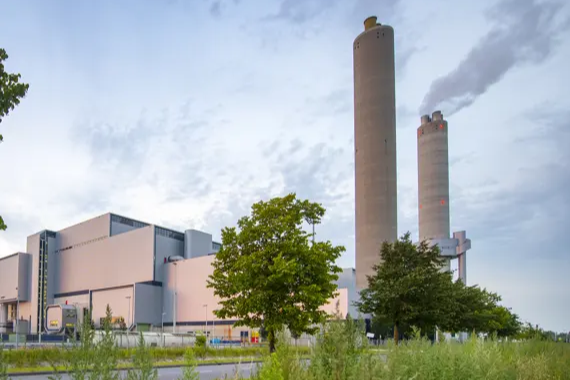
A consortium led by ACCIONA, alongside Sener and SLB Capturi, is to design and implement a facility capable of capturing CO₂ emissions generated by AEB’s waste processing plant in Amsterdam, in the Netherlands.

The project, known as Aurora—the first of its kind that ACCIONA has headed up—will begin with an initial engineering phase in which the plant will be designed.

The facility will capture the emissions by means of organic compounds derived from amines (a derivative of ammonia), using the kind of technology commonly used in this type of process.

Within the consortium, ACCIONA will largely be responsible for managing the project, handling customer relations and coordinating matters between the partners and project management.

The emissions produced by the AEB plant will be captured via Aurora and the resulting CO₂ will then be permanently injected into a carbon storage field. The project will bring AEB closer to its goal of capturing and storing around 0.5 million tons of CO₂ by 2028, which will reduce the total emissions generated within the municipality of Amsterdam by 10%.

Iberostar Hotels & Resorts deploys Sener’s artificial intelligence to reduce its energy footprint and improve customer experience

Iberostar Hotels & Resorts deploys Sener’s artificial intelligence to reduce its energy footprint and improve customer experience

02/04/2025

Iberostar and Sener have launched BRAIAN, a virtual operator based on artificial intelligence and designed to achieve a more efficient management of energy consumption in its hotels, ensuring the guests’ comfort. This solution is now available in the chain’s hotels in Spain and Mexico.

In line with its objective of achieving carbon neutrality in 2030, that is, 20 years before the industry’s target, Iberostar Hotels & Resorts has taken another step in its ambitious decarbonisation strategy and has joined the Sener engineering and technology group to create BRAIAN, a solution based on artificial intelligence that enables hotels to improve their energy performance by optimising the air-conditioning system, their main energy consumer.

BRAIAN (a play on the words brain and artificial intelligence) is geared towards the company’s commitment to climate action, a key focus area of the Iberostar Wave of Change movement, and it addresses two objectives: achieving energy savings of 35% and a reduction of 85% of scope 1 and 2 emissions by 2030, while ensuring an excellent experience for its guests.

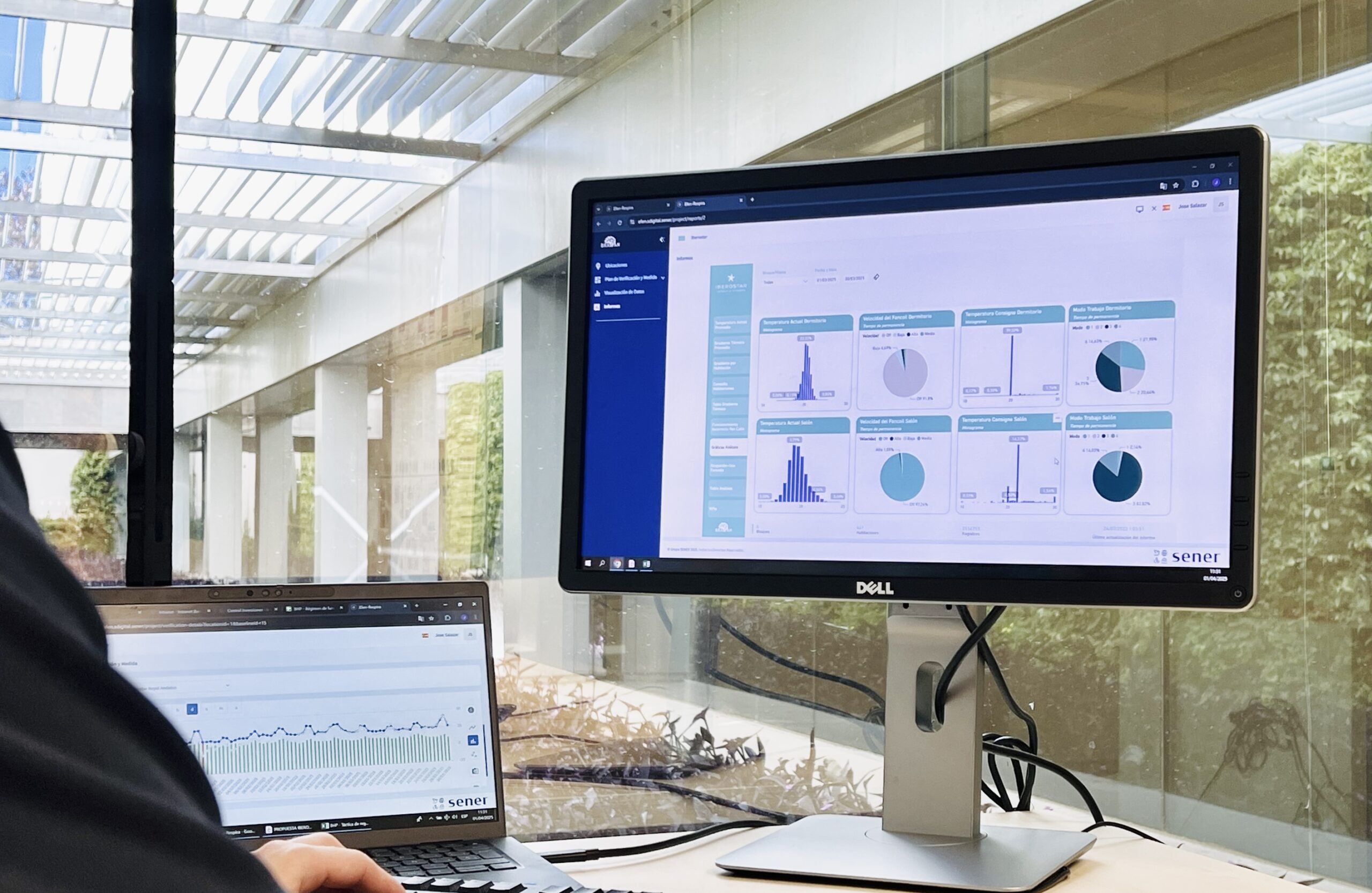
Thanks to artificial intelligence, BRAIAN manages to predict more precisely the energy performance of hotels and optimise their operation by means of a system that anticipates needs for the purpose of better decision-making. As a result, the tool centralises and analyses energy data from different variables of the chain’s management systems, such as the hotel’s control system or BMS and the hotel’s occupation in a given period or PMS, and other external data, such as the weather forecast, in order to integrate them into a single platform.

For example, this system allows anticipating the flow of guests in a specific area and adjusting its air-conditioning beforehand, thus helping to save energy while ensuring a higher degree of thermal comfort. BRAIAN can also perform as a virtual operator working hand in hand with the hotels’ technical service professionals, simplifying their daily work.

The tool will be implemented in a maximum of five hotels in the chain in 2025, and it is currently available in Iberostar Waves Royal Andalus (Cadiz), Iberostar Waves Alcudia Park and Iberostar Selection Playa de Palma (Mallorca). It will also be operational shortly at Iberostar Selection Cancun (Mexico).

This operator is based on a solution previously developed by Sener, Respira®, which is designed to centralise and analyse energy data. Respira® has already been successfully deployed on infrastructure such as metros or airports, e.g. in the air conditioning systems of Manises airport, in Valencia, or the Barcelona Metro.

Álvaro Sánchez López, Global Director of Sustainability – Integration and Impact at Iberostar Hotels & Resorts, states that “this project represents our commitment to innovation, sustainability and providing our customers with an excellent experience. We have a solid roadmap for the decarbonisation of our operations, and BRAIAN contributes on this path. We highly value the support it offers to our maintenance staff”.

Meanwhile, Guillem Peris, director of the Respira® project at Sener, points out that “Iberostar has set an ambitious goal to reduce its emissions and move towards a more sustainable model, committing to technology and data in its achievement. We are glad that they have trusted in our AI capabilities for this endeavour. BRAIAN is the materialisation of Iberostar’s commitment to new technologies aimed at maximising efficiency in its hotels and, as a result, improving customer experience”.

BRAIAN won the Smart Buildings category of the 12th edition of the enerTIC Awards held in 2024. These awards are organised by enerTIC and recognise innovation and the improvement of energy competitiveness through digitisation.

Cristina Ginés, Quark’s New International Business Development Manager

Cristina Ginés, Quark’s New International Business Development Manager

31/03/2025
The Sener group has appointed Cristina Ginés as Quark’s International Business Development Manager. This appointment follows a successful career at Sener spanning more than 20 years.
Prior to this appointment, Cristina served as Head of International Business Development at Sener and, since 2016, as Director of Mobility Business Development for Europe, based in the United Kingdom and Madrid. Her contribution has been key to securing strategic contracts such as HS2 (London to Birmingham High Speed ​​Line), the Edinburgh tram, and the new runway at Dublin Airport.

Now, Cristina is leaving this position to fully assume her new responsibilities at Quark, a company experiencing significant growth and already boasting a cumulative capacity of more than 1GW in designed data centers and 350,000 square meters of built-up area.

Cristina holds a law degree from the University of Zaragoza, an LLM in International Law and European Law from the University of Leuven, and an Executive MBA from IE Business School.

Sener Appoints Lisa France as General Manager for Energy, Data Centres, and Sports Divisions in Australia

Sener Appoints Lisa France as General Manager for Energy, Data Centres, and Sports Divisions in Australia

27/03/2025

Former Member of the Queensland Parliament, Assistant Minister for Natural Resources and Mines, and Assistant Minister for finance, administration and regulatory reform, and with remarkable experience in the private sector, Lisa brings a wealth of expertise to her new role, with a strong background of over 30 years in environmental science and a track record of leadership. Sener is a leading engineering and technology group, with more than 4,000 professionals around the world, experts in the Mobility, Energy, Advanced Facilities for Data Centres, Aerospace and Defence, and Digital industries.

The engineering and technology group Sener has appointed Lisa France as General Manager for the Energy, Data Centres, and Sports divisions in Australia. In this role, Lisa will lead the expansion of Quark, Sener’s Data Centre subsidiary, and drive the development of energy solutions and sports technology initiatives, including state-of-the-art stadium systems, such as Hypogea®, Sener’s retractable pitch system, already implemented in world-renowned stadiums such as the Santiago Bernabéu. With more than 4,000 professionals around the world, Sener is a global leader in the Mobility, Energy, Advanced Facilities for Data Centres, Aerospace and Defence and Digital industries.

Lisa France, Australia

Lisa will play a key role in leading Sener’s data centre engineering across Australia, focusing on providing energy-efficient, scalable infrastructure solutions that support the growing digital economy while minimising environmental impacts. Sener has built a strong reputation for designing and delivering data centres that integrate the latest in energy-efficient technology while prioritising efficiency and sustainability. Sener – through its subsidiary Quark – has a portfolio of more than 45 designed data centres, with an accumulated power of 1 GW and 350,000 square metres of built space. Sener’s work in Australia includes partnering with industry leaders to create facilities that are not only designed for peak performance but are also powered by renewable energy sources, setting new benchmarks in the industry.

On the sports side, Lisa will lead Sener’s business development of innovative solutions, such as retractable pitch systems. This cutting-edge technology, already implemented in world-renowned stadiums such as the Santiago Bernabéu, allows stadiums to retract their natural grass pitches into underground storage and replace with different surfaces. This gives the venue flexibility to host a range of events while preserving the quality of the playing surface.

Lisa brings a wealth of expertise to her new role, with a strong background in environmental science and a track record of leadership across both the public and private sectors. Having served as the State Member for Pumicestone in the Queensland Parliament and as Assistant Minister for Natural Resources and Mines, Lisa focused on the roll out of Queensland’s $70B CSG industry and policies that balanced sustainable development with resource management. Lisa also served as Assistant Minister for finance, administration and regulatory reform in the Queensland Parliament.

Before joining Sener, Lisa held senior executive positions at Hatch and SMEC, where she led major energy, infrastructure, and data centre projects. At Hatch, she was responsible for overseeing natural gas and energy projects across Australia and Asia, while at SMEC, she led renewable energy initiatives globally that contributed to the global decarbonisation initiatives in the private and public sector.

Ben Neary, CEO of Sener in Australia, highlighted: “We are excited to have Lisa on board and look forward to her leadership in driving Sener’s success in Australia. Under her leadership, Sener is poised to expand its influence in the energy, data centres and sports space, continuing our focus on sustainable energy and innovative infrastructure solutions.Lisa France added: “Australia’s growing demand for low carbon energy and efficient infrastructures is aligned with Sener’s commitment to sustainable and innovative solutions development. I look forward to using my expertise to help the company keep pushing the boundaries of technology to help our local customers meet their needs in an ever-evolving market”.

Management structure changes at Sener in Poland

Management structure changes at Sener in Poland

26/03/2025

Sener in Poland, a leader in innovation in space technology, announces changes in its management structure. Jakub Pierzchała, who has been with the company for five years, has been appointed General Manager of Sener in Poland. At the same time, a new position – Head of Area – has been created, which will be held by Beatriz Pérez, the former General Manager of Sener in Poland.

Jakub Pierzchała joined Sener in Poland in 2020 as Procurement Manager, where he was responsible for supply chain management. He later transitioned to the role of Head of Business Development, fostering collaboration with the European Space Agency (ESA) and building relationships with key Polish institutions such as the Polish Space Agency and the Ministry of Development and Technology. His contributions significantly advanced the growth of Sener’s Polish office, including the expansion of its space project portfolio. Jakub is a graduate of two prestigious UK universities – the University of Portsmouth and the University of Surrey – where he specialized in business and operations management.

In his new role, Jakub will continue his current responsibilities in business development while also taking on the duties of Director of Sener in Poland.

“Becoming the General Manager of Sener in Poland is a great honor and a tremendous responsibility. Together with the team, we will continue to strengthen the company’s position as a key player in the space sector, both domestically and internationally,” said Jakub Pierzchała.

Simultaneously with Jakub Pierzchała’s promotion, a new position – Head of Area – has been established. This role will be taken on by Beatriz Pérez, who successfully led Sener in Poland for the past three years. During her tenure, she played a pivotal role in the company’s growth, increasing the scale of its projects and expanding its team. In her new role, Beatriz will continue to support the development of the Polish office until her return to Spain.

These management changes mark another step in the dynamic development of Sener in Poland, enabling the company to better adapt its operations to the needs of its clients and the market.

Jakub y Beatriz, Polonia

Beatriz Pérez, Jakub Pierzchała.

Sener appoints Esteban Álvarez as Director of its Digital Area

Sener appoints Esteban Álvarez as Director of its Digital Area

19/03/2025

Sener, a leading engineering and technology group, has announced the appointment of Esteban Álvarez as Director of its Digital Area. With more than 20 years of experience in IT consulting and digital services, Esteban Álvarez will bring his expertise in business development, project management, and strategic alliance building to the area, which is comprised of a team of experts in digital transformation, including digital twin, BIM, artificial intelligence (AI), systems, descriptive and advanced analytics, IoT, cloud architectures, and cybersecurity.

Esteban Álvarez
Esteban Álvarez

In this way, Sener develops its value proposition in the digital industry, becoming one of the first major engineering companies to combine extensive and in-depth knowledge of businesses and markets (such as energy, mobility, data centres, and aerospace and defence) with digital technologies.

A graduate in Physics from the University of Valladolid, Esteban Álvarez has distinguished himself throughout his career for his strategic and analytical approach, combined with advanced skills in negotiation, planning, and relationship management with clients and partners. His experience in cloud, data, and AI solutions complements his profile, which is focused on achieving high-impact, value-added results for the organizations with which he has collaborated. In his new role, he will be responsible for defining and executing the strategy for Sener’s Digital area, leading growth and business development initiatives. In addition to providing consulting services, Sener’s Digital area has developed its own high-value-added solutions to improve its clients’ operations, leveraging its knowledge of AI and cybersecurity, among others.

Before joining Sener, Esteban Álvarez was Business Development Director for the EMEA region of Keepler Data Tech, a consulting firm specializing in AI and advanced cloud analytics solutions. Previously, he led the strategic alliance between Google and Accenture in the Iberian market, being responsible for the creation and development of the consulting firm’s Google Cloud team, which is comprised of more than 50 people.

“I am excited about the challenge of driving the growth of Sener’s Digital division, working to ensure its services and solutions maintain the group’s characteristic level of excellence,” says Esteban Álvarez. With this appointment, Sener continues to advance its innovation strategy, reaffirming its commitment to excellence and solving its clients’ most complex technological challenges.

Sener takes part in a new Ariane 6 launch

Sener takes part in a new Ariane 6 launch

07/03/2025

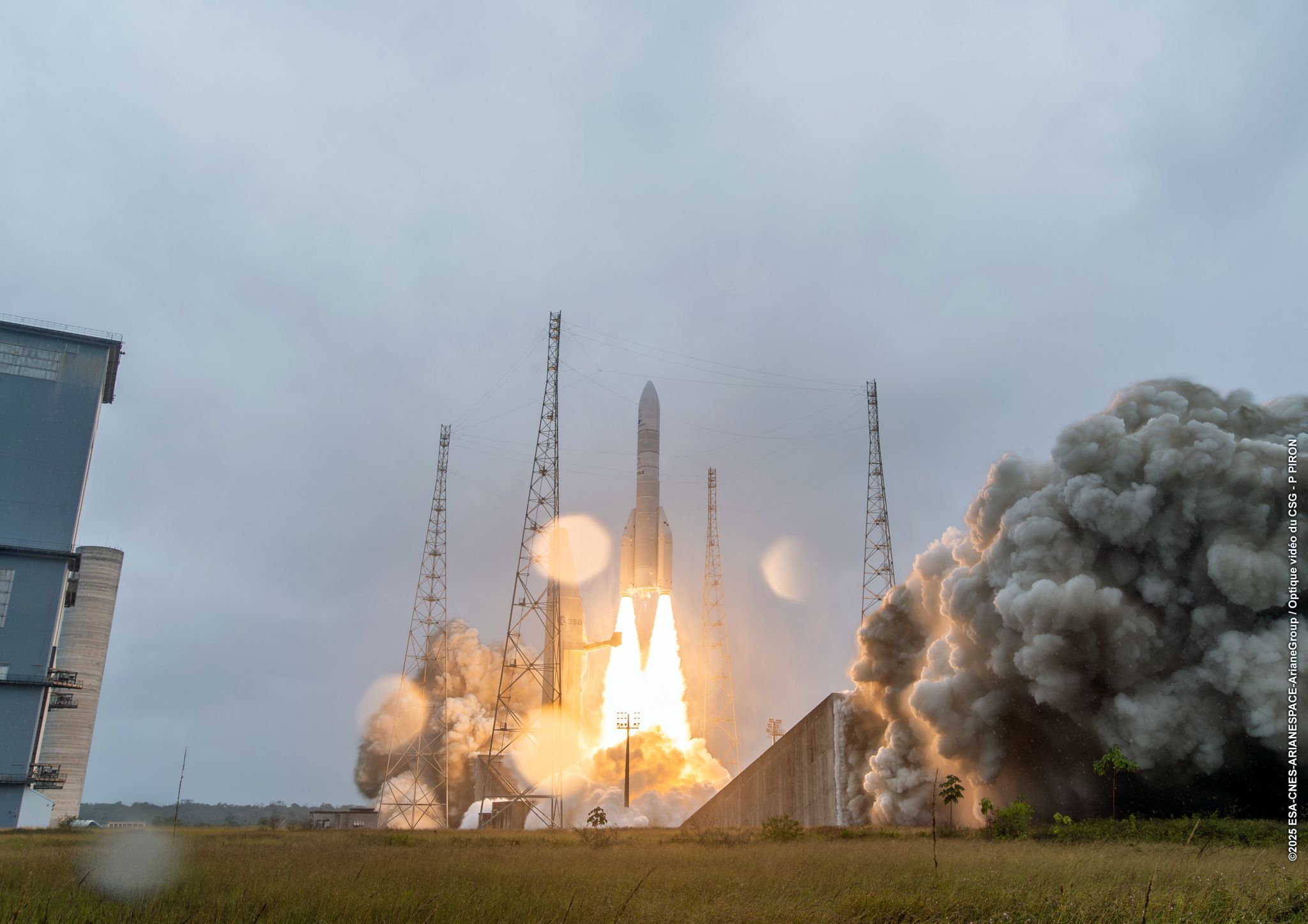
The second flight of the Ariane 6 rocket, launched from the European Spaceport in Kourou in French Guiana, has seen the participation of Sener. This second launch, promoted by the European Space Agency (ESA) and in collaboration with its partners ArianeGroup and Arianespace, will put into orbit the CSO-3 reconnaissance satellite intended to support the French army.

Specifically, Sener has been the company in charge of supplying a telemetry antenna for the European Ariane 6 launcher. This antenna allows monitoring and transmitting data from the Ariane 6 to ground stations during the flight. This includes critical information on the status of the launcher’s systems, sensors and subsystems.

In this way, control and communication between the rocket and the ground teams is enabled and it is possible to track and locate the Ariane 6 during its different flight phases, as well as, eventually, resolve possible problems by the technical teams on the ground, helping to guarantee the success of the space mission.

The European Space Agency has awarded Sener the contract to develop several critical systems for the Rosalind Franklin mission, which will travel to Mars in 2028

The European Space Agency has awarded Sener the contract to develop several critical systems for the Rosalind Franklin mission, which will travel to Mars in 2028

04/03/2025

Sener will design and manufacture all the separation systems for the descent module, the UHF communications antennas and the landing gear for the platform that houses the Rosalind Franklin rover. Sener is also responsible for the positioning and translation system for the rover’s drill, the mechanisms for deploying the solar panels and its communications antennas for the rover and the communications antennas for the orbiter. The mission in which the Rosalind Franklin is a part is the third to Mars in which Sener is participating, after having provided the antenna pointing mechanism for the Perseverance and Curiosity rover, for NASA’s Mars 2020 and Mars Science Laboratory missions.

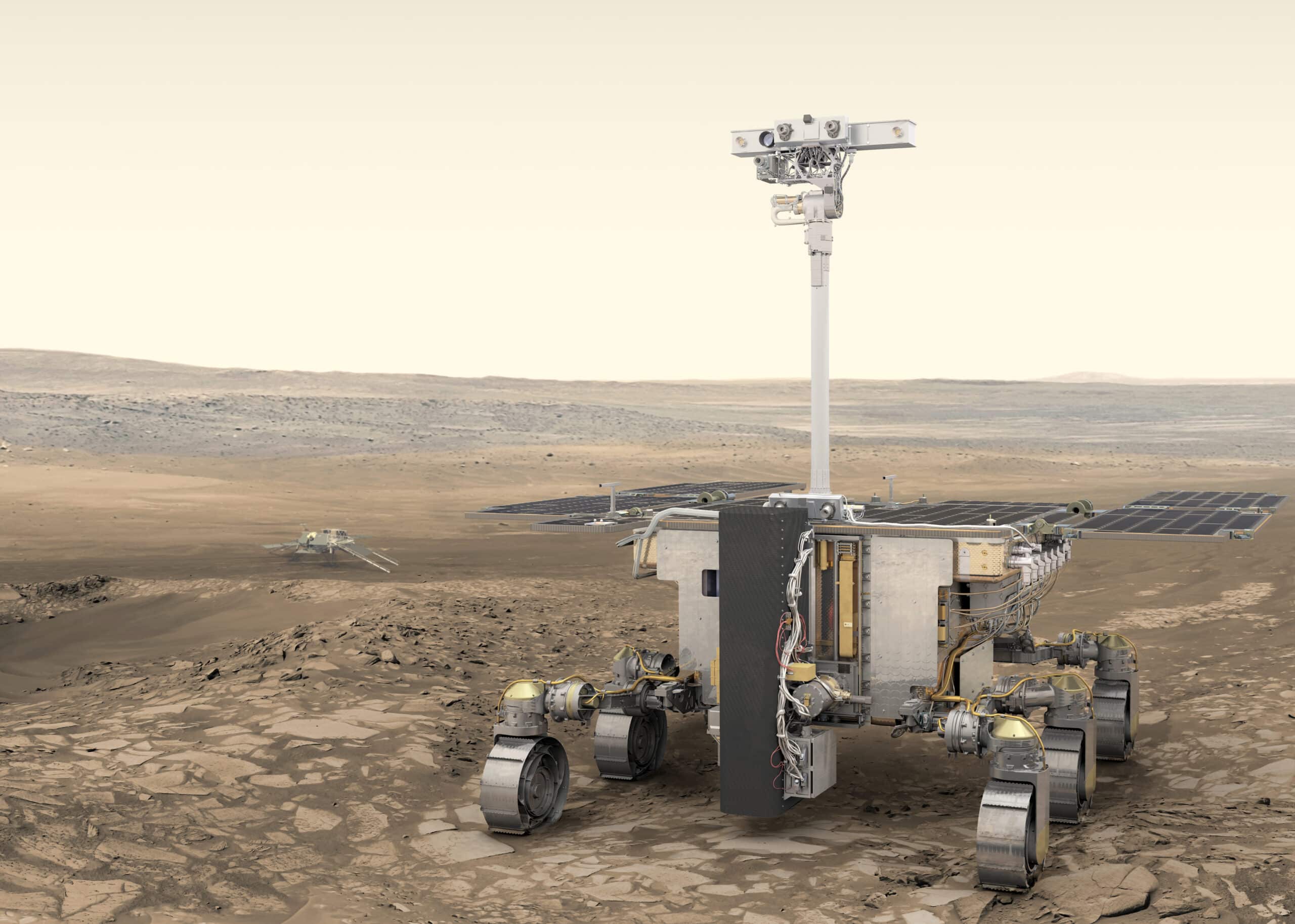
Sener has been selected by the European Space Agency (ESA) to develop several key systems for the entry module of the Rosalind Franklin, the rover (or vehicle for space exploration) that will form part of the ExoMars mission, whose launch is scheduled for 2028.

The Rosalind Franklin will search for traces of life on Mars, carrying out advanced scientific research on its surface. Sener will be responsible for the design, development and supply of various essential systems that will guarantee the success of the mission. Specifically, Sener will design and manufacture three key subsystems for the correct landing of the rover on Mars: the landing gear, the mechanisms and adapter for separating the entry capsule, and its UHF communications antennas. The rover will also carry on board equipment developed by Sener: the drill positioning and translation system, the solar panel deployment mechanism, and X and UHF band antennas.

These systems will help achieve the mission’s objective, thanks to the capabilities of the rover, which will have to drill holes up to two meters deep into the Martian surface to take soil samples and analyze their composition. In addition to the search for traces of life, ExoMars will investigate the variation of the Martian geochemical environment, study the composition of traces of gases in the Martian atmosphere and their sources of origin, and demonstrate the feasibility of using key technologies for future space exploration missions.

In the words of Yon Jáuregui, project director at Aerospace and Defence at Sener, “it is a privilege to work on a mission like ExoMars, which combines the technical challenge with the value of seeking fundamental answers about life and the universe. Projects like this not only challenge us professionally but also remind us why we chose to dedicate ourselves to space exploration.”

ExoMars will be the third mission to Mars in which Sener participates, after the Mars 2020 and Mars Science Laboratory missions of NASA. In both cases, Sener was responsible for the design, manufacture, verification and integration of similar systems that confirm Sener’s ability to now be part of the Rosalind Franklin mission.

In addition, Sener has designed and manufactured in Poland the umbilical release mechanism (URM) or “umbilical cord” of the ExoMars Rosalind Franklin mission, a critical element for the electromechanical connection between the rover and the descent module, which will provide the vehicle with electrical power once it lands on the planet’s surface, and which must remain operational in extreme conditions.