






Solar Orbiter reaches closets approach to the Sun

Solar Orbiter reaches closets approach to the Sun

25/03/2022

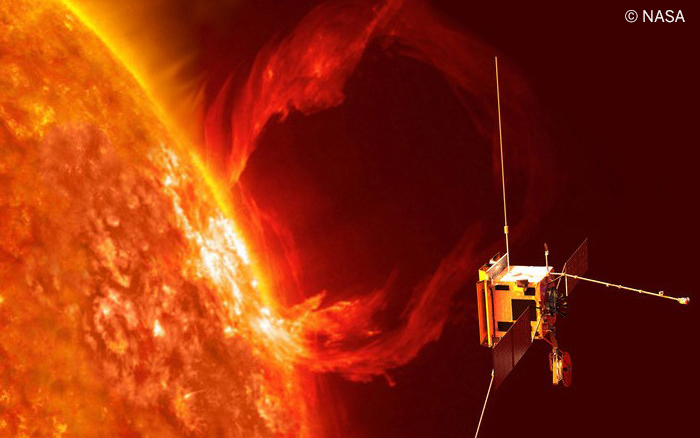
Solar Orbiter spacecraft, a joint initiative of the European (ESA) and American (NASA) space agencies to study the Sun, is speeding towards its historic first close pass of the Sun. This Saturday 26 March it will reach closest approach to the Sun. The 26 March perihelion passage is one of the major events in the mission.

Solar Orbiter spacecraft, a joint initiative of the European (ESA) and American (NASA) space agencies to study the Sun, is speeding towards its historic first close pass of the Sun. This Saturday 26 March it will reach closest approach to the Sun. The 26 March perihelion passage is one of the major events in the mission.

The mission to the Sun represents the largest contribution of equipment and subsystems to a space mission in the history of SENER Aeroespacial, which has worked in parallel on five different contracts: the antennae subsystem, the feed-through filter subsystem, the boom instrument, and the EPD and So-Phi scientific instruments.

On 26 March, Solar Orbiter will be less than one-third of the distance from the Sun to the Earth, and it is designed to survive this close for relatively extended periods of time. It will spend until 6 April inside the orbit of Mercury. Around perihelion, the name for closest approach to the Sun, Solar Orbiter will bring high resolution telescopes that will allow the observation of the solar surface closer than ever before.

The instrument boom keeps the instruments that require greater sensitivity away from the probe’s own disturbances and especially from its electromagnetic emissions. The feed-throughs opening mechanisms allow the solar particles to pass through during the scientific measurements, keeping the sensors closed during the rest of the mission. The antenna subsystem also developed by SENER Aeroespacial has two low-gain antennas used for receiving commands and telemetry during the phases of the mission closest to the ground, a medium-gain steerable antenna for the reception and transmission of telecommands and telemetry during the rest of the mission and finally a high-gain antenna steerable on two axes that allows sending all the data and measurements collected by the scientific instruments.

All ten instruments will be operating simultaneously to gather as much data as possible, including the two instruments with SENER Aeroespacial technology on board: the ESPADA or EPD (Energetic and Surathermal PArticle Detector Analizer), which will analyze high energy particles; and So-Phi (Polarimetric and Helioseismic Imager), a high-performance camera whose objective is to map the magnetic field vector and speed, along the line of sight, of the solar photospheric plasma.

In ESPADA, SENER Aeroespacial has carried out systems engineering, quality assurance and consultancy in electronic and mechanical/thermal engineering, as well as software, for the main researcher which is the Universidad de Alcalá (in Spain). For the So-Phi instrument, whose Spanish consortium is led by the Instituto Astrofísico de Andalucía (IAA), SENER Aerospacial has been responsible for system engineering support, quality and manufacturing tasks and testing of all the models of the electronic unit e-Unit and the correlator camera (CTC).

Together with data and images from Solar Orbiter’s other instruments, these could reveal more information about the solar storms or miniature flares dubbed campfires that the mission revealed in its first images, as well as the first images of the poles of our star. To do this, Solar Orbiter will use its remote sensing instruments to image the Sun, and its in-situ instruments to measure the solar wind as it flows past the spacecraft.
SENER Aeroespacial completes Hard Capture System (HCS) for the International Berthing and Docking Mechanism

SENER Aeroespacial completes Hard Capture System (HCS) for the International Berthing and Docking Mechanism

24/03/2022

Solar Orbiter spacecraft, a joint initiative of the European (ESA) and American (NASA) space agencies to study the Sun, is speeding towards its historic first close pass of the Sun. This Saturday 26 March it will reach closest approach to the Sun. The 26 March perihelion passage is one of the major events in the mission.

Solar Orbiter spacecraft, a joint initiative of the European (ESA) and American (NASA) space agencies to study the Sun, is speeding towards its historic first close pass of the Sun. This Saturday 26 March it will reach closest approach to the Sun. The 26 March perihelion passage is one of the major events in the mission.

The mission to the Sun represents the largest contribution of equipment and subsystems to a space mission in the history of SENER Aeroespacial, which has worked in parallel on five different contracts: the antennae subsystem, the feed-through filter subsystem, the boom instrument, and the EPD and So-Phi scientific instruments.

On 26 March, Solar Orbiter will be less than one-third of the distance from the Sun to the Earth, and it is designed to survive this close for relatively extended periods of time. It will spend until 6 April inside the orbit of Mercury. Around perihelion, the name for closest approach to the Sun, Solar Orbiter will bring high resolution telescopes that will allow the observation of the solar surface closer than ever before.

The instrument boom keeps the instruments that require greater sensitivity away from the probe’s own disturbances and especially from its electromagnetic emissions. The feed-throughs opening mechanisms allow the solar particles to pass through during the scientific measurements, keeping the sensors closed during the rest of the mission. The antenna subsystem also developed by SENER Aeroespacial has two low-gain antennas used for receiving commands and telemetry during the phases of the mission closest to the ground, a medium-gain steerable antenna for the reception and transmission of telecommands and telemetry during the rest of the mission and finally a high-gain antenna steerable on two axes that allows sending all the data and measurements collected by the scientific instruments.

All ten instruments will be operating simultaneously to gather as much data as possible, including the two instruments with SENER Aeroespacial technology on board: the ESPADA or EPD (Energetic and Surathermal PArticle Detector Analizer), which will analyze high energy particles; and So-Phi (Polarimetric and Helioseismic Imager), a high-performance camera whose objective is to map the magnetic field vector and speed, along the line of sight, of the solar photospheric plasma.

In ESPADA, SENER Aeroespacial has carried out systems engineering, quality assurance and consultancy in electronic and mechanical/thermal engineering, as well as software, for the main researcher which is the Universidad de Alcalá (in Spain). For the So-Phi instrument, whose Spanish consortium is led by the Instituto Astrofísico de Andalucía (IAA), SENER Aerospacial has been responsible for system engineering support, quality and manufacturing tasks and testing of all the models of the electronic unit e-Unit and the correlator camera (CTC).

Together with data and images from Solar Orbiter’s other instruments, these could reveal more information about the solar storms or miniature flares dubbed campfires that the mission revealed in its first images, as well as the first images of the poles of our star. To do this, Solar Orbiter will use its remote sensing instruments to image the Sun, and its in-situ instruments to measure the solar wind as it flows past the spacecraft.
PDF

Format: PDF

95,59 KB

SENER Aeroespacial and Aerdron collaborate to develop a drone designed to fly on Mars

SENER Aeroespacial and Aerdron collaborate to develop a drone designed to fly on Mars

23/03/2022

Solar Orbiter spacecraft, a joint initiative of the European (ESA) and American (NASA) space agencies to study the Sun, is speeding towards its historic first close pass of the Sun. This Saturday 26 March it will reach closest approach to the Sun. The 26 March perihelion passage is one of the major events in the mission.

Solar Orbiter spacecraft, a joint initiative of the European (ESA) and American (NASA) space agencies to study the Sun, is speeding towards its historic first close pass of the Sun. This Saturday 26 March it will reach closest approach to the Sun. The 26 March perihelion passage is one of the major events in the mission.

The mission to the Sun represents the largest contribution of equipment and subsystems to a space mission in the history of SENER Aeroespacial, which has worked in parallel on five different contracts: the antennae subsystem, the feed-through filter subsystem, the boom instrument, and the EPD and So-Phi scientific instruments.

On 26 March, Solar Orbiter will be less than one-third of the distance from the Sun to the Earth, and it is designed to survive this close for relatively extended periods of time. It will spend until 6 April inside the orbit of Mercury. Around perihelion, the name for closest approach to the Sun, Solar Orbiter will bring high resolution telescopes that will allow the observation of the solar surface closer than ever before.

The instrument boom keeps the instruments that require greater sensitivity away from the probe’s own disturbances and especially from its electromagnetic emissions. The feed-throughs opening mechanisms allow the solar particles to pass through during the scientific measurements, keeping the sensors closed during the rest of the mission. The antenna subsystem also developed by SENER Aeroespacial has two low-gain antennas used for receiving commands and telemetry during the phases of the mission closest to the ground, a medium-gain steerable antenna for the reception and transmission of telecommands and telemetry during the rest of the mission and finally a high-gain antenna steerable on two axes that allows sending all the data and measurements collected by the scientific instruments.

All ten instruments will be operating simultaneously to gather as much data as possible, including the two instruments with SENER Aeroespacial technology on board: the ESPADA or EPD (Energetic and Surathermal PArticle Detector Analizer), which will analyze high energy particles; and So-Phi (Polarimetric and Helioseismic Imager), a high-performance camera whose objective is to map the magnetic field vector and speed, along the line of sight, of the solar photospheric plasma.

In ESPADA, SENER Aeroespacial has carried out systems engineering, quality assurance and consultancy in electronic and mechanical/thermal engineering, as well as software, for the main researcher which is the Universidad de Alcalá (in Spain). For the So-Phi instrument, whose Spanish consortium is led by the Instituto Astrofísico de Andalucía (IAA), SENER Aerospacial has been responsible for system engineering support, quality and manufacturing tasks and testing of all the models of the electronic unit e-Unit and the correlator camera (CTC).

Together with data and images from Solar Orbiter’s other instruments, these could reveal more information about the solar storms or miniature flares dubbed campfires that the mission revealed in its first images, as well as the first images of the poles of our star. To do this, Solar Orbiter will use its remote sensing instruments to image the Sun, and its in-situ instruments to measure the solar wind as it flows past the spacecraft.

PDF

Format: PDF

95,59 KB

SENER is certified in BIM according to ISO 19650 with LRQA

SENER is certified in BIM according to ISO 19650 with LRQA

15/03/2022

Solar Orbiter spacecraft, a joint initiative of the European (ESA) and American (NASA) space agencies to study the Sun, is speeding towards its historic first close pass of the Sun. This Saturday 26 March it will reach closest approach to the Sun. The 26 March perihelion passage is one of the major events in the mission.

Solar Orbiter spacecraft, a joint initiative of the European (ESA) and American (NASA) space agencies to study the Sun, is speeding towards its historic first close pass of the Sun. This Saturday 26 March it will reach closest approach to the Sun. The 26 March perihelion passage is one of the major events in the mission.

The mission to the Sun represents the largest contribution of equipment and subsystems to a space mission in the history of SENER Aeroespacial, which has worked in parallel on five different contracts: the antennae subsystem, the feed-through filter subsystem, the boom instrument, and the EPD and So-Phi scientific instruments.

On 26 March, Solar Orbiter will be less than one-third of the distance from the Sun to the Earth, and it is designed to survive this close for relatively extended periods of time. It will spend until 6 April inside the orbit of Mercury. Around perihelion, the name for closest approach to the Sun, Solar Orbiter will bring high resolution telescopes that will allow the observation of the solar surface closer than ever before.

The instrument boom keeps the instruments that require greater sensitivity away from the probe’s own disturbances and especially from its electromagnetic emissions. The feed-throughs opening mechanisms allow the solar particles to pass through during the scientific measurements, keeping the sensors closed during the rest of the mission. The antenna subsystem also developed by SENER Aeroespacial has two low-gain antennas used for receiving commands and telemetry during the phases of the mission closest to the ground, a medium-gain steerable antenna for the reception and transmission of telecommands and telemetry during the rest of the mission and finally a high-gain antenna steerable on two axes that allows sending all the data and measurements collected by the scientific instruments.

All ten instruments will be operating simultaneously to gather as much data as possible, including the two instruments with SENER Aeroespacial technology on board: the ESPADA or EPD (Energetic and Surathermal PArticle Detector Analizer), which will analyze high energy particles; and So-Phi (Polarimetric and Helioseismic Imager), a high-performance camera whose objective is to map the magnetic field vector and speed, along the line of sight, of the solar photospheric plasma.

In ESPADA, SENER Aeroespacial has carried out systems engineering, quality assurance and consultancy in electronic and mechanical/thermal engineering, as well as software, for the main researcher which is the Universidad de Alcalá (in Spain). For the So-Phi instrument, whose Spanish consortium is led by the Instituto Astrofísico de Andalucía (IAA), SENER Aerospacial has been responsible for system engineering support, quality and manufacturing tasks and testing of all the models of the electronic unit e-Unit and the correlator camera (CTC).

Together with data and images from Solar Orbiter’s other instruments, these could reveal more information about the solar storms or miniature flares dubbed campfires that the mission revealed in its first images, as well as the first images of the poles of our star. To do this, Solar Orbiter will use its remote sensing instruments to image the Sun, and its in-situ instruments to measure the solar wind as it flows past the spacecraft.

PDF

Format: PDF

95,59 KB

SENER Aeroespacial awarded with a new contract for Airbus’ OneSat program

SENER Aeroespacial awarded with a new contract for Airbus’ OneSat program

10/03/2022

Solar Orbiter spacecraft, a joint initiative of the European (ESA) and American (NASA) space agencies to study the Sun, is speeding towards its historic first close pass of the Sun. This Saturday 26 March it will reach closest approach to the Sun. The 26 March perihelion passage is one of the major events in the mission.

Solar Orbiter spacecraft, a joint initiative of the European (ESA) and American (NASA) space agencies to study the Sun, is speeding towards its historic first close pass of the Sun. This Saturday 26 March it will reach closest approach to the Sun. The 26 March perihelion passage is one of the major events in the mission.

The mission to the Sun represents the largest contribution of equipment and subsystems to a space mission in the history of SENER Aeroespacial, which has worked in parallel on five different contracts: the antennae subsystem, the feed-through filter subsystem, the boom instrument, and the EPD and So-Phi scientific instruments.

On 26 March, Solar Orbiter will be less than one-third of the distance from the Sun to the Earth, and it is designed to survive this close for relatively extended periods of time. It will spend until 6 April inside the orbit of Mercury. Around perihelion, the name for closest approach to the Sun, Solar Orbiter will bring high resolution telescopes that will allow the observation of the solar surface closer than ever before.

The instrument boom keeps the instruments that require greater sensitivity away from the probe’s own disturbances and especially from its electromagnetic emissions. The feed-throughs opening mechanisms allow the solar particles to pass through during the scientific measurements, keeping the sensors closed during the rest of the mission. The antenna subsystem also developed by SENER Aeroespacial has two low-gain antennas used for receiving commands and telemetry during the phases of the mission closest to the ground, a medium-gain steerable antenna for the reception and transmission of telecommands and telemetry during the rest of the mission and finally a high-gain antenna steerable on two axes that allows sending all the data and measurements collected by the scientific instruments.

All ten instruments will be operating simultaneously to gather as much data as possible, including the two instruments with SENER Aeroespacial technology on board: the ESPADA or EPD (Energetic and Surathermal PArticle Detector Analizer), which will analyze high energy particles; and So-Phi (Polarimetric and Helioseismic Imager), a high-performance camera whose objective is to map the magnetic field vector and speed, along the line of sight, of the solar photospheric plasma.

In ESPADA, SENER Aeroespacial has carried out systems engineering, quality assurance and consultancy in electronic and mechanical/thermal engineering, as well as software, for the main researcher which is the Universidad de Alcalá (in Spain). For the So-Phi instrument, whose Spanish consortium is led by the Instituto Astrofísico de Andalucía (IAA), SENER Aerospacial has been responsible for system engineering support, quality and manufacturing tasks and testing of all the models of the electronic unit e-Unit and the correlator camera (CTC).

Together with data and images from Solar Orbiter’s other instruments, these could reveal more information about the solar storms or miniature flares dubbed campfires that the mission revealed in its first images, as well as the first images of the poles of our star. To do this, Solar Orbiter will use its remote sensing instruments to image the Sun, and its in-situ instruments to measure the solar wind as it flows past the spacecraft.
PDF

Format: PDF

95,59 KB

SENER wins the Best Engineering Corporate Governance Europe 2021 award

SENER wins the Best Engineering Corporate Governance Europe 2021 award

08/03/2022

Solar Orbiter spacecraft, a joint initiative of the European (ESA) and American (NASA) space agencies to study the Sun, is speeding towards its historic first close pass of the Sun. This Saturday 26 March it will reach closest approach to the Sun. The 26 March perihelion passage is one of the major events in the mission.

Solar Orbiter spacecraft, a joint initiative of the European (ESA) and American (NASA) space agencies to study the Sun, is speeding towards its historic first close pass of the Sun. This Saturday 26 March it will reach closest approach to the Sun. The 26 March perihelion passage is one of the major events in the mission.

The mission to the Sun represents the largest contribution of equipment and subsystems to a space mission in the history of SENER Aeroespacial, which has worked in parallel on five different contracts: the antennae subsystem, the feed-through filter subsystem, the boom instrument, and the EPD and So-Phi scientific instruments.

On 26 March, Solar Orbiter will be less than one-third of the distance from the Sun to the Earth, and it is designed to survive this close for relatively extended periods of time. It will spend until 6 April inside the orbit of Mercury. Around perihelion, the name for closest approach to the Sun, Solar Orbiter will bring high resolution telescopes that will allow the observation of the solar surface closer than ever before.

The instrument boom keeps the instruments that require greater sensitivity away from the probe’s own disturbances and especially from its electromagnetic emissions. The feed-throughs opening mechanisms allow the solar particles to pass through during the scientific measurements, keeping the sensors closed during the rest of the mission. The antenna subsystem also developed by SENER Aeroespacial has two low-gain antennas used for receiving commands and telemetry during the phases of the mission closest to the ground, a medium-gain steerable antenna for the reception and transmission of telecommands and telemetry during the rest of the mission and finally a high-gain antenna steerable on two axes that allows sending all the data and measurements collected by the scientific instruments.

All ten instruments will be operating simultaneously to gather as much data as possible, including the two instruments with SENER Aeroespacial technology on board: the ESPADA or EPD (Energetic and Surathermal PArticle Detector Analizer), which will analyze high energy particles; and So-Phi (Polarimetric and Helioseismic Imager), a high-performance camera whose objective is to map the magnetic field vector and speed, along the line of sight, of the solar photospheric plasma.

In ESPADA, SENER Aeroespacial has carried out systems engineering, quality assurance and consultancy in electronic and mechanical/thermal engineering, as well as software, for the main researcher which is the Universidad de Alcalá (in Spain). For the So-Phi instrument, whose Spanish consortium is led by the Instituto Astrofísico de Andalucía (IAA), SENER Aerospacial has been responsible for system engineering support, quality and manufacturing tasks and testing of all the models of the electronic unit e-Unit and the correlator camera (CTC).

Together with data and images from Solar Orbiter’s other instruments, these could reveal more information about the solar storms or miniature flares dubbed campfires that the mission revealed in its first images, as well as the first images of the poles of our star. To do this, Solar Orbiter will use its remote sensing instruments to image the Sun, and its in-situ instruments to measure the solar wind as it flows past the spacecraft.

PDF

Format: PDF

95,59 KB

SENER and Aena will work together to improve air quality and energy efficiency at airports

SENER and Aena will work together to improve air quality and energy efficiency at airports

02/03/2022

Solar Orbiter spacecraft, a joint initiative of the European (ESA) and American (NASA) space agencies to study the Sun, is speeding towards its historic first close pass of the Sun. This Saturday 26 March it will reach closest approach to the Sun. The 26 March perihelion passage is one of the major events in the mission.

Solar Orbiter spacecraft, a joint initiative of the European (ESA) and American (NASA) space agencies to study the Sun, is speeding towards its historic first close pass of the Sun. This Saturday 26 March it will reach closest approach to the Sun. The 26 March perihelion passage is one of the major events in the mission.

The mission to the Sun represents the largest contribution of equipment and subsystems to a space mission in the history of SENER Aeroespacial, which has worked in parallel on five different contracts: the antennae subsystem, the feed-through filter subsystem, the boom instrument, and the EPD and So-Phi scientific instruments.

On 26 March, Solar Orbiter will be less than one-third of the distance from the Sun to the Earth, and it is designed to survive this close for relatively extended periods of time. It will spend until 6 April inside the orbit of Mercury. Around perihelion, the name for closest approach to the Sun, Solar Orbiter will bring high resolution telescopes that will allow the observation of the solar surface closer than ever before.

The instrument boom keeps the instruments that require greater sensitivity away from the probe’s own disturbances and especially from its electromagnetic emissions. The feed-throughs opening mechanisms allow the solar particles to pass through during the scientific measurements, keeping the sensors closed during the rest of the mission. The antenna subsystem also developed by SENER Aeroespacial has two low-gain antennas used for receiving commands and telemetry during the phases of the mission closest to the ground, a medium-gain steerable antenna for the reception and transmission of telecommands and telemetry during the rest of the mission and finally a high-gain antenna steerable on two axes that allows sending all the data and measurements collected by the scientific instruments.

All ten instruments will be operating simultaneously to gather as much data as possible, including the two instruments with SENER Aeroespacial technology on board: the ESPADA or EPD (Energetic and Surathermal PArticle Detector Analizer), which will analyze high energy particles; and So-Phi (Polarimetric and Helioseismic Imager), a high-performance camera whose objective is to map the magnetic field vector and speed, along the line of sight, of the solar photospheric plasma.

In ESPADA, SENER Aeroespacial has carried out systems engineering, quality assurance and consultancy in electronic and mechanical/thermal engineering, as well as software, for the main researcher which is the Universidad de Alcalá (in Spain). For the So-Phi instrument, whose Spanish consortium is led by the Instituto Astrofísico de Andalucía (IAA), SENER Aerospacial has been responsible for system engineering support, quality and manufacturing tasks and testing of all the models of the electronic unit e-Unit and the correlator camera (CTC).

Together with data and images from Solar Orbiter’s other instruments, these could reveal more information about the solar storms or miniature flares dubbed campfires that the mission revealed in its first images, as well as the first images of the poles of our star. To do this, Solar Orbiter will use its remote sensing instruments to image the Sun, and its in-situ instruments to measure the solar wind as it flows past the spacecraft.
PDF

Format: PDF

95,59 KB

SENER Aeroespacial and the Instituto Tecnológico de Galicia develop the artificial intelligence that will be used to detect and deactivate improvised explosive devices

SENER Aeroespacial and the Instituto Tecnológico de Galicia develop the artificial intelligence that will be used to detect and deactivate improvised explosive devices

02/03/2022

Solar Orbiter spacecraft, a joint initiative of the European (ESA) and American (NASA) space agencies to study the Sun, is speeding towards its historic first close pass of the Sun. This Saturday 26 March it will reach closest approach to the Sun. The 26 March perihelion passage is one of the major events in the mission.

Solar Orbiter spacecraft, a joint initiative of the European (ESA) and American (NASA) space agencies to study the Sun, is speeding towards its historic first close pass of the Sun. This Saturday 26 March it will reach closest approach to the Sun. The 26 March perihelion passage is one of the major events in the mission.

The mission to the Sun represents the largest contribution of equipment and subsystems to a space mission in the history of SENER Aeroespacial, which has worked in parallel on five different contracts: the antennae subsystem, the feed-through filter subsystem, the boom instrument, and the EPD and So-Phi scientific instruments.

On 26 March, Solar Orbiter will be less than one-third of the distance from the Sun to the Earth, and it is designed to survive this close for relatively extended periods of time. It will spend until 6 April inside the orbit of Mercury. Around perihelion, the name for closest approach to the Sun, Solar Orbiter will bring high resolution telescopes that will allow the observation of the solar surface closer than ever before.

The instrument boom keeps the instruments that require greater sensitivity away from the probe’s own disturbances and especially from its electromagnetic emissions. The feed-throughs opening mechanisms allow the solar particles to pass through during the scientific measurements, keeping the sensors closed during the rest of the mission. The antenna subsystem also developed by SENER Aeroespacial has two low-gain antennas used for receiving commands and telemetry during the phases of the mission closest to the ground, a medium-gain steerable antenna for the reception and transmission of telecommands and telemetry during the rest of the mission and finally a high-gain antenna steerable on two axes that allows sending all the data and measurements collected by the scientific instruments.

All ten instruments will be operating simultaneously to gather as much data as possible, including the two instruments with SENER Aeroespacial technology on board: the ESPADA or EPD (Energetic and Surathermal PArticle Detector Analizer), which will analyze high energy particles; and So-Phi (Polarimetric and Helioseismic Imager), a high-performance camera whose objective is to map the magnetic field vector and speed, along the line of sight, of the solar photospheric plasma.

In ESPADA, SENER Aeroespacial has carried out systems engineering, quality assurance and consultancy in electronic and mechanical/thermal engineering, as well as software, for the main researcher which is the Universidad de Alcalá (in Spain). For the So-Phi instrument, whose Spanish consortium is led by the Instituto Astrofísico de Andalucía (IAA), SENER Aerospacial has been responsible for system engineering support, quality and manufacturing tasks and testing of all the models of the electronic unit e-Unit and the correlator camera (CTC).

Together with data and images from Solar Orbiter’s other instruments, these could reveal more information about the solar storms or miniature flares dubbed campfires that the mission revealed in its first images, as well as the first images of the poles of our star. To do this, Solar Orbiter will use its remote sensing instruments to image the Sun, and its in-situ instruments to measure the solar wind as it flows past the spacecraft.
PDF

Format: PDF

95,59 KB

SENER has developed VISSEQ (drought viewer), essential in situations of water scarcity

SENER has developed VISSEQ (drought viewer), essential in situations of water scarcity

01/03/2022

Solar Orbiter spacecraft, a joint initiative of the European (ESA) and American (NASA) space agencies to study the Sun, is speeding towards its historic first close pass of the Sun. This Saturday 26 March it will reach closest approach to the Sun. The 26 March perihelion passage is one of the major events in the mission.

Solar Orbiter spacecraft, a joint initiative of the European (ESA) and American (NASA) space agencies to study the Sun, is speeding towards its historic first close pass of the Sun. This Saturday 26 March it will reach closest approach to the Sun. The 26 March perihelion passage is one of the major events in the mission.

The mission to the Sun represents the largest contribution of equipment and subsystems to a space mission in the history of SENER Aeroespacial, which has worked in parallel on five different contracts: the antennae subsystem, the feed-through filter subsystem, the boom instrument, and the EPD and So-Phi scientific instruments.

On 26 March, Solar Orbiter will be less than one-third of the distance from the Sun to the Earth, and it is designed to survive this close for relatively extended periods of time. It will spend until 6 April inside the orbit of Mercury. Around perihelion, the name for closest approach to the Sun, Solar Orbiter will bring high resolution telescopes that will allow the observation of the solar surface closer than ever before.

The instrument boom keeps the instruments that require greater sensitivity away from the probe’s own disturbances and especially from its electromagnetic emissions. The feed-throughs opening mechanisms allow the solar particles to pass through during the scientific measurements, keeping the sensors closed during the rest of the mission. The antenna subsystem also developed by SENER Aeroespacial has two low-gain antennas used for receiving commands and telemetry during the phases of the mission closest to the ground, a medium-gain steerable antenna for the reception and transmission of telecommands and telemetry during the rest of the mission and finally a high-gain antenna steerable on two axes that allows sending all the data and measurements collected by the scientific instruments.

All ten instruments will be operating simultaneously to gather as much data as possible, including the two instruments with SENER Aeroespacial technology on board: the ESPADA or EPD (Energetic and Surathermal PArticle Detector Analizer), which will analyze high energy particles; and So-Phi (Polarimetric and Helioseismic Imager), a high-performance camera whose objective is to map the magnetic field vector and speed, along the line of sight, of the solar photospheric plasma.

In ESPADA, SENER Aeroespacial has carried out systems engineering, quality assurance and consultancy in electronic and mechanical/thermal engineering, as well as software, for the main researcher which is the Universidad de Alcalá (in Spain). For the So-Phi instrument, whose Spanish consortium is led by the Instituto Astrofísico de Andalucía (IAA), SENER Aerospacial has been responsible for system engineering support, quality and manufacturing tasks and testing of all the models of the electronic unit e-Unit and the correlator camera (CTC).

Together with data and images from Solar Orbiter’s other instruments, these could reveal more information about the solar storms or miniature flares dubbed campfires that the mission revealed in its first images, as well as the first images of the poles of our star. To do this, Solar Orbiter will use its remote sensing instruments to image the Sun, and its in-situ instruments to measure the solar wind as it flows past the spacecraft.
SENER brings artificial intelligence to the M-30

SENER brings artificial intelligence to the M-30

23/02/2022

Solar Orbiter spacecraft, a joint initiative of the European (ESA) and American (NASA) space agencies to study the Sun, is speeding towards its historic first close pass of the Sun. This Saturday 26 March it will reach closest approach to the Sun. The 26 March perihelion passage is one of the major events in the mission.

Solar Orbiter spacecraft, a joint initiative of the European (ESA) and American (NASA) space agencies to study the Sun, is speeding towards its historic first close pass of the Sun. This Saturday 26 March it will reach closest approach to the Sun. The 26 March perihelion passage is one of the major events in the mission.

The mission to the Sun represents the largest contribution of equipment and subsystems to a space mission in the history of SENER Aeroespacial, which has worked in parallel on five different contracts: the antennae subsystem, the feed-through filter subsystem, the boom instrument, and the EPD and So-Phi scientific instruments.

On 26 March, Solar Orbiter will be less than one-third of the distance from the Sun to the Earth, and it is designed to survive this close for relatively extended periods of time. It will spend until 6 April inside the orbit of Mercury. Around perihelion, the name for closest approach to the Sun, Solar Orbiter will bring high resolution telescopes that will allow the observation of the solar surface closer than ever before.

The instrument boom keeps the instruments that require greater sensitivity away from the probe’s own disturbances and especially from its electromagnetic emissions. The feed-throughs opening mechanisms allow the solar particles to pass through during the scientific measurements, keeping the sensors closed during the rest of the mission. The antenna subsystem also developed by SENER Aeroespacial has two low-gain antennas used for receiving commands and telemetry during the phases of the mission closest to the ground, a medium-gain steerable antenna for the reception and transmission of telecommands and telemetry during the rest of the mission and finally a high-gain antenna steerable on two axes that allows sending all the data and measurements collected by the scientific instruments.

All ten instruments will be operating simultaneously to gather as much data as possible, including the two instruments with SENER Aeroespacial technology on board: the ESPADA or EPD (Energetic and Surathermal PArticle Detector Analizer), which will analyze high energy particles; and So-Phi (Polarimetric and Helioseismic Imager), a high-performance camera whose objective is to map the magnetic field vector and speed, along the line of sight, of the solar photospheric plasma.

In ESPADA, SENER Aeroespacial has carried out systems engineering, quality assurance and consultancy in electronic and mechanical/thermal engineering, as well as software, for the main researcher which is the Universidad de Alcalá (in Spain). For the So-Phi instrument, whose Spanish consortium is led by the Instituto Astrofísico de Andalucía (IAA), SENER Aerospacial has been responsible for system engineering support, quality and manufacturing tasks and testing of all the models of the electronic unit e-Unit and the correlator camera (CTC).

Together with data and images from Solar Orbiter’s other instruments, these could reveal more information about the solar storms or miniature flares dubbed campfires that the mission revealed in its first images, as well as the first images of the poles of our star. To do this, Solar Orbiter will use its remote sensing instruments to image the Sun, and its in-situ instruments to measure the solar wind as it flows past the spacecraft.

PDF

Format: PDF

95,59 KB