






 About us
 / section
Careers
Careers / section
News & events
News & events / sectionCountries section
About us
About us / section
Careers
Careers / section
News & events
News & events / sectionCountries section


 More results
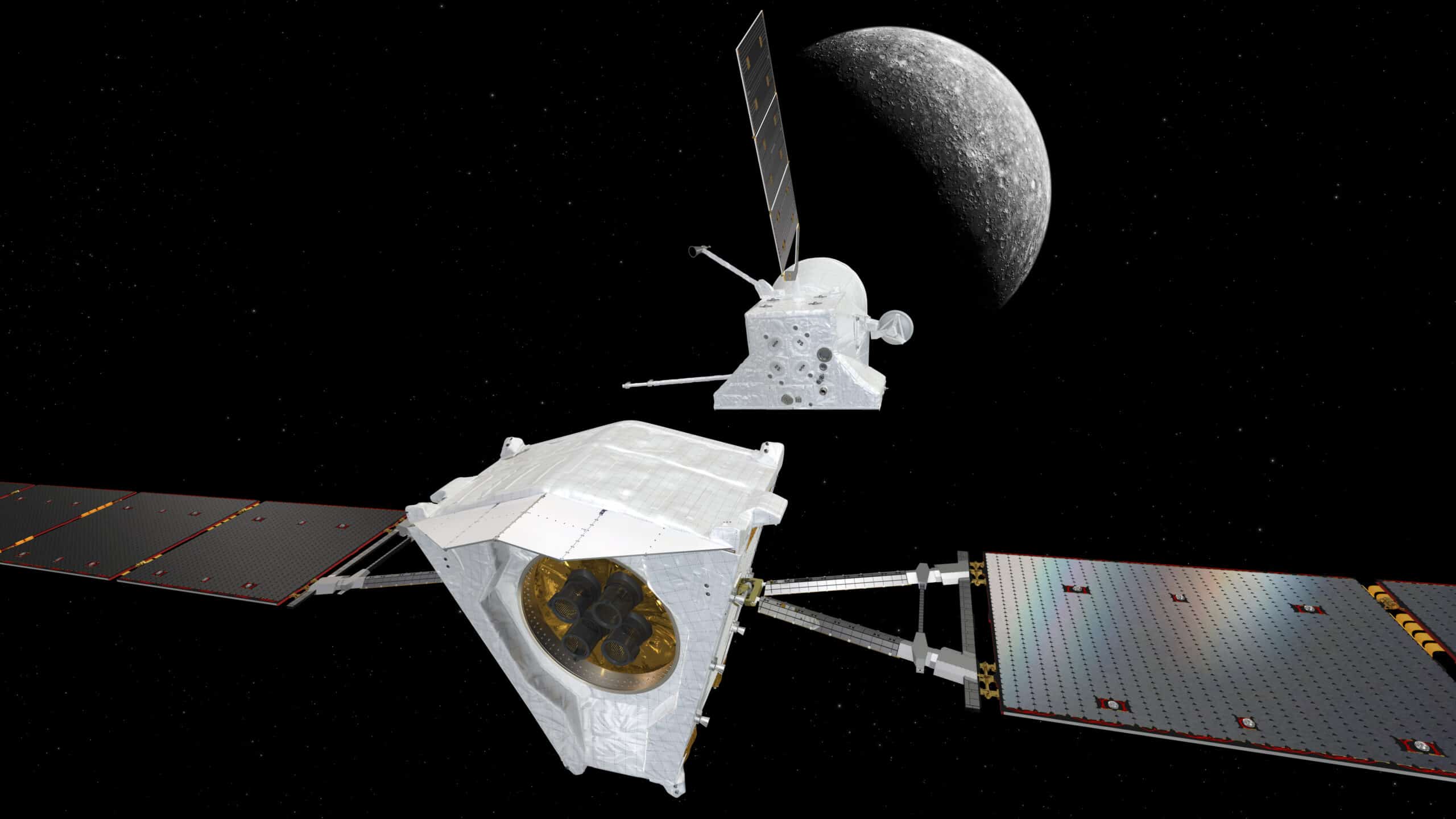
The company has developed a range of communications systems and scientific equipment for the European Space Agency (ESA) and Japan Aerospace Exploration Agency (JAXA) mission. BepiColombo is Europe’s first mission to Mercury, the smallest and least explored terrestrial planet in our Solar System.
After almost eight years travelling through the inner Solar System, BepiColombo is entering the final phase of its arrival at Mercury. The mission, led by the European Space Agency (ESA) in collaboration with the Japan Aerospace Exploration Agency (JAXA), is scheduled to begin its orbital insertion manoeuvre on 21 November.
This latest milestone follows the successful separation of the Mercury Transfer Module, which was responsible for providing propulsion and power to the spacecraft throughout its journey, on 3 September. The mission’s two scientific orbiters, ESA’s Mercury Planetary Orbiter (MPO) and JAXA’s Mio, will continue together until their separation, scheduled for 9 and 10 December. The scientific phase will begin in April 2027.
Sener has contributed to the mission through the development of several systems for communications and scientific data acquisition. These include the high-gain antenna pointing mechanism, which precisely orients the antenna to maintain communications with Earth while also serving as a precision instrument. It enables highly accurate measurements of Mercury’s orbit and the influence of the Sun’s gravity on it as part of a radio science experiment.
Sener’s contribution also includes the medium-gain antenna and its pointing mechanism, the magnetometer deployable boom, the low-gain antenna and the waveguides for the radio-frequency channels. The communications systems transmit telemetry, receive telecommands and send the data collected by the mission’s scientific instruments back to Earth.
The deployable boom, meanwhile, positions the magnetometers away from the magnetic interference generated by the spacecraft itself, an essential requirement for obtaining precise scientific measurements of Mercury’s environment. Mercury’s magnetic field remains one of the planet’s major unknowns, and measuring it accurately is one of the mission’s main objectives.
Developing this equipment required the use of materials, motors, sensors and components capable of operating across an exceptionally wide temperature range, from approximately −130 °C to +400 °C. The technologies employed included silver plating on titanium, together with motors and sensors designed to withstand extreme temperatures.
BepiColombo was launched in October 2018. Since then, it has travelled 9.9 billion kilometres and completed nine planetary flybys before beginning the final phase of its arrival at Mercury. It will be the first mission to place two spacecraft in orbit around the planet simultaneously: Europe’s MPO and Japan’s Mio orbiter.
BepiColombo’s arrival at Mercury demonstrates how the exceptionally high-precision systems developed by our professionals enable communications and scientific measurements under some of the most demanding operating conditions in our Solar System, following years of travel.
Iñaki Pinto, Director of Space and Science at Sener.
Senhy facilitates the deployment of green hydrogen across Europe

Sener Foundation, ICLI and TADEH join forces to improve access to water in rural and vulnerable communities

Sener advances qualification of the Rosalind Franklin rover landing gear ahead of its journey to Mars in 2028
Almirall autonomously optimises energy operations at its Sant Andreu de la Barca plant using a digital twin developed by Sener