






 About us

 More results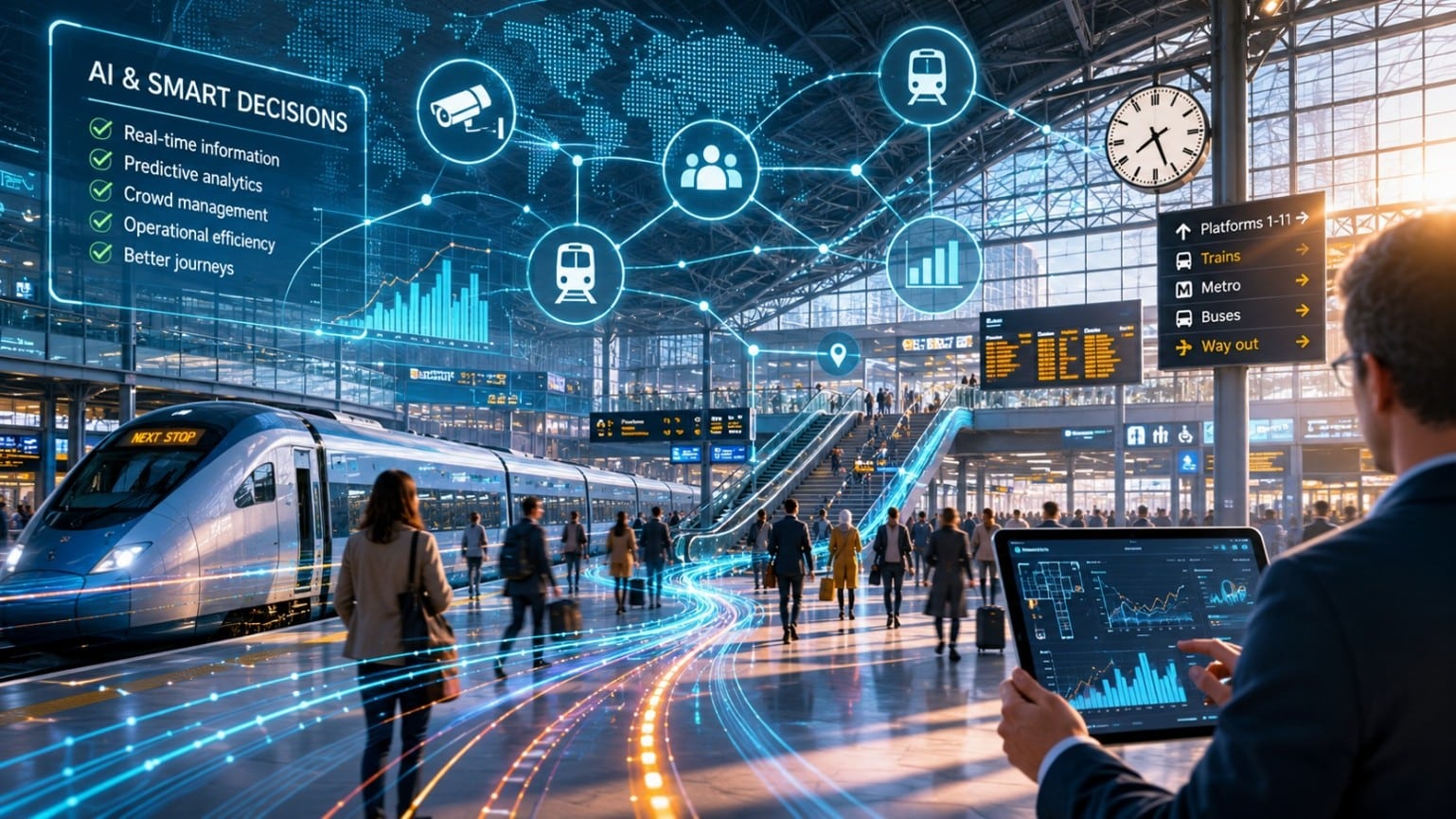
- Mobility & Infrastructures
Categories:
When did a railway station stop being simply a place to catch a train? It was probably a gradual transformation, driven by the growth of cities, digitalisation and the increasing integration of different modes of transport. Today, stations have evolved into extraordinarily complex systems, where thousands of decisions must be made every day to ensure safety, punctuality and efficiency.
Simply observing a major station for a few minutes is enough to understand this. Thousands of people coexist with trains, metros, buses, bicycles, retail services, maintenance teams, security systems and real-time information networks that must all operate in a coordinated manner. A minor disruption can trigger cascading effects, while a well-judged decision taken at the right moment can prevent passengers from even noticing that a problem existed.
Managing such a system requires understanding what is happening at every moment, anticipating how a situation may evolve and having the best possible information available to make fast, well-informed decisions. This is where artificial intelligence begins to deliver real value.
However, this article is not about replacing people with technology. It is about how engineering can help us understand and manage increasingly complex systems while keeping passengers and railway professionals at the centre of every decision.
Because artificial intelligence is not the goal. It is a tool for managing the complexity of stations more effectively and, ultimately, for making travel simpler for people.
More than just a building
Although we often associate a station with its platforms or architecture, a modern station is one of the most complex operational systems in the transport sector. Its complexity does not stem solely from passenger volumes or the number of trains passing through it, but from the enormous number of interactions taking place simultaneously. Passengers, railway operators, other transport modes, information systems, technical installations, security devices and commercial services must all function in a coordinated way to deliver a safe and seamless experience.
Moreover, it is a dynamic system. A delay, technical fault, unexpected increase in passengers or event taking place in the city can alter operations within minutes and generate impacts across the station and even the wider rail network.
Added to this are new requirements such as multimodality, accessibility, sustainability, cybersecurity and energy efficiency. The challenge is no longer simply ensuring trains depart on time; it is ensuring the entire system operates in a coordinated, passenger-centred manner.
The more complex a system becomes, the greater the value of tools capable of integrating information, identifying patterns and supporting decision-making. This is precisely the role that artificial intelligence can fulfil.
The passenger’s real enemy is uncertainty
Uncertainty will always be part of rail transport. Delays, technical incidents and adverse weather conditions will continue to occur. The real challenge is not eliminating them entirely, but managing them more effectively.
When we discuss service quality, we usually think of punctuality, safety or comfort. Yet experience shows that another factor is equally decisive: uncertainty.
A delay of a few minutes does not necessarily create a poor passenger experience. What truly causes frustration is not knowing what is happening or what to do next. Has the platform changed? Will I still make my connection? Is there an alternative route? Where can I get assistance?
Each of these questions represents a moment of uncertainty. And every moment of uncertainty increases stress and reduces passengers’ confidence in the system.
For years, the response was to provide ever more information. However, more information does not always mean better information. Large volumes of data, if not adapted to a person’s specific context, can be almost as unhelpful as having no information at all.
The objective should be to help passengers make better decisions. This is where artificial intelligence offers one of its greatest benefits. By analysing multiple sources of information alongside the operational context of each situation, it can transform vast quantities of data into useful, personalised and proactive information.
The goal is no longer merely to communicate a disruption, but to explain its consequences, propose alternatives and anticipate passengers’ needs.
Ultimately, managing uncertainty more effectively means improving the travel experience.
A new model for managing complex stations
The history of railway operations has, to a large extent, been the history of managing complexity. For decades, the response was fundamentally reactive: when an incident occurred, teams analysed the situation and determined the most appropriate course of action.
That approach will remain essential. However, the growing complexity of modern stations means that reacting is no longer enough. The more complex the system, the greater the value of anticipation.
This is perhaps the most important change introduced by artificial intelligence. It does not alter the objectives of operations, nor does it replace professional expertise. What it changes is the way complexity is managed: moving from a predominantly reactive approach towards one that is increasingly anticipatory.
Stations continuously generate information from cameras, sensors, ticketing systems, mobile applications and technical installations. The challenge is no longer collecting more data, but understanding what those data mean and how they relate to one another.
Through this understanding, it becomes possible to identify patterns, predict congestion, anticipate passenger flow behaviour and estimate the impact of specific incidents before they affect services.
It is important to emphasise that artificial intelligence does not make operational decisions. Its role is to support those who do. It acts as an advanced decision-support system, transforming data into insight and insight into recommendations that help evaluate alternatives and enable earlier action.
Experience, operational judgement and accountability remain entirely human responsibilities. For this reason, AI recommendations must be transparent, understandable and reliable if they are to be genuinely useful.
Decisions must also be communicated. It is not enough to act correctly; information must reach passengers clearly, at the right time and in a way that reflects their individual circumstances.
Finally, every complex system must learn. Every incident, decision and observed behaviour generates knowledge that can progressively improve future predictions and operational performance.
Observe, predict, decide, communicate and learn: together these form a new management model capable of addressing the growing complexity of railway stations more effectively.
Looking to the future
Stations will continue to evolve. Multimodality will expand, passengers will expect increasingly personalised experiences, the need to optimise energy consumption will grow, and operations will need to adapt to an ever more dynamic and interconnected environment.
The future of stations will not depend solely on incorporating more technology. It will depend on understanding how these complex systems function and equipping those who manage them with tools that enable faster, better-informed and more coordinated decisions.
Artificial intelligence will play an important role in this evolution because it can interpret large volumes of information in real time, identify relationships that are difficult to detect and anticipate situations before they become operational problems.
However, the real transformation will not be technological. It will be a change in the way stations are managed: moving from reacting to incidents towards anticipating them and understanding the behaviour of the system as a whole.
The best stations will not necessarily be those that deploy the most artificial intelligence, but those that are able to turn information into knowledge, knowledge into decisions, and decisions into better journeys.
Conclusion
Railway stations will become increasingly intermodal, digital and sustainable. As a consequence, they will also become more complex.
That complexity is not a problem; it is a natural result of transport systems that are becoming more connected and more capable of delivering better services. The challenge is to understand and manage that complexity more intelligently.
In this context, artificial intelligence represents an extraordinary opportunity. Not because it will replace people, but because it enables a deeper understanding of complex systems, allows organisations to anticipate incidents and improves the quality of decision-making. Examples such as VISUALFY, which enhances accessibility for people with hearing impairments, and RESPIRA®, developed by Sener to optimise metro station ventilation through artificial intelligence, demonstrate that this transformation is already under way.
However, the value of artificial intelligence should not be measured by its capacity for automation, but by the quality of the decisions it helps people make.
The best artificial intelligence will be the kind that passengers barely notice. Not because it is invisible, but because it has fulfilled its true purpose: helping operations run more effectively, reducing uncertainty and making travel simpler, more accessible and more reliable.
After all, passengers do not experience algorithms.
They experience journeys.
Author

Joaquín Botella
Joaquín is Chief Technical Engineer at Sener. He has experience in all types of railway projects in Spain and other countries such as Australia, Portugal, France, Ireland, Poland, Hungary, the United States, Chile, Mexico, the United Arab Emirates, Qatar, and Oman. He has decades of experience in the design, operation, maintenance, and functionality of all types of railway systems, and has given over 25 presentations and presentations at international conferences and exhibitions.

