






 About us

 More results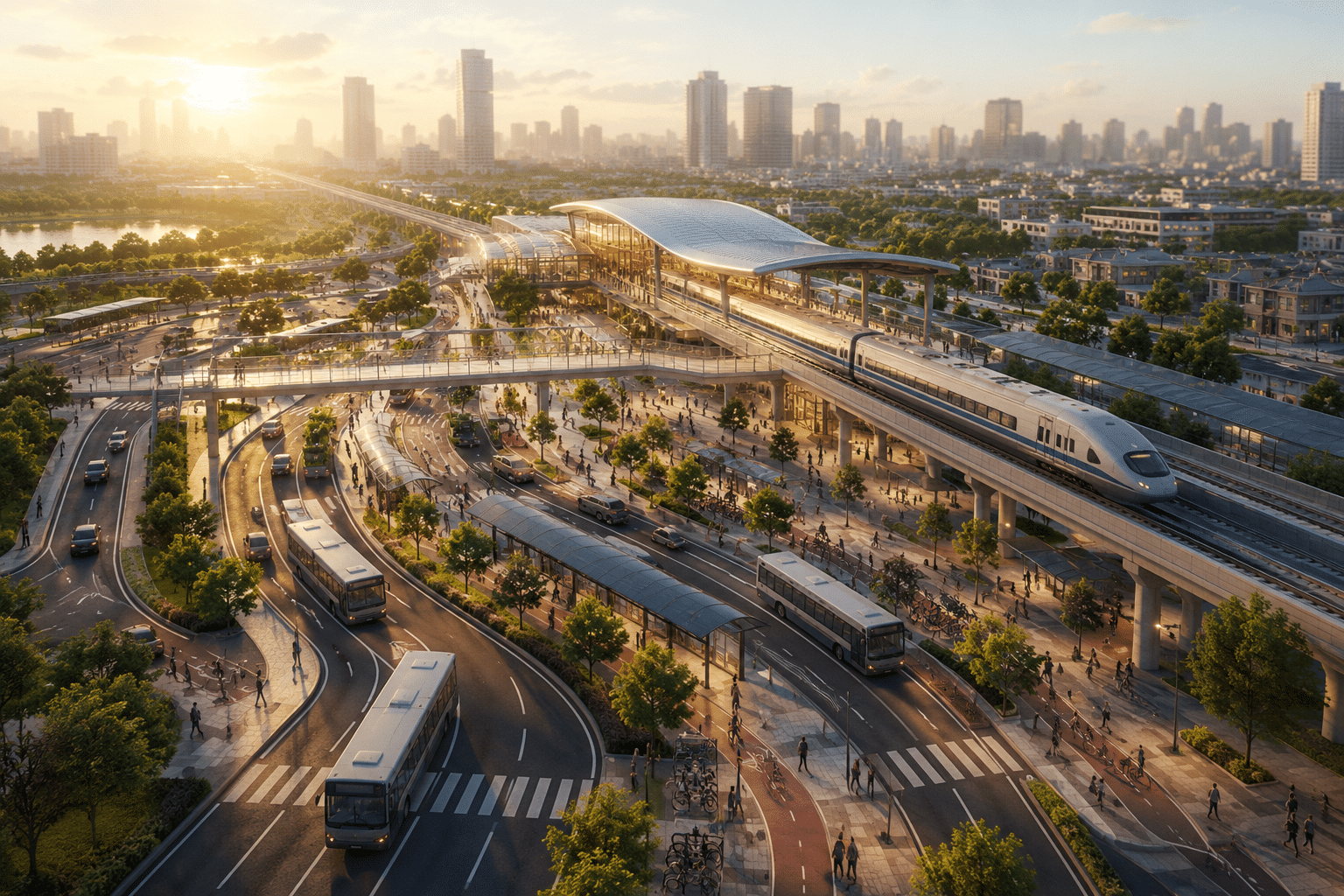
- Mobility & Infrastructures
Categories:
When we think of a train journey, we tend to picture a fairly simple sequence: arrive at the station, board the train and travel to our destination. However, the reality is very different.
A journey does not begin when the traveller walks through the station doors. Not even when they leave home. It begins much earlier, at the moment a need arises: to get to work, attend a meeting, visit a relative, catch a flight or enjoy a day out.
From that moment, even if unconsciously, each person starts to evaluate alternatives. Should I drive? Use public transport? Is the trip worth it? Which option will be the most comfortable, quickest or most reliable?
It is precisely at that point that the railway enters the competition. And this is an idea with profound implications for those of us who design infrastructure. Because if the journey starts before the station, railway infrastructure ought to do so as well.
When the best train is not enough
Railway engineering has achieved extraordinary advances over recent decades. We have built high-speed lines capable of exceeding 300 km/h. We have developed increasingly sophisticated signalling systems. We have reduced journey times that seemed impossible only a few decades ago.
However, there is a paradox that any transport professional has observed at some point: technically excellent systems that fail to reach the expected levels of demand. Why does this happen?
Because users do not assess only the rail leg. They assess the entire journey. Consider an everyday trip. A traveller must get to the station, access the platform, wait for the train, make the journey, leave the destination station and complete the final leg to where they actually need to be.
When we analyse the whole chain, an uncomfortable reality emerges: much of the travel time occurs outside the train. That is why, for the user, the railway competes not only on speed. It competes on accessibility, simplicity, reliability and ease of use.
The railway as part of a system
Traditionally, many railway projects have been conceived as large exercises in linear engineering. A route is defined, stations are designed, systems are selected and the operation is then adapted to the resulting infrastructure.
However, contemporary mobility demands a different perspective. We increasingly understand that a railway does not operate in isolation. It forms part of a broader ecosystem involving buses, metro, shared mobility services, pedestrian routes, parking, fare policies and travel habits.
From this perspective, a railway line ceases to be a simple transport corridor and becomes an element within a much more complex network. And, as with any complex system, overall performance is rarely determined by the strongest element. It is usually constrained by the weakest.
A high-performance line can lose much of its appeal if access to stations is difficult. Likewise, a perfectly designed station may deliver limited results if connections with other modes are poor. The system works as a whole.
Demand before infrastructure
For a long time, the standard planning process consisted of designing the infrastructure first and then analysing how to operate it. Increasingly, projects are reversing this logic.
The initial question is no longer only which infrastructure we want to build, but which mobility we want to provide. What journeys do we want to enable? What demand actually exists? What level of service will be required in ten, twenty or thirty years?
Once these questions are answered, it becomes much easier to define frequencies, journey times, stopping patterns and, ultimately, the infrastructure needed to support them.
This approach forces a shift in perspective. Infrastructure ceases to be the starting point and becomes the consequence of mobility needs.
Small decisions, big consequences
There is a natural tendency to associate railway progress with major projects: new lines, large stations, tunnels tens of kilometres long, multi‑billion‑pound investments.
Yet many of the decisions that most influence system performance are surprisingly discreet. The geometry of a station. The location of a crossover. Platform height. The arrangement of access points. The time required to make a transfer. The position of a set of points or a permanent speed restriction.
These are seemingly small decisions that are repeated thousands of times every day for decades. For this reason, an essential part of railway engineering is identifying those interventions capable of generating long-term cumulative benefits.
Sometimes, improving a system does not require major works. It requires precision. Some professionals refer to this as “railway microsurgery”: small interventions in infrastructure, operation or service that produce disproportionately large improvements in capacity, reliability or user experience.
The reality of existing systems
Although major projects tend to capture public attention, most railway interventions take place on existing networks. And that completely changes the rules of the game.
Engineers must work with historic alignments, stations built decades ago, urban constraints, budget limitations and systems that continue to operate while improvements are delivered. In these environments, success does not depend solely on building more infrastructure. It depends on understanding which elements can be modified and which must be accepted as constraints.
The ability to optimise existing systems is, in many cases, just as important as the ability to design new ones.
When a station transforms an entire project
Sometimes a single decision can transform an entire network. A particularly interesting example can be found in South Korea. The creation of Suseo Station in the Seoul metropolitan area was not simply an architectural or urban planning decision. Its implementation drove the development of a new high-speed connection and the construction of a tunnel of approximately 51 kilometres.
What matters is not the scale of the work, but the reason behind it. The infrastructure was developed to bring the network closer to where demand actually was. It is an excellent example of how a decision related to accessibility and connectivity can ultimately drive investments on a vast scale. Because stations are not just places where trains stop: they are the interface between the railway system and the city.
Designing for relevance
Perhaps the most important lesson is that infrastructure is not an end in itself. Its value does not lie in the amount of concrete used, the length of the tunnels or the maximum speed achieved by trains. Its value lies in its ability to connect people, activities and opportunities.
For decades, we have measured railway success in kilometres built, installed capacity or maximum speeds. All of these remain important metrics. But for the user, there is a much simpler measure: does the system help them get where they need to go?
Ultimately, that is the question that should guide any railway project. Because the true objective has never been to build railways. The objective is to make them relevant.
- Railways
Tags:
Author

Joaquín Botella
Joaquín is Chief Technical Engineer at Sener. He has experience in all types of railway projects in Spain and other countries such as Australia, Portugal, France, Ireland, Poland, Hungary, the United States, Chile, Mexico, the United Arab Emirates, Qatar, and Oman. He has decades of experience in the design, operation, maintenance, and functionality of all types of railway systems, and has given over 25 presentations and presentations at international conferences and exhibitions.

