




 About us
 / section
Careers
Careers / section
News & events
News & events / sectionCountries section
About us
About us / section
Careers
Careers / section
News & events
News & events / sectionCountries section
About us
About us / section
Careers
Careers / section
News & events
News & events / sectionCountries section
About us
About us / section
Careers
Careers / section
News & events
News & events / sectionCountries section


 More results
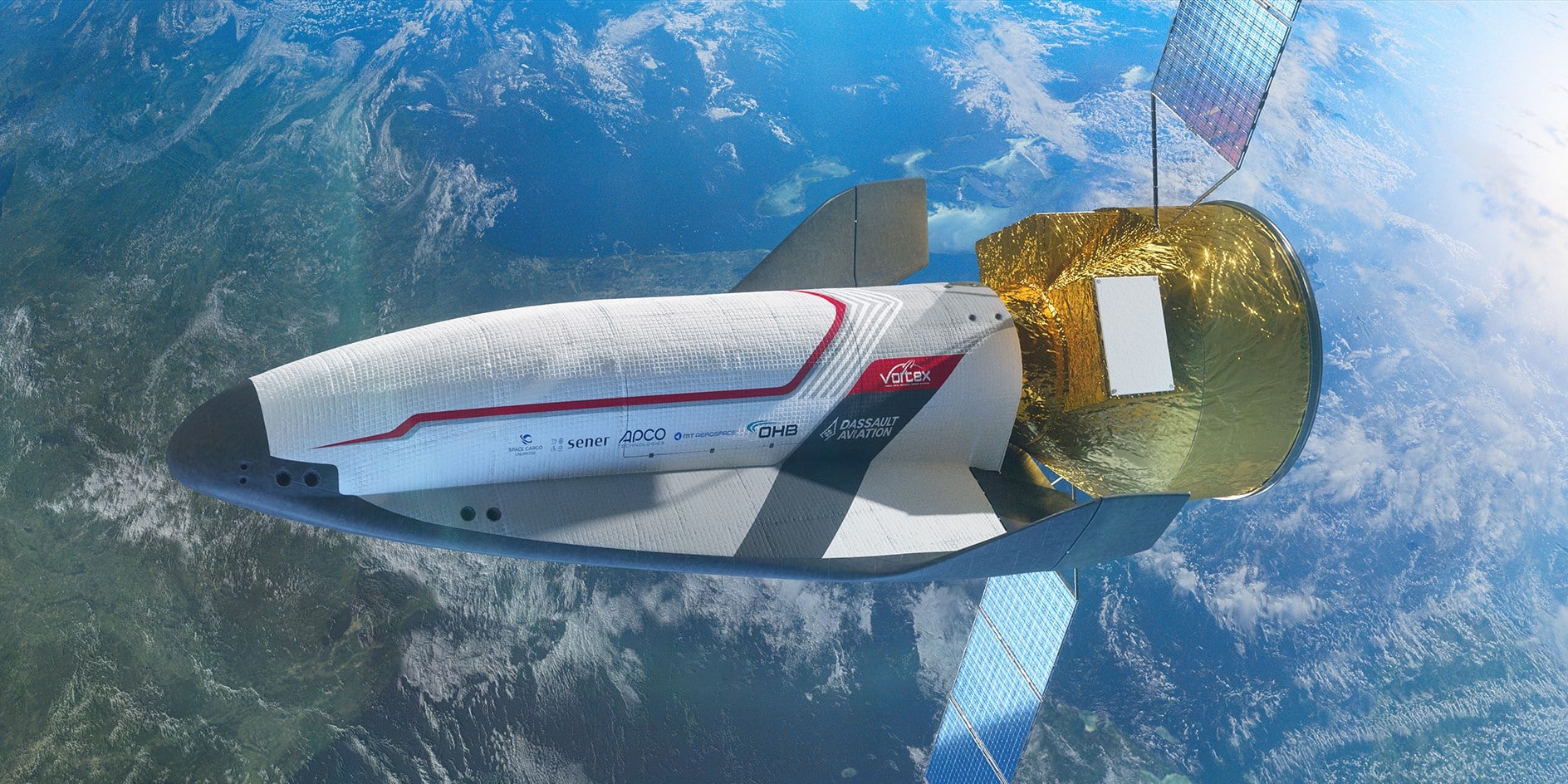
Sener will deliver VORTEX-S’s proximity guidance, navigation and control (GNC) and docking system, a critical technology enabling the vehicle to safely approach and dock with other orbital infrastructure. The spaceplane was unveiled at the 2026 ILA Berlin Air Show as part of a European initiative to advance next-generation space mobility capabilities, under the leadership of Dassault Aviation.
Sener, the engineering and technology industrial group, has joined the team of companies developing the European VORTEX-S, a reusable, multipurpose spaceplane conceived to operate in low Earth orbit and carry out round-trip transport missions to space stations, as well as autonomous operations in space.
The project was unveiled at ILA Berlin 2026, where a scale model of VORTEX-S was presented. It forms part of the VORTEX roadmap, announced by Dassault Aviation at the 2025 Paris Air Show, which aimes at developing a family of reusable spaceplanes. Designed to operate in low Earth orbit and return via a conventional runway landing, VORTEX-S is intended to advance new European space mobility capabilities, including payload transportation, support for orbital stations, autonomous missions, in-orbit servicing and maintenance, and space object recovery operations.
Sener is providing VORTEX-S’s proximity guidance, navigation and control (GNC) and docking system, two mission-critical capabilities for this type of space mission. Proximity GNC enables rendezvous – the controlled approach of one spacecraft to another in orbit – while docking is the phase in which the two vehicles establish a physical connection. Together, these systems allow a spacecraft to safely and accurately approach another vehicle, module or orbital infrastructure and form a secure connection to support activities such as cargo transfer, servicing and other mission operations.
Established expertise in critical space technologies
Sener’s role in VORTEX-S builds on its extensive expertise in GNC technologies, which enable spacecraft to determine their position and trajectory, calculate manoeuvres and execute them safely in highly demanding operating environments. For example, on the Euclid mission, Sener served as the prime contractor for the spacecraft’s Attitude and Orbit Control System (AOCS/GNC), responsible for delivering the exceptional stability required for the telescope to carry out its scientific observations.
Sener also has extensive experience in spacecraft docking systems through the International Berthing and Docking Mechanism (IBDM), a European low-impact, androgynous berthing and docking system designed to enable docking between both small and large spacecraft. As part of this programme, Sener contributed to the development of the mechanism’s structural docking system, which is responsible for creating a rigid, pressurised connection between two spacecraft.
VORTEX-S marks an important step forward in the development of new European capabilities for autonomous, flexible and reusable operations in orbit. For Sener, participating in this programme allows us to bring our expertise in GNC systems and docking technologies to a project that is paving the way for the space operations that will become increasingly important in the years ahead.
Diego Rodríguez, Director of Space and Science at Sener
José Antonio García Cantera, new independent board member on the Board of Directors of Sener Group

Sener Foundation promotes social innovation in the 3rd edition of the SocialTech Challenge.
The Sener group reports revenue growth to €933 million in 2025, driven by strong performance across all business areas
Sener begins flight trials of Razor under the SIROCO programme