






 About us

 More results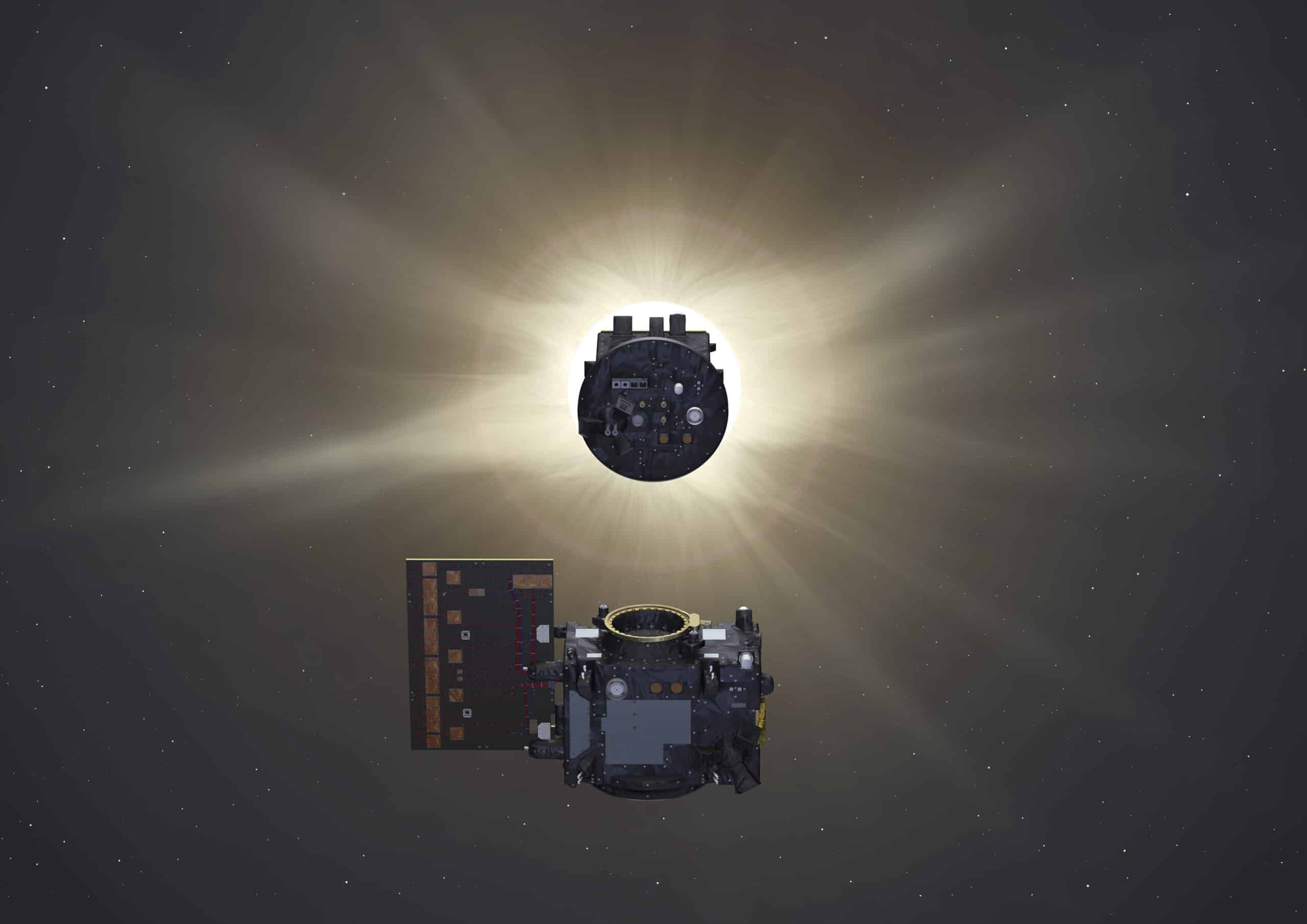
- Aerospace
Categories:
The cosmos has fascinated humanity since its earliest days. For modern engineering, however, space is not merely a source of wonder, but the ultimate frontier of technological development. The forthcoming total solar eclipse on 12 August 2026 represents an unprecedented astronomical milestone in Spain’s recent history. Beyond the sheer spectacle of such an event, it is a crucial scientific and technological catalyst for the aerospace industry, where Spanish engineering plays a leading international role.
At Sener, true to our purpose of transforming the world by challenging the limits of technology, we examine why this 2026 total solar eclipse is an exceptional scientific opportunity. We also reflect on how such eclipses are simply the natural equivalent of what is being achieved artificially through the European Space Agency’s (ESA) Proba-3 mission, in which Sener has played a pivotal role as prime contractor. It offers a new opportunity, this time from Earth, to continue studying the behaviour of the solar corona from a different perspective.
Why is the solar eclipse of 12 August 2026 so significant?
Total solar eclipses visible from the same region are extremely rare phenomena. The last total eclipse seen in Spain occurred in 1905, and after the 12 August solar eclipse, another event of this category will not be visible from Spanish territory until 2053 (although there will be one visible in southern Spain in 2027, and an annular eclipse in 2028).
What makes total solar eclipses on Earth so remarkable is a perfect, albeit fleeting, geometric coincidence:
- The 400-to-1 coincidence: The Sun is approximately 400 times larger than the Moon, but it is also around 400 times farther away from Earth than our natural satellite. However, this alone is not sufficient.
- Alignment at perigee: For a solar eclipse to be total, not only must the Sun, Earth and Moon be aligned, but the Moon must also be at perigee, its closest orbital point to Earth.
At this moment, its apparent size becomes almost identical to that of the solar disc, completely and almost perfectly blocking the photosphere, the Sun’s bright visible surface, for a matter of minutes.
This precise and unique relationship within our Solar System not only allows us to obscure this intense source of light, but also opens a cosmic window onto the solar corona, the Sun’s outer atmosphere where the solar wind and solar storms originate. Understanding the corona’s dynamics is critical for the space sector, as these storms of charged particles can severely damage the electronic systems and components aboard telecommunications satellites, potentially disrupting critical infrastructure on Earth.
Proba-3: artificial solar eclipses on demand in space
While total solar eclipses such as the one occurring this summer provide valuable minutes of darkness for studying the solar corona from Earth, science cannot rely solely on the rarity and brevity of these natural events. To overcome this limitation, ESA conceived the Proba-3 mission, a breakthrough in scientific knowledge acquisition in which Spain’s technology sector has played a leading role.
Proba-3 aims to overcome the limitations of natural eclipses by creating artificial solar eclipses in orbit on an almost continuous basis.
The challenge of virtual rigid structures and formation flying
The technical foundation of Proba-3 lies in two satellites flying in a coordinated elliptical orbit, behaving as though they were physically connected and forming a virtual rigid structure.
- Millimetre-precision formation flying: The satellites maintain an ultra-precise separation of approximately 150 metres.
- A colossal coronagraph: One satellite acts as an occulting disc, blocking the solar photosphere, while the second spacecraft captures images using its coronagraph camera. Together, they create a large virtual scientific instrument.
By positioning the occulting disc 150 metres away from the camera, Proba-3 dramatically reduces the effects of light diffraction. The advantages do not stop there. By controlling the distance between the satellites, engineers can precisely adjust the portion of the Sun being obscured, making it possible to observe the innermost regions of the solar corona, something unattainable with a conventional coronagraph.
In addition, by operating in space, the mission avoids atmospheric distortion, enabling the capture of solar corona images with unprecedented clarity and resolution.
The success of this technology is undeniable. Whereas observers on Earth must wait decades and travel extensively to witness a natural eclipse, the Proba-3 mission accumulated approximately 250 hours of solar corona observations during its first year, equivalent to around 5,000 natural eclipses, generating roughly six hours of high-quality scientific imagery per orbit. This represents a genuine paradigm shift in solar corona research.
Sener’s contribution to Spanish leadership in space
At Sener, the development of Proba-3 demonstrates the maturity of our expertise in high-precision engineering and complex space systems. We are developing cutting-edge technology that not only provides vital scientific information today, but also lays the foundations for the space telescopes of the future.
These future systems will no longer depend on the large and heavy rigid support structures required today. Instead, they will rely entirely on formation-flying technologies and virtual structures, enabling previously unimaginable missions.
Our role as prime contractor for the mission, coordinating a consortium of more than 29 companies across 17 countries, demonstrates that Spain’s aerospace industry is a world-class reference point, capable of designing and operating complex missions that push the known limits of physics.
Towards a new technological frontier
The 2026 total solar eclipse reminds us of the vastness of the cosmos and of the importance of the star that sustains life on Earth. Yet the true revolution lies in our ability to recreate this phenomenon artificially, expanding the boundaries of human knowledge while helping us anticipate and mitigate the risks posed by solar activity.
For those fortunate enough to witness this spectacular event on 12 August 2026, safety remains essential: certified eclipse glasses must always be used to avoid eye damage. While we watch the Sun disappear naturally behind the Moon, Sener’s teams will continue working in orbit to ensure that eclipses never end, helping to drive scientific discovery forward.
- Space

