





 About us

 More results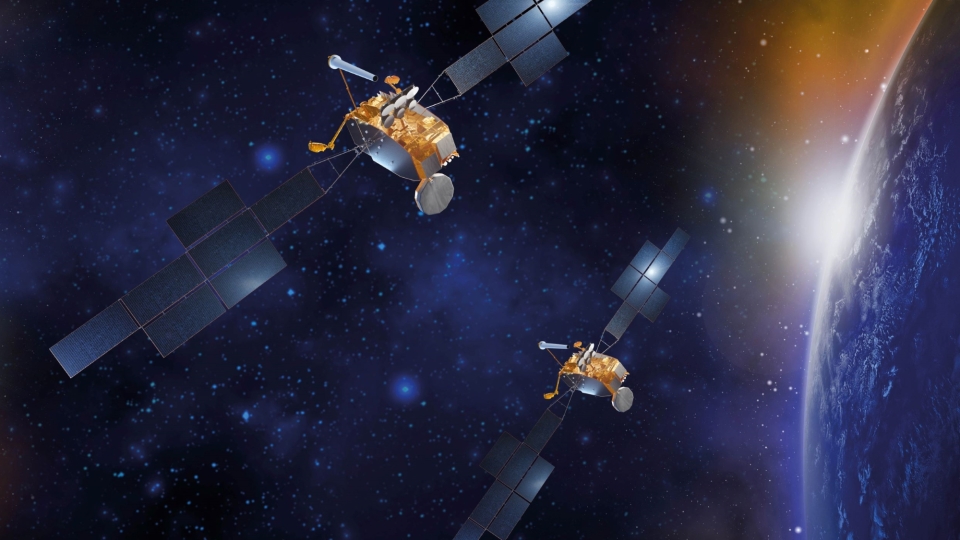
- Data Centers
Categories:
The growing momentum of artificial intelligence and the demand for advanced data processing are creating new challenges for digital infrastructure. Faced with the limits of energy and physical space on Earth, major technology players such as SpaceX and Amazon, led by Elon Musk and Jeff Bezos, are exploring innovative alternatives such as Space-Based Data Centers (SBDC), which could provide more sustainable and ubiquitous computing solutions.
What is the current reality of Space-Based Data Centers (SBDC)?
In recent years, major technology companies and aerospace start-ups have launched programmes aimed at developing orbital data centres (Space-Based Data Centers, SBDC). These initiatives are based on two key pillars: the availability of continuous solar energy in orbit and the deployment of low-latency Low Earth Orbit (LEO) connectivity constellations as communications infrastructure.
Companies such as SpaceX, Amazon and OneWeb are consolidating global satellite networks capable of offering latencies in the order of 20–40 milliseconds, enabling hybrid Earth-space architectures. In parallel, cloud providers such as Google and Microsoft are exploring models where part of the processing is brought closer to the source of the data, either through experimental orbital clusters or terrestrial data centres connected by satellite links.
Alongside the major players, specialised start-ups such as Axiom Space, Starcloud, Aetherflux and Lonestar Data Holdings have emerged. These companies have already demonstrated capabilities for processing, storing and training AI models in orbit, or even on the lunar surface. These tests confirm that the concept is technically feasible, at least on a small scale.
At the institutional level, the European Union has formally assessed the viability of space-based data centres, concluding that they could be technically and environmentally competitive in the long term, with a deployment horizon beyond 2035.
What challenges does the construction of orbital data centres face?
From an engineering perspective, SBDCs present challenges that are radically different from those of conventional data centres:
Energy: Solar generation in orbit offers capacity factors far higher than those on Earth, particularly in sun-synchronous orbits. However, the available power is limited by launchable mass, which constrains computing density. For example, each Aetherflux satellite will carry around 10 interconnected GPUs together with a 93 m² solar panel (roughly the size of eight parking spaces).
- Thermal management: In the absence of convection, heat dissipation depends exclusively on thermal radiation, requiring large, lightweight and deployable radiators. In the Aetherflux example mentioned above, a 46 m² radiator is required to dissipate heat. This is currently the main bottleneck when it comes to scaling computing power.
- Radiation and reliability: Electronics must be fault-tolerant and radiation-resistant, incorporating redundancy and error-correction systems, which penalise both performance and cost.
- Communications: Inter-satellite optical networks and Earth-to-space laser links enable distributed architectures with competitive latencies and high levels of security, although they require specialised ground stations.
- Software architecture: Orchestrating resources on mobile orbital platforms requires new approaches to distributed computing, interruption tolerance and advanced load management.
Overall, the technology has moved beyond the conceptual phase, but scalability remains limited by energy availability, thermal dissipation and orbital logistics.
Economic viability and launch market costs for SBDCs
The main economic constraint is launch cost, which still amounts to thousands of dollars per kilogram in Low Earth Orbit. The business model reverses the traditional logic: high initial CAPEX versus almost zero energy OPEX during the system’s operational lifetime.
Large-scale viability depends critically on the arrival of fully reusable launch vehicles capable of reducing costs below approximately 300 USD/kg. Today, launch costs remain around 2,500 USD/kg.
Despite this, the potential market is significant. Analysts estimate that off-planet processing and storage services could reach tens of billions of dollars in the next decade, driven by use cases such as:
- In-orbit processing of Earth-observation data
- Intensive training of AI models
- Ultra-secure storage for governments and critical sectors
- Provision of cloud services in regions without terrestrial infrastructure
In the initial phase, these centres will not compete directly with traditional data centres but will instead cover niches where their value proposition is unique.
Conclusions: orbital data centres as complementary infrastructure
Space-based data centres are not science fiction, but neither are they an immediate solution to the exponential growth in digital demand. Technically viable and strategically attractive, their mass deployment will depend on key advances in launch systems, thermal management and space-grade electronics.
In the short term, SBDCs will act as complementary infrastructure for high value-added applications. In the medium and long term, they could become a new pillar of the digital and space economy, redefining the very concept of cloud infrastructure.
However, perhaps the most important conclusion of this analysis is that if anyone can carry out such an endeavour from a technical standpoint, it is Sener, with its Aerospace, Energy and Data Center divisions working in coordination. Frankly, this is no small statement, but such an effort would truly honour our purpose: transforming the world by challenging the limits of technology.
- data centers
Tags:

Ricardo Abad
CEO de Quark
Ricardo, over his 30 years of experience, has worked as an executive in engineering consulting firms, construction companies, installation companies, and critical equipment manufacturers, always with his primary focus on the data center sector. Certified as an ATD (Accredited Tier Designer) by the Uptime Institute and a Data Center Design Specialist by DC Pro, he is a member of the Board of Directors of SpainDC (Spanish Data Center Association).

