





 About us
 / section
Careers
Careers / section
News & events
News & events / sectionCountries section
About us
About us / section
Careers
Careers / section
News & events
News & events / sectionCountries section
About us
About us / section
Careers
Careers / section
News & events
News & events / sectionCountries section
About us
About us / section
Careers
Careers / section
News & events
News & events / sectionCountries section


 More results
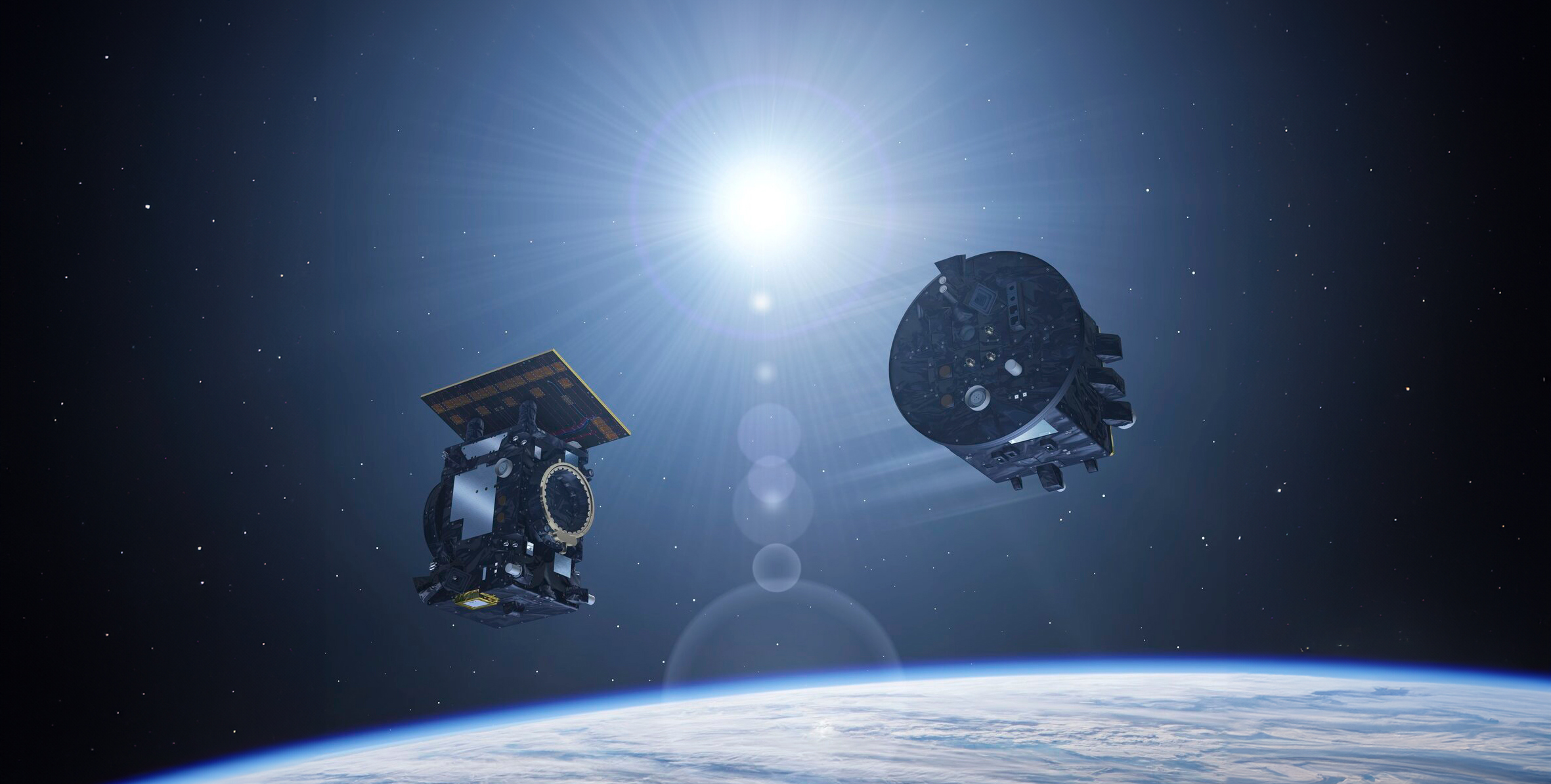
Proba-3 is the first ESA space mission to use precise formation flying technology. It demonstrates the maturity of this technology and, at the same time, uses it to perform scientific observations of the solar corona under conditions never achieved before.
Proba-3 is an ESA space mission that uses precise formation flying technology for the first time. Its objective is to demonstrate the maturity of this technology and, at the same time, use it to perform scientific observations of the solar corona under conditions never achieved before. Precise formation flying technology enables the two Proba-3 satellites to be positioned with millimetre-level relative accuracy and a pointing precision of thousandths of a degree.
The mission commissioning phase was completed in July 2025, at which point ESA declared the mission objectives achieved.
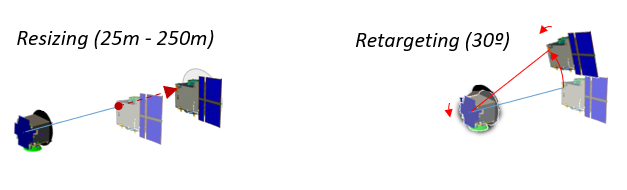
Formation flying demonstrates the capabilities of this technology for use in scientific missions through the execution of specific in-orbit manoeuvres, such as controlled approach and separation between satellites, or reorientation of the formation as a virtual rigid body.
These operations include:
The success of Proba-3 demonstrates that small, independent, and easy-to-launch platforms can replace bulky structures, such as telescopes, and operate as a single entity achieving high performance.
In 2025, several approach operations were carried out, including one at a distance of 30 m in November 2025.
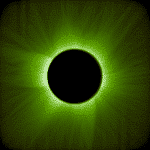
Coronagraph Satellite observed from the cameras of the Occulter Satellite during an operational orbit. ©ESA
Proba-3 also performs scientific observations by capturing images of the solar corona through a coronagraph instrument located on one of the spacecraft. Formation flying technology involves placing one of the two Proba-3 satellites in front of the instrument’s lens, thereby blocking the solar disk and creating an artificial eclipse in flight.
Achieving this in space, at a distance of 150 m and with observation periods of up to 6 continuous hours per orbit, delivers unprecedented performance in coronagraphy. As a result, the Proba-3 mission provides highly valuable results to the scientific community.
In 2025, Proba-3 accumulated data equivalent to 4,000 solar eclipses. These data, together with measurements from other solar observation satellites such as Proba-2 and SOHO, enable a better understanding of how coronal mass ejections (CMEs) are generated and propagated from the centre of the Sun to the outer corona.
Another distinctive feature of this mission is that most operations are carried out fully autonomously, without ground intervention to actively control the formation, while always being monitored by a ground team. The Proba-3 satellites coordinate their operations based on a predefined timeline specifying their activities.
They are also capable of making autonomous decisions in case of anomalies, breaking the formation and placing the satellites into a safe configuration until the issues can be further investigated from the ground.
The Proba-3 space segment consists of two satellites. The first, called the Coronagraph Spacecraft (CSC), carries the main instrument (coronagraph). The second, called the Occulter Spacecraft (OSC), carries an occulting disk that blocks the solar disk as seen from the other satellite.
The OSC, as the leading element of the formation flying system, also integrates the main metrology units used for formation flying, including a laser system and a set of cameras forming part of a vision-based system.
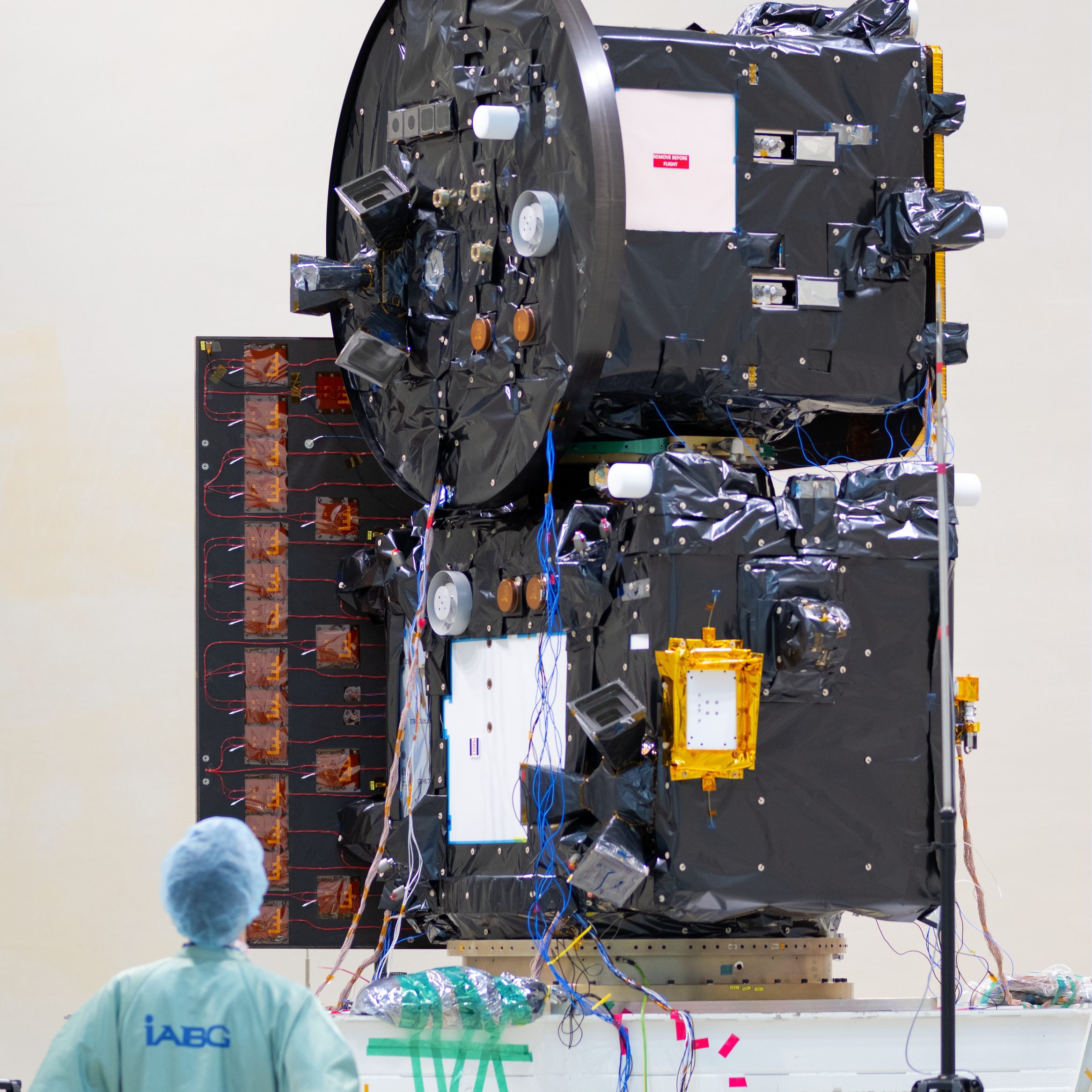
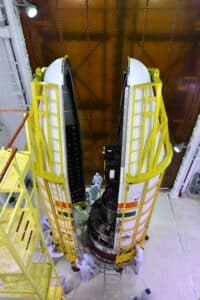
The two satellites are launched in a stacked configuration, with the OSC mounted on top of the CSC and the CSC’s solar array folded.
Orbit | High Elliptical Orbit (HEO) |
Launcher | PSLV-XL (ISRO) |
Ground segment | Antennas of INTA (Spain) and SSC (Chile, Australia) |
Lifetime | 2 years |
Satellites | Laser-based system (FLLS) |
Payloads & Experiments | ASPIICS (Coronagraph) |
Operations | Autonomous operations of up to 7 days |
The Sener technology group has led, as Prime Contractor, the development of the Proba-3 mission system, including both the space and ground segments, in close collaboration with an industrial team comprising Airbus Defence and Space (Spain), GMV, Redwire, and Spacebel, within a broader consortium of more than 29 companies from 17 countries.
Sener also led the industrial team responsible for satellite operations during the in-orbit commissioning phase, completed in July 2025. Since then, the satellites have been operated under ESA responsibility.
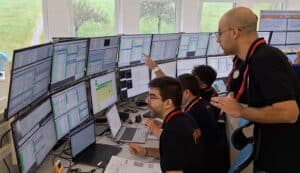
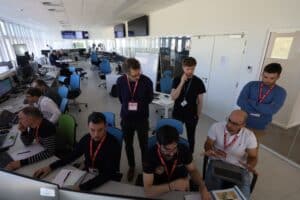
Proba-3 is part of ESA’s General Support Technology Programme (GSTP), and Spain’s participation has been made possible through the support of CDTI (Centre for the Development of Technology and Innovation).
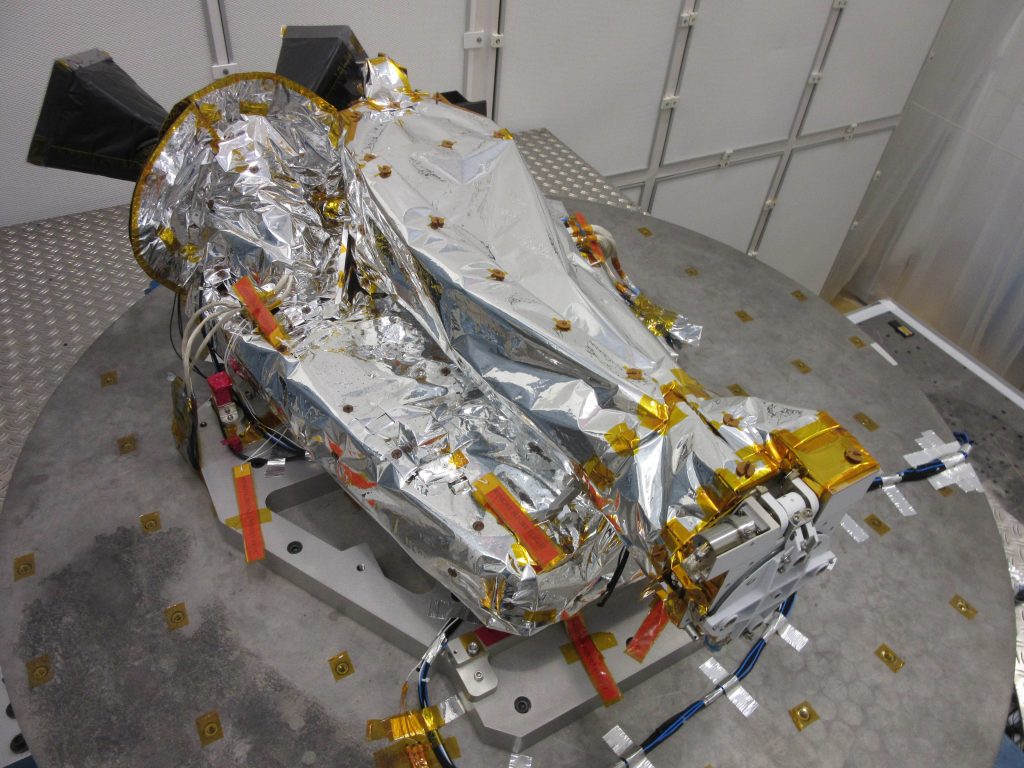
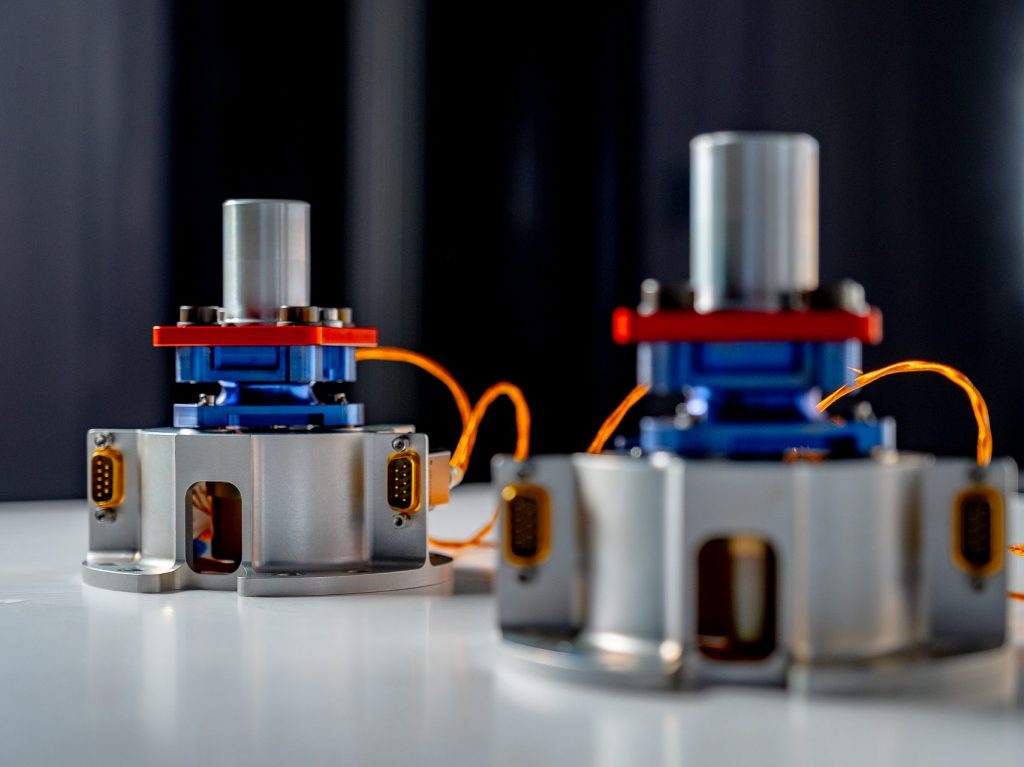
Sener has also been responsible for the design, manufacturing, and testing of several satellite units:
The two Proba-3 spacecraft were launched together by the PSLV-XL launcher of the Indian Space Research Organisation (ISRO), which provides the required performance at a reasonable cost to place the combined 550-kilogram pair into their highly elliptical orbit. This orbit involves reaching an altitude of 60,000 kilometres from Earth before descending to just 600 kilometres.
Sener, as Prime Contractor, developed the satellite platforms and the formation flying system for this pioneering space mission.
ESA’s Proba-3 space mission was launched on 5 December 2024.
The Proba-3 mission represents a major milestone in space exploration thanks to its innovative formation flying approach and its miniaturised satellites.
This technology enables the creation of a modular system in orbit capable of operating with the precision of a single structure, thanks to its millimetre-level accuracy. In this way, formation flying makes it possible to build complex structures, such as telescopes, which would otherwise be very costly to launch into space due to the large dimensions required during operation.
This technology opens new frontiers in astronomy, geodesy, and Earth observation. In particular, Proba-3’s ability to generate its own solar eclipses allows for very long-duration observations of the solar corona, achieving unprecedented precision.