




 About us
 / section
Careers
Careers / section
News & events
News & events / sectionCountries section
About us
About us / section
Careers
Careers / section
News & events
News & events / sectionCountries section
About us
About us / section
Careers
Careers / section
News & events
News & events / sectionCountries section
About us
About us / section
Careers
Careers / section
News & events
News & events / sectionCountries section


 More results
The DEMELEK project researches new prospective models and advanced tools to predict future electricity demand, optimise grid capacity management and integrate flexibility mechanisms in high‑consumption sectors. The consortium, led by i‑DE Redes Eléctricas Inteligentes, includes the participation of Ayesa Ibermática, Sener, Ariadna, Veltium Smart Chargers, Iberdrola Clientes, Saltoki, Vidrala, Fundiciones Fumbarri and Ebielec, with the support of the Basque Government through the Hazitek programme.
Electricity grids: a key element in the decarbonisation of the economy
The electrification process is advancing rapidly in key sectors such as industry and transport, driven by European decarbonisation targets. The deployment of new infrastructure, including data processing centres and electric mobility charging systems, together with the incorporation of electrical technologies into production processes, points to a very significant increase in electricity demand over the coming decade.
In this context, the updated draft of Spain’s National Integrated Energy and Climate Plan (PNIEC), published in June 2023, reinforces the country’s commitments to emissions reduction and the energy transition. Among the objectives set out in this document, a key target is to increase the electrification of the economy to 34% by 2030, consolidating it as one of the main drivers of decarbonisation and energy independence.
The Basque Government has also taken decisive steps with the approval of the Basque Country Energy Transition and Climate Change Act, which seeks to leverage the opportunities of the transition process to strengthen industrial competitiveness. The law establishes technological innovation and decarbonisation as strategic pillars for transforming the productive model.
However, this energy transformation entails structural challenges. The Basque electricity grid is operating at the limit of its capacity and requires urgent reinforcement to meet the new needs arising from the electrification of industry and mobility. This situation is highlighted in the Basque Government’s proposal to Red Eléctrica for strengthening the transmission grid in the Basque Country, which underlines the loss of competitiveness that would result from failing to make the necessary investments, putting up to 75,000 jobs at risk.
DEMELEK: a collaborative industrial research project
Against this backdrop, the DEMELEK project, “Solutions based on prospective models and new flexibility services for demand electrification”, aims to anticipate the growth of electrification through the development of georeferenced prospective models that enable accurate estimation of the evolution of electricity demand in key sectors for the Basque Country. Based on these models, grid scenarios will be generated that take into account different levels of electrification and their likelihood of occurrence, thus providing a detailed and dynamic view of the future electricity system. To this end, work will focus on modelling and quantifying the uncertainties associated with demand and infrastructure planning, integrating them into advanced decision‑support tools that optimise the management of available grid capacity by operators.
In parallel, DEMELEK will address the development of new flexibility strategies, from both the grid operation and demand perspectives. The project will incorporate flexibility into capacity management optimisation processes, analysing how consumption in different sectors — with particular emphasis on industry, electric mobility and data processing centres — can adapt to the conditions of the electricity system. In addition, new technological capabilities will be promoted to increase demand flexibility, enabling smarter interaction between consumers and system operators.
Ultimately, the DEMELEK project will enable electricity grid operation to adapt and respond efficiently to connection needs arising from the evolution of electrification demand, thereby mitigating its potential impact on grid saturation and strengthening resilience in the face of the challenges of the energy transition.
The project is coordinated by i‑DE Redes Eléctricas Inteligentes, which is responsible for developing the georeferenced model that will enable the generation of future demand scenarios for the target economic sectors. Ayesa Ibermática will develop the optimisation model for deploying flexibility according to grid constraints. Sener will be responsible for characterising the behaviour of electrification technologies and designing new flexibility models that highlight their value in industrial processes, with the support of Fundiciones Fumbarri and Vidrala as end industrial users. Veltium Smart Chargers, together with Iberdrola Clientes, will address the design of flexibility schemes for electric vehicle charging. Saltoki and Ebielec will study advanced strategies to optimise flexibility management in data processing centres. Finally, Ariadna will develop a tool to apply different future electricity demand scenarios and the grid capacity management optimisation strategies designed in the project to a representative case study in the Basque Country.
Given its highly technological and innovative nature, DEMELEK also benefits from the contribution of agents from the Basque Network for Science, Technology and Innovation (RVCTI). Tecnalia supports the project’s design and strategic vision, while the Ibermática Institute of Innovation (i3B) and Ikerlan provide research support to the companies involved. The BASQUENERGY Cluster supports the consortium by energising communication and dissemination activities.
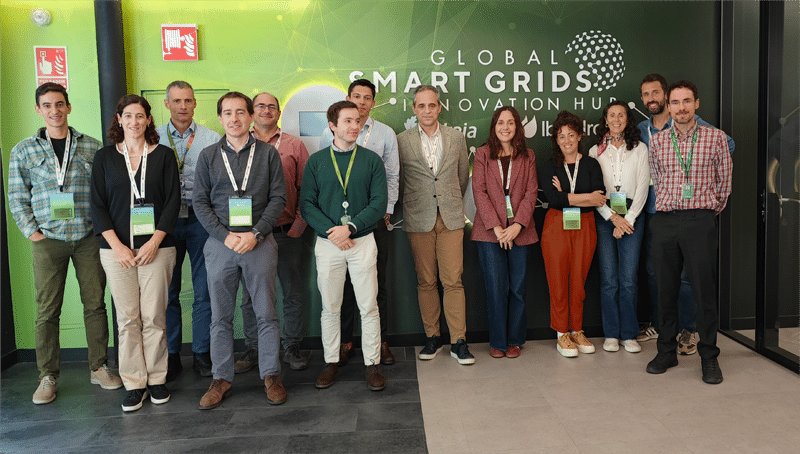
The DEMELEK partners, whose work will span approximately three years, held their kick‑off meeting on 8 October at Iberdrola’s Global Smart Grids Innovation Hub in Bilbao. The project is co‑funded by the Basque Government’s Department of Industry, Energy Transition and Sustainability (HAZITEK Programme) and by the European Union through the European Regional Development Fund 2021–2027 (ERDF).