






 About us
 / section
Careers
Careers / section
News & events
News & events / sectionCountries section
About us
About us / section
Careers
Careers / section
News & events
News & events / sectionCountries section
About us
About us / section
Careers
Careers / section
News & events
News & events / sectionCountries section
About us
About us / section
Careers
Careers / section
News & events
News & events / sectionCountries section


 More results
SGAN-Next will develop EU electronic equipment operating at very high frequencies to enhance satellite antennas and communications. These systems will be more efficient, compact and robust than existing alternatives, making them ideal for satellites in low Earth orbit (LEO) and geostationary orbit (GEO), particularly in the Q–V band.
SGAN-Next, supported by the European Commission through the Horizon Europe Space R&I work programme, will strengthen EU technological autonomy and contribute to the creation of a robust and competitive supply chain in the space sector.
The industrial engineering and technology group Sener is coordinating the international consortium behind SGAN-Next, a cutting-edge European initiative aimed at developing a new generation of European electronic equipment based on gallium nitride (GaN), capable of operating at very high frequencies and specifically designed for next-generation space systems (GH‑10).
These devices, based on gallium nitride (GaN) technology on silicon carbide (SiC), will significantly improve the efficiency, size and data transmission capacity of satellite communication systems, both in low Earth orbit (LEO) and geostationary orbit (GEO).
Sener is responsible for coordinating the consortium, which includes the following partners: United Monolithic Semiconductors, SweGaN, Airbus, the Ferdinand Braun Institute, the University of Bologna, the Autonomous University of Barcelona, and Thales Alenia Space.
The project is funded by the European Commission under the Horizon Europe Space R&I work programme and aligns with the strategic objective of reinforcing EU technological autonomy and consolidating a robust and competitive supply chain in the space sector.
In recent years, GaN-based technology has become a solid alternative for space applications, particularly for advanced active antennas. Its evolution towards higher frequencies is essential to enable satellites with greater transmission capacity and more compact payloads—key factors for increasing data throughput and developing more compact and efficient systems for future space and defence missions.
SGAN-Next aims to drive a new generation of European space electronic components through the design of solid-state power amplifiers (SSPAs), low-noise amplifiers (LNAs) and high-frequency switches, all of them more efficient and robust.
“Thanks to Sener’s participation, Spain reaffirms its key role in the European aerospace industry. This project highlights Spanish innovation and represents a strategic advance for EU’s space industry. It will enable us to develop more efficient, compact equipment capable of operating at higher frequencies, strengthening the continent’s technological autonomy and competitiveness against global players,” says David Gala, Project Director in Aerospace and Defence at Sener.
The project also aims to validate the reliability of the European manufacturing process so that it can be qualified by the European Space Components Coordination (ESCC), while establishing a fully European supply chain. In this context, the first wafer containing functional prototypes has already been manufactured.
This project has received funding from the European Union’s Horizon Europe Space Research and Innovation programme under grant agreement No. 101082611, SGAN-Next.
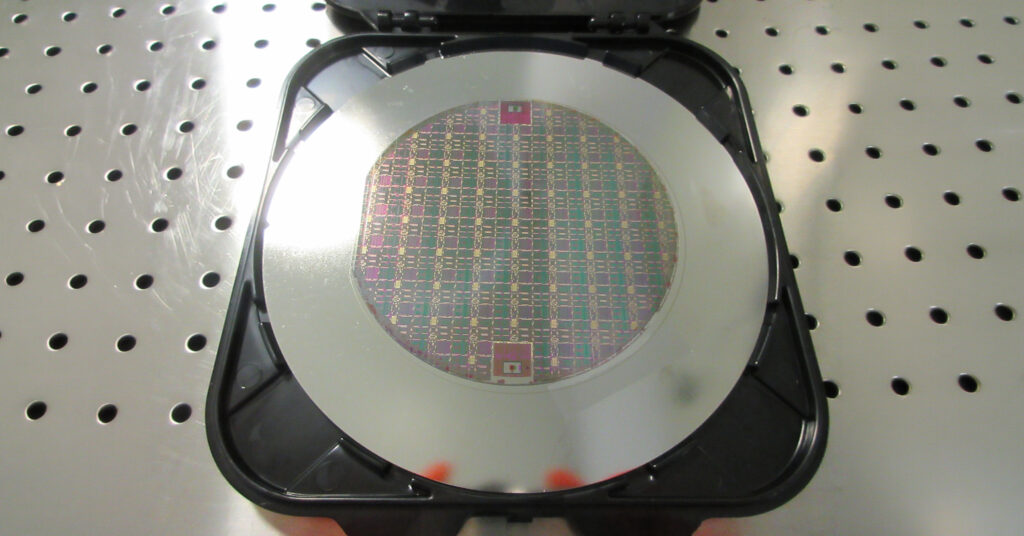
SGAN-Next Run 1 wafer with MMICs for different tipologies of SSPAs in Q band, LNAs in V-band, RF Switch

