






 About us

 More results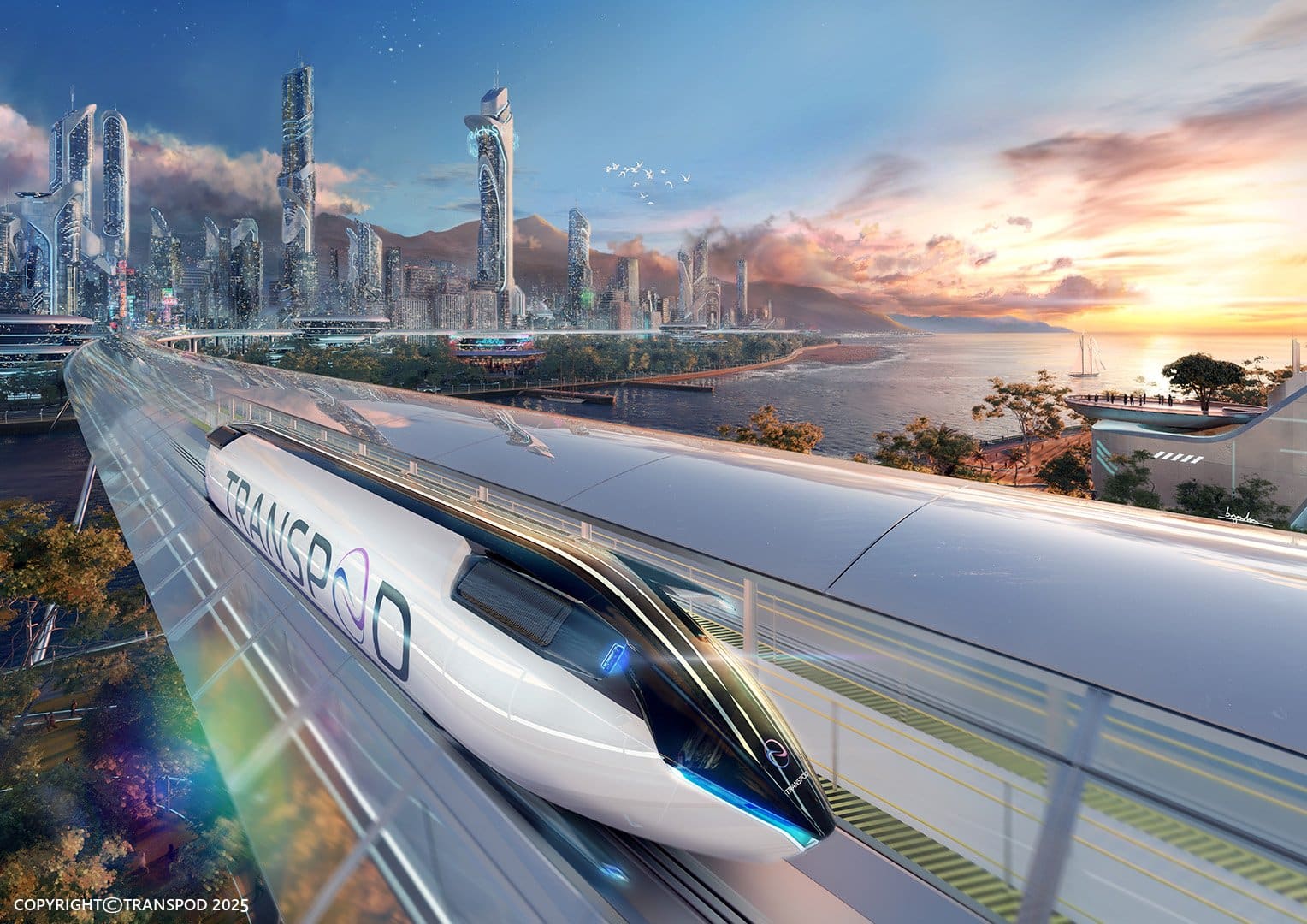
- Mobility & Infrastructures
Categories:
The search for a terrestrial transport system that combines the speed of aviation with energy efficiency and railway regularity has crystallised in the Hyperloop concept. This mode of ultra-high speed is not presented as a simple evolution of existing systems, but as a category of its own designed to occupy the strategic space between short-haul aviation and high-speed rail. Based on radical physical principles, its development proposes a paradigm shift in interregional mobility, suggesting a system capable of reaching speeds close to 1,000 km/h.
What is Hyperloop and how vacuum levitation technology works
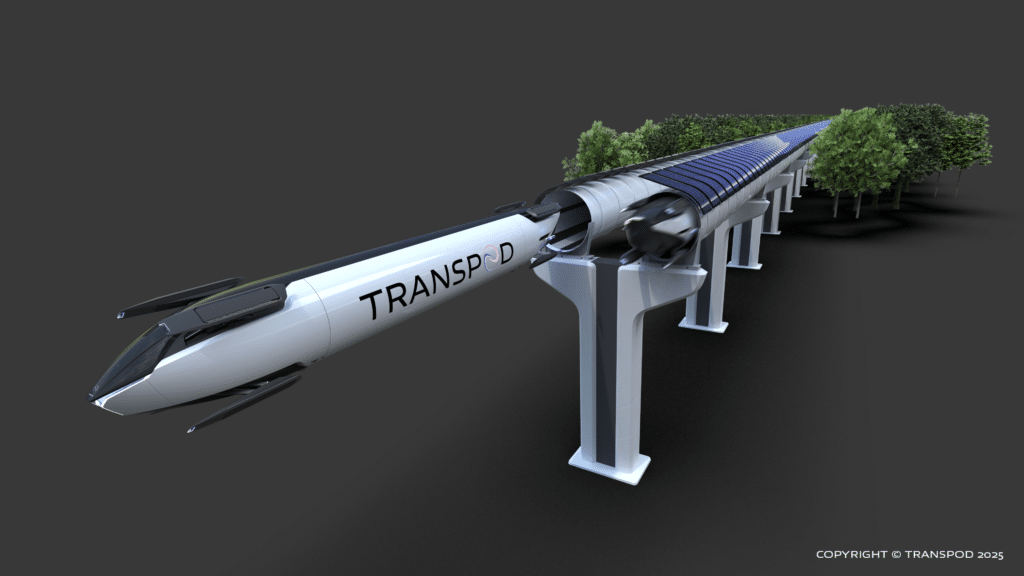
The technical architecture of Hyperloop is based on the elimination of the two main brakes on movement: aerodynamic resistance and mechanical friction. To achieve this, the system confines the vehicle within an infrastructure of sealed tubes where most of the air is extracted, creating a quasi-vacuum environment.
The concept of a pressurised capsule in low-aerodynamic-resistance environments
The Hyperloop vehicle should not be understood as a conventional train, but as a pressurised capsule. Its design is closer to an aircraft fuselage than a passenger carriage, as it must maintain stable internal habitability and pressure conditions while travelling through a low-pressure external environment. By circulating inside a vacuum tube, the capsule drastically reduces air friction, allowing it to reach extreme speeds with much lower energy consumption than any other terrestrial transport.
Electric propulsion and magnetic levitation systems at 1,000 km/h
To reach and maintain speeds of up to 1,000 km/h, the system dispenses with physical contact with the infrastructure. The capsule travels without continuous rolling support, using systems that may include magnetic levitation or other very low-friction support solutions. Propulsion is electric, using linear motors that accelerate the capsule through the tube. Different companies such as Hardt, Swisspod, or TransPod, among others, are currently the most active firms in research within this field, exploring various technical variants in levitation and propulsion methods to optimise the efficiency of the whole.
Differences compared to short-haul aviation and conventional railways
Although Hyperloop shares automatic operation and the need for almost straight alignments with high-speed rail, it differs in its entire operational ecosystem (pressure, levitation, and sealed environment). Compared to aviation, its main advantage is that it operates on fixed ground infrastructure, allowing for greater frequency and regularity, as well as direct integration into terrestrial transport nodes, eliminating the waiting and management times associated with airports.
What are the advantages and disadvantages of the Hyperloop model
As with any disruptive technology in an advanced research phase, Hyperloop presents a complex balance between its potential benefits and the technical barriers it must still overcome to demonstrate commercial viability.
Energy efficiency and regularity compared to current transport systems
The main advantage of the model is its potential for efficiency. By minimising air resistance and friction, the energy required to maintain cruise speed is significantly lower than that of a high-speed train or an aircraft. Furthermore, being a confined and fully automated system, it is not affected by external weather conditions, which guarantees operational regularity superior to any current mode of transport.
Operational challenges in emergency management and evacuation in closed systems
The sealed and pressurised environment that enables its speed is, in turn, one of its greatest operational challenges. Emergency management in a system of these characteristics is extremely complex. Evacuating passengers from a capsule stopped inside a vacuum tube requires engineering solutions that have yet to be demonstrated on a large scale, representing one of the critical barriers for the system’s safety certification.
Engineering challenges: tube integrity, vacuum, and thermal expansion
From a structural point of view, the construction of corridors spanning hundreds of kilometres of tubes that maintain a permanent vacuum is an unprecedented challenge. The infrastructure must manage physical phenomena such as the thermal expansion of materials and ensure the absolute integrity of the tube against potential leaks or structural failures. Maintaining these vacuum conditions in such extensive infrastructures requires technical precision that elevates the complexity of the civil works.
What is the current state of Hyperloop and its technological maturity
Despite global interest and the proliferation of prototypes, Hyperloop is still in an advanced research phase. We are not looking at a mature mode of transport, but at a technology that is validating its critical components in testing centres distributed around the world.
Technological heterogeneity and the challenge of international interoperability
Currently, the sector is characterised by great heterogeneity. Different development companies employ divergent technical approaches in key areas such as the track-switching system or the levitation method. This lack of a common technical base poses a challenge for future international interoperability; without shared standards, the creation of trans-national Hyperloop networks would be very costly and difficult, limiting the system to isolated and technologically closed corridors.
What Hyperloop needs to be viable as a future alternative
For Hyperloop to move from being a technological promise to a real transport alternative, it must move beyond the realm of experimentation and enter a phase of industrial and regulatory consolidation.
The importance of standardisation and solid financing models
The maturity of the system will come hand in hand with technical standardisation. It is imperative to establish common standards that allow for industrial scale and reduce development costs. Likewise, the deployment of these infrastructures requires solid financing models that can support the high initial investment required by such sophisticated technology—something that will only be achieved when technical risk levels have been significantly reduced.
Critical factors for commercial deployment: safety and economies of scale
Commercial deployment depends directly on the sector’s ability to guarantee safety levels equivalent to or higher than current railways. Only by demonstrating safe and reliable operation can the economies of scale necessary for the cost per kilometre to be competitive be achieved. Engineering must resolve how to industrialise the production of tubes and capsules so that the system is economically sustainable in the long term.
High-demand corridors: where it makes sense to apply this technology
Hyperloop is not a universal solution for every journey. Its strategic sense lies in high-demand corridors where current high-speed rail cannot offer competitive travel times compared to flying. These are interregional distances where ultra-high speed can transform connectivity, turning journeys of several hours into trips of just a few minutes, provided there is a sufficient volume of passengers to justify the fixed infrastructure.
Conclusion: a category of its own in transport engineering
In short, Hyperloop should not be seen as an improvement on the train, but as a new category of terrestrial transport. It is a bet on the future that depends critically on the evolution of engineering in the coming years. If it manages to overcome its technical, regulatory, and financial challenges, it will have the potential to transform interregional mobility, offering a disruptive alternative in a world that demands greater speed with lower emissions. Its final success will determine whether ultra-high speed in a vacuum becomes the new standard for mobility or whether it will continue, for a longer period, in the field of advanced experimentation.
- mobility
Tags:
Author

Joaquín Botella
Joaquín is Chief Technical Engineer at Sener. He has experience in all types of railway projects in Spain and other countries such as Australia, Portugal, France, Ireland, Poland, Hungary, the United States, Chile, Mexico, the United Arab Emirates, Qatar, and Oman. He has decades of experience in the design, operation, maintenance, and functionality of all types of railway systems, and has given over 25 presentations and presentations at international conferences and exhibitions.

