




 About us

 More results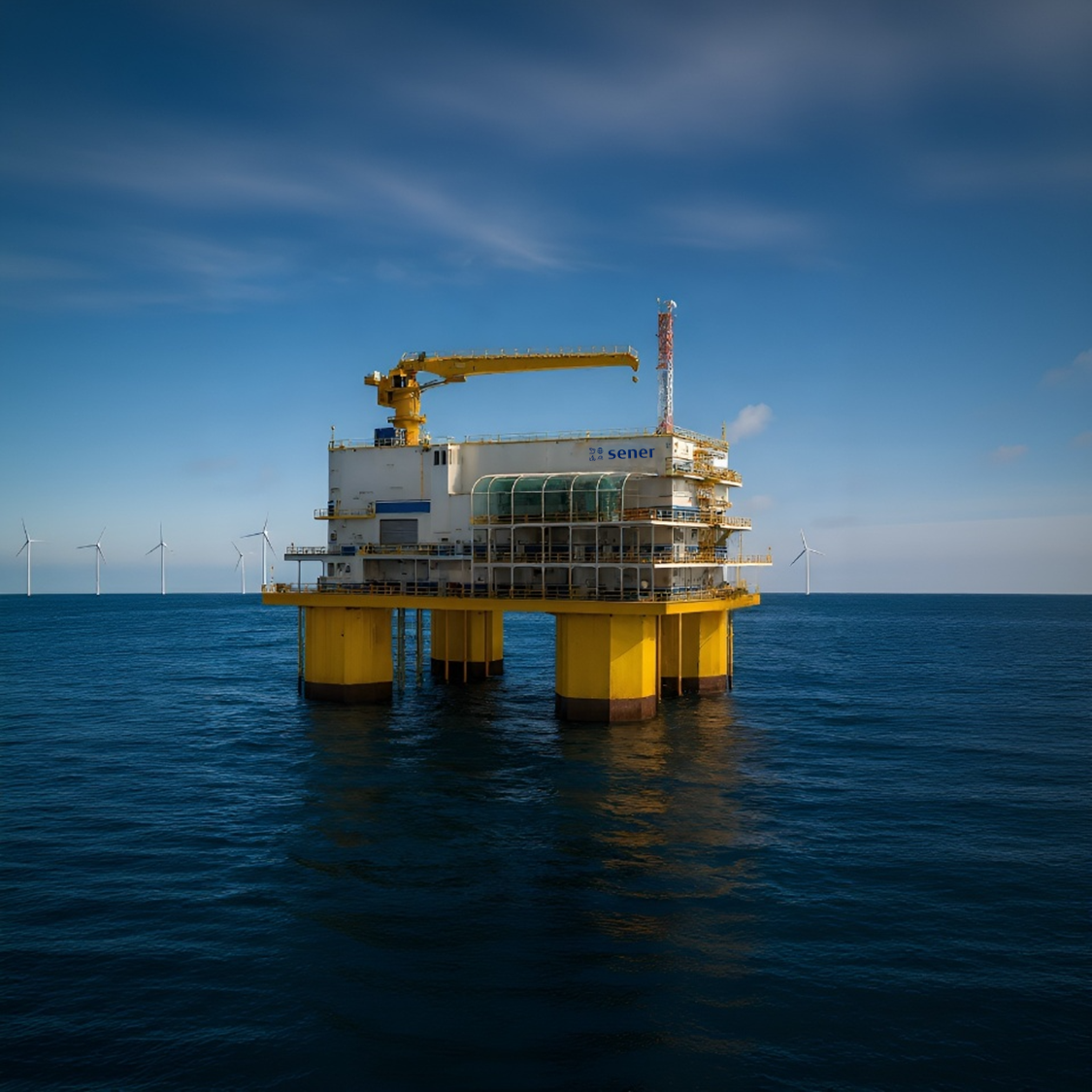
- Energy
Categories:
As offshore wind ventures into deeper waters, often beyond 100 meters, the industry faces a new challenge: how to efficiently collect and transmit energy from floating wind farms to onshore grids. One of the key technologies enabling this transition is the floating offshore substation (FOSS) — an innovation that combines naval architecture, electrical engineering, and digital solutions to deliver reliable power from the open sea.
For years, fixed-bottom substations have served the offshore wind sector well in shallow waters. These platforms, anchored to the seabed, have been the backbone of offshore energy transmission. However, as projects move into deeper zones, these traditional solutions become economically and technically unfeasible. The cost and complexity of installing fixed foundations at depths greater than 70–80 meters rise exponentially, making them impractical for the next generation of offshore wind farms.
This is where floating technology comes into play. Floating wind turbines have already begun to address this challenge, with several concepts, such as HiveWind, demonstrating the viability of floating foundations for energy generation. Now, floating substations are emerging as the next critical enabler, ensuring that energy generated offshore can be transformed and exported to shore, even from sites located far from the coast.
Why floating substations matter
Deep-water locations often offer superior wind resources, with higher and more consistent wind speeds than nearshore sites. These conditions make them ideal for large-scale renewable energy deployment. However, without floating substations, the ability to harness this potential would be severely limited.
Floating substations act as the nerve center of offshore wind farms. They step up the voltage of the electricity generated by turbines, enabling efficient transmission to shore via export cables. In addition, they house critical systems for monitoring, control, and grid integration. Without them, the economics of deep-water wind would not be viable.
The market potential is enormous. With 20 GW of floating wind capacity expected in the mid-term and up to 100 GW in the long-term, demand for floating substations could reach 40 units by 2030 and 100 units by 2050, assuming an average substation capacity of 500 MW. This growth is driven by ambitious national and regional targets, particularly in Europe and Asia, where deep-water sites offer vast untapped potential. Floating substations will be essential to unlocking these resources and accelerating the global energy transition.
Engineering challenges: a new design paradigm
Compared to their bottom-fixed counterparts, floating substations introduce a unique set of engineering challenges due to their constant motion and exposure to harsh marine environments. These challenges span three tightly interlinked domains:
- Dynamic cable systems must be designed to withstand long-term fatigue and mechanical stress while maintaining electrical performance across varying voltage levels.
- High-voltage equipment, such as transformers and switchgear, must be adapted to floating conditions, where accelerations, and space constraints influence both sizing and layout. Equipment traditionally designed for stable platforms now needs to operate reliably under motion.
- Topside and hull design, including station-keeping systems, must ensure platform stability while integrating electrical systems and responding to site-specific environmental conditions. This requires advanced hydrodynamic analysis and structural optimization.
Experience shows these elements are deeply interdependent. A successful floating substation design requires close collaboration across engineering disciplines to meet system-level requirements without compromising reliability or cost-effectiveness.
Beyond technology: a strategic enabler for the energy transition
Floating substations are more than a technical solution, they are a strategic enabler of the offshore wind industry’s future. By unlocking access to deep-water sites, they expand the geographical reach of offshore wind, reduce dependence on scarce shallow-water areas, and open new opportunities for countries with deep continental shelves.
At Sener, we envision a modular, scalable, and resilient energy system where floating technologies play a central role. Through contributions to floating wind platforms such as HiveWind, we are helping shape this future — one where clean energy flows from the deep sea to the grid, powering a more sustainable world.

Marco Vergassola
Offshore Engineer at Sener and a PhD candidate in Civil Engineering at TU Delft. He holds a Mechanical Engineering degree and a Master’s in Sustainable Energy Technology. Marco specializes in offshore wind foundations, both bottom-fixed and floating, with expertise in structural dynamics, naval architecture, station-keeping systems, dynamic power cable systems, and advanced numerical simulations. At Sener, he leads engineering activities for floating wind and substation projects, including ECOFOSS, where he is responsible for numerical modelling of the global system, seakeeping analysis, and station-keeping system design, and acts as technical lead for the tank test campaign performed at IH Cantabria.

