





 About us

 More results
- Energy
Categories:
The rapid expansion of data centers, driven by digitization and the boom of artificial intelligence, poses unprecedented technical and energy challenges. From design and grid access to dynamic stability and resource efficiency, addressing these complexities is crucial to ensuring resilient, sustainable and competitive infrastructures in the long term.
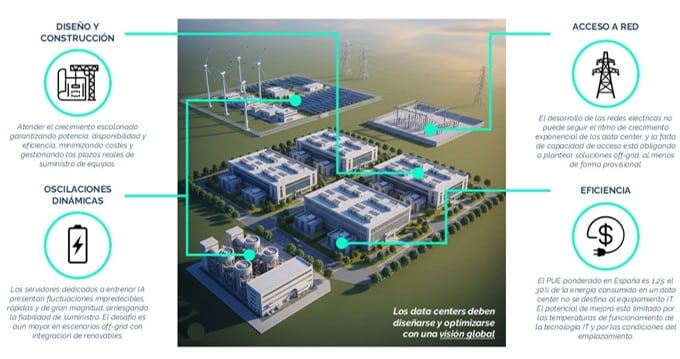
Current challenges in the data center sector
Design and construction
The current context is marked by a race for pole position, where the first data centers to be implemented are usually advantaged in their commercialization thanks to hyperscale developments, with capacities that easily exceed 120 MW IT. This pressure to reduce the time-to-market favors the adoption of modular architectures that enable building and operating to begin as soon as possible.
Phased development introduces a critical challenge: ensuring that each stage maintains the same standards of availability, redundancy and efficiency as the final installation. This requires coordinating the expansion of buildings, electrical systems and energy generation so that each phase operates autonomously but remains integrated into a global vision.
Added to this complexity are the long lead times for supplying critical equipment, resulting from high global demand. To ensure the commissioning schedule and the consistency of modular development, it is crucial to make engineering decisions from early stages, secure manufacturing windows with strategic suppliers, and, in some cases, anticipate temporary solutions for the initial operational phases.
Achieving the sector’s typical availability levels (99.999%) in a cost-efficient manner requires selecting optimal combinations of energy vectors gas, electricity, hydrogen and generation and storage technologies turbines, engines, fuel cells, renewables and batteries without oversizing, as well as planning equipment maintenance without impacting operations.
In this context, advanced modeling and simulation engineering allows defining robust modular architectures, properly sizing energy assets and establishing optimal operating strategies. Combined with recognized standards and certifications, such as TIER, LEED, BREEAM or CEEDA, this approach facilitates the development of critical infrastructures that are highly available, efficient and prepared to evolve in an orderly manner throughout their life cycle.
Grid access
Hyperscale data centers require continuous 24/7 operation with very high power, while the development of grid infrastructures is progressing at a significantly slower pace than the growth of this demand. Limited available capacity and lengthy administrative time frames have become one of the main bottlenecks for new projects, conditioning the design from early stages.
In off-grid scenarios, where there is no access to the grid, proprietary energy systems capable of meeting the entire demand have to be designed, combining thermal generation, renewables, storage and stabilization solutions to guarantee security of supply and availability.
In other cases, the connection is constrained by weak or limited infrastructure, where access is only possible under power restrictions, interrupted or managed, by the grid operator or in exchange for providing the system with one’s own generated resources. In these scenarios, the data center takes an active role in the electrical system, relying on its own generation, storage or load management strategies in order to adapt to limitations without compromising operational continuity.
Some data centers allow IT load modulation through operational staggering or by shifting loads to other geographical locations. These strategies reduce power requirements and provide flexibility to the data center operator and to the electrical system as a whole. At the grid level, the use of technologies such as Dynamic Line Rating (DLR) enables real-time adjustment of the admissible capacity based on environmental and weather conditions, unlocking additional capacity without the need for new infrastructure.
Lastly, in scenarios of medium-term grid access, evaluating temporary solutions,such as mobile systems,that allow initiating activity without high and permanent investments becomes relevant.
Beyond electrical capacity, grid access can be conditioned by environmental and social factors linked to the project’s location, such as emissions, noise, sustainability requirements, land use or acceptance by the local community. All of this must be addressed from a comprehensive approach that combines engineering, regulation and the environment.
Dynamic oscillations
Data centers dedicated to Artificial Intelligence (AI) exhibit highly fluctuating load profiles, with steep ramps and short cycles that are difficult to anticipate. Instantaneous demand depends on multiple factors, such as the type of servers, the degree of concurrency, the algorithm in execution or the training phase, making it difficult to define a stable and predictable load profile. This unpredictability generates disturbances in voltage and frequency that can compromise the stability of the supply if not managed properly.
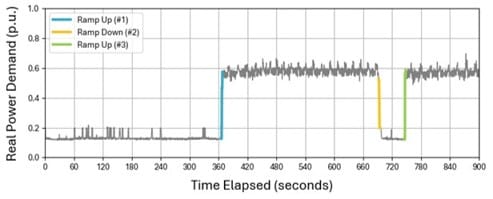
Demand curve of a 50 MW data center dedicated to AI training (EdgeTunePower)
When the grid’s or one’s own electrical infrastructure is not capable of absorbing these dynamic oscillations, specific stabilization systems need to be incorporated between the generation and IT loads. Technologies such as high-C-rate batteries, supercapacitors or flywheels dampen sudden power variations, decoupling the behavior of the electrical grid’s servers.
In on-grid environments, these systems facilitate compliance with the stability requirements required by operators and allow providing auxiliary services such as voltage control, frequency support or load shifting. In off-grid scenarios, the plant itself must guarantee the stability of the microgrid, a challenge that intensifies with high renewable penetration, where the lower inertia of the system makes it essential to implement fast and well-coordinated stabilization solutions that compensate for both load fluctuations and generation variations.
In this context, dynamic simulation allows anticipating the data center’s electrical behavior, properly sizing stabilization systems and reducing operational risks, thus reinforcing the installation’s resilience and its integration into the electrical system.
Efficiency
The sustained growth of installed capacity and density per rack in data centers is increasing significantly and, with it, the thermal and electrical requirements. This context requires rethinking the design from the early stages, adopting a comprehensive approach to the efficient use of resources that determines key indicators such as PUE (Power Usage Effectiveness), WUE (Water Usage Effectiveness) and FRE (Fraction of Renewable Energy). The optimization of thermal flows; the adoption of advanced technologies such as direct liquid cooling, along with heat recovery strategies using ORC cycles, CCGT configurations or absorption chillers; and the integration of renewable generation must be addressed in a coordinated manner to ensure availability without disproportionate increases in CAPEX and OPEX.
Achievable efficiency is also strongly conditioned by the location, where factors such as climate, water availability or space have an impact on the viability of strategies such as free cooling or certain thermal recovery and renewable integration solutions. Adapting the design to these local conditions through hybrid solutions, precise asset sizing and operating strategies tailored to the actual load profile allows reducing consumption, controlling costs and maximizing the installation’s overall performance, thus guaranteeing sustainable and economically feasible solutions in the long term.
The development of large-scale data centers requires a comprehensive approach that connects design, grid access, dynamic behavior and efficiency from the project’s earliest phases. Increasing technical complexity, electrical infrastructure constraints and sustainability demands make it essential to combine flexible architectures, tailored energy solutions, advanced stabilization systems and the efficient use of resources. Engineering, supported by modeling and simulation tools, therefore becomes a key enabler for transforming these challenges into opportunities, thus guaranteeing resilient, efficient infrastructures that are prepared to evolve in an increasingly demanding energy environment.
- Decarbonisation
Tags:

Irene Donoso
Industrial engineer with experience in decarbonisation projects, energy efficiency, and demand flexibility in industrial and hotel environments. She specialises in the design of self-consumption installations and multi-asset simulations. She possesses knowledge of electric markets and energy storage systems, including both electric storage in batteries and thermal storage in solid materials and molten salts.

