






 About us


 More results
- Aerospace
Categories:
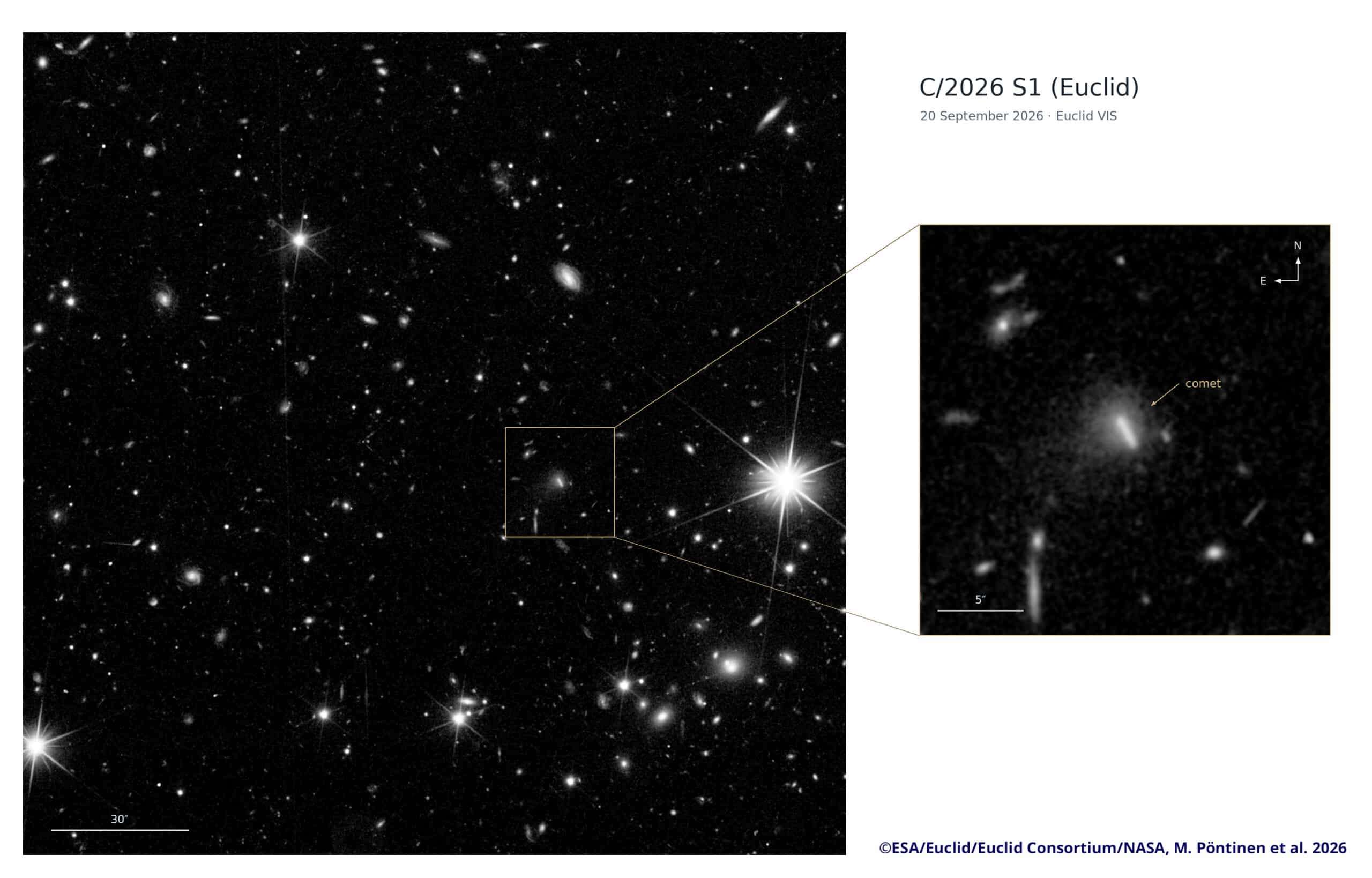
At 1.3 billion kilometres from Earth, the Euclid space telescope has discovered a previously unknown comet. The finding not only expands our knowledge of our cosmic surroundings, but also demonstrates a capability that could help identify a suitable future target for Comet Interceptor, the European Space Agency mission for which Sener is leading the design and manufacture of one of its probes.
The new object, designated C/2026 S1, appeared in images obtained between 16 and 24 September 2026. Euclid, a European Space Agency (ESA) space mission, is designed to observe the distant universe and study the influence of dark matter and dark energy. However, its observations have also made it possible to identify Solar System objects within its field of view and obtain additional information of considerable scientific value, despite this not being part of its original purpose.
For Euclid’s dark-energy observations, the telescope must maintain an extremely stable orientation. Sener led the design and development of the system that provides this precision and also supplied the antennas that enable communications with Earth during the mission’s initial phases. Once the images have been obtained, the next step is to identify the small moving objects that appear in them.
The comet’s trail was identified using software developed by Mikko Pöntinen of the University of Helsinki to detect small Solar System objects in Euclid images. The tool automatically searches for the trails left by bodies moving against the background of stars and galaxies, allowing potential objects of interest to be identified within the telescope’s vast volume of data. In this case, the initial detection allowed Pöntinen to locate the comet in five sets of observations. Subsequent analysis revealed a diffuse cloud around it, characteristic of an active object releasing dust and gas. After confirming that it did not match any known comet or asteroid, the observations were reported to the International Astronomical Union’s Minor Planet Center, which confirmed the discovery on 8 October.
C/2026 S1 follows an orbit that will take thousands of years to complete. However, it will not be the comet studied by Comet Interceptor: ESA has confirmed that this particular object is not a suitable candidate for the mission. The significance of the discovery lies elsewhere. The speed with which it was identified and validated demonstrates that Euclid can detect new comets while they are still relatively far from the Sun, a capability that could help locate a suitable target for Comet Interceptor.
The discovery also provides a real-world case for testing how the teams behind the two missions could coordinate in the future when new objects are detected. This connection helps illustrate what makes Comet Interceptor unique: the mission is being developed before the comet it will study has even been identified.
Its objective will be to explore a long-period comet making its first entry into the inner Solar System. Such a comet would be a pristine or dynamically new object, capable of preserving unprocessed material from the earliest stages of the Solar System. Studying it could provide information about the conditions and components present during the formation of the planets.
Comet Interceptor is currently scheduled for launch in late 2028 or early 2029. After leaving Earth, the spacecraft will travel to the Sun-Earth L2 Lagrange point, where it will remain until a suitable comet is identified. Only then will it begin its journey towards the selected target.
Comet Interceptor will comprise a main spacecraft and two probes, which will take simultaneous measurements from different locations during the fly-by. By combining their observations, scientists will be able to reconstruct the comet’s environment in three dimensions and study its physical and chemical properties, as well as its interaction with the solar wind, the stream of particles emitted by the Sun.
One of these probes is being developed under Sener’s leadership. The company is responsible for its design and manufacture, heading an international industrial consortium. The probe will separate from the main spacecraft to observe the comet at closer range, while the main spacecraft maintains a more distant trajectory. In this way, the mission will be able to study the same environment from different perspectives.
Sener is also providing the antennas that will transmit scientific data to Earth and the mechanism that will release the probe, and is participating in scientific instruments in collaboration with the Institute of Astrophysics of Andalusia. Its contributions span different stages of the exploration process: deploying the probe, gathering information and transmitting it for analysis.
The discovery of C/2026 S1 shows how observations from a mission designed to study the distant universe can help prepare for the exploration of our own Solar System. Although this comet will not be Comet Interceptor’s destination, its detection marks a step forward in the search for a suitable target.
The final destination remains unknown, but the technology required to study it is already taking shape. Preparing before the destination is known will make it possible to seize the opportunity presented by a future discovery and bring us closer to answering a question that remains open: what was the material from which the planets formed really like?
- Space

